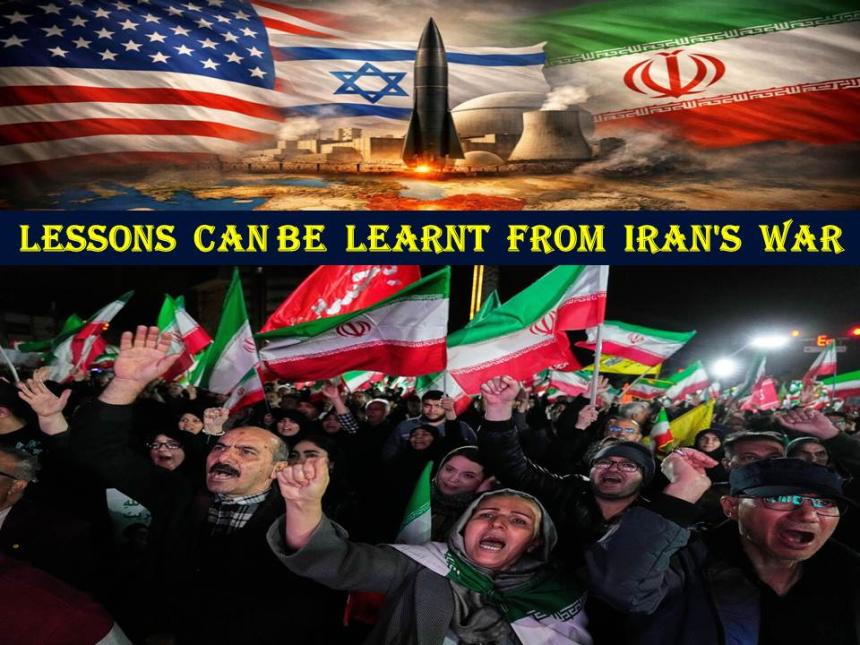

Lessons can be Learnt from Iran's War
Iranian civilization, one of the world's oldest continuous civilizations, known historically as Persia. The Iranian civilization, located at a crossroads between Asia and the Middle East, is often referred to as "Greater Iran," influencing areas from the Levant to the Indus Valley. The Islamic era of Iranian civilization (651 CE–present) began with the Arab-Muslim conquest of the Sasanian Empire. Iran saw another revolution in 1979 led by Imam Ruhollah Khomeini. The 2026 Iran war highlights that even mid-tier powers using low-cost drones and missiles can overwhelm advanced defense systems, making conflict prolonged and costly. This write up is about lessons learnt from this war.
أَعُوذُ بِاللّٰهِ مِنَ الشَّيْطَانِ الرَّجِيمِ۔
بِسۡمِ ٱللهِ ٱلرَّحۡمَـٰنِ ٱلرَّحِيمِ
In the name of ALLAH, the Most Gracious, the Most Merciful
Lessons can be Learnt from Iran's War
Iranian civilization, one of the world's oldest continuous civilizations, began on the Iranian plateau over 8,000 years ago. Known historically as Persia, it reached its zenith with the Achaemenid Empire (founded by Cyrus the Great, c. 550 BCE), establishing major innovations in art, architecture, and governance. Deeply influenced by Zoroastrianism and the Sasanian Empire before adopting Islam in the 7th century, it remains a globally influential cultural force.
The Achaemenid Empire founded by Cyrus the Great is recognized as one of the first and largest global empires. Iranian civilization has long been a source of literature, poetry, philosophy, and music, serving as a pillar of Middle Eastern history and cultural influence. Ancient Iranians made early strides in mathematics, astronomy, and medicine. The Iranian civilization, located at a crossroads between Asia and the Middle East, is often referred to as "Greater Iran," influencing areas from the Levant to the Indus Valley.
The Islamic era of Iranian civilization (651 CE–present) began with the Arab-Muslim conquest of the Sasanian Empire, marking a profound transformation that shifted Iran from a Zoroastrian-dominated state to a predominantly Muslim society, and then exerting its Islamic influence in all adjacent areas including Indus Valley. Iran later emerged as the center of Shia Islam under Safavid Dynasty (1501–1736), which was a pivotal period where Shah Ismail-1 enforced Twelver Shi'ism as the official state religion, distinct from the neighboring Sunni Ottoman Empire.
Iran saw another revolution in 1979, when Islamic Revolution, led by Imam Ruhollah Khomeini, overthrew the Pehalvi Shah to establish an Islamic Republic based on Velayat-e Faqih (guardianship of the jurist). It transformed Iran into a theocracy, eliminating Western influence, enforcing conservative social values, and establishing a new, ideological governing system.
The revolution used Shia Islam as a unifying force to mobilize popular support against "internal tyranny and foreign domination". The monarchy was replaced with a system governed by Islamic jurists to uphold Sharia law and prevent corruption. The revolution was solidified by the 1979 Iranian Hostage Crisis, which radicalized the movement, and the 8-year Iran-Iraq war, which consolidated the clerical regime and bolstered a hardened, revolutionary ideology.
The revolution transformed Iran's foreign policy to be heavily anti-American and anti-Western. Conservative hardliners tightened control over all societal aspects, including universities and media. The regime aimed to transition from a revolution to an "Islamic government" and eventually a "new Islamic civilization". The Islamic Revolutionary Guard Corps (IRGC) became a crucial military and economic power, protecting the regime's ideology.
Resultantly, the western powers along with the Zionist Jewish State of Israel targeted IR of Iran on all fronts and even attacked violently to dislodge the Islamic Regime and deploy a pliant group of western supported stooges. The latest act of war imposed upon the IR of Iran was the 40 days US-Israel-Iran-War 2026; where in the last 300 years the world's sole Super Power, USA + the invincible Israel's IDF have been thwarted by a weak but determined Nation. The USA is now dodging the world in the name of "Peace Negotiation" since declaration of "cease fire" on 8th April 2026.
The 2026 Iran war highlights that even mid-tier powers using low-cost drones and missiles can overwhelm advanced defense systems, making conflict prolonged and costly. Key lessons include the failure of quick-victory assumptions, the strategic importance of Gulf resilience, and the limits of Western military dominance. However, we shall be more observant about this 40 days US-Israel-Iran-War 2026 and the very nation of Iran and it's transformation under Islamic Revolution. In the following, let's read an article published in The Observer (Uganda) "View Point" on April 8, 2026; which has drawn references from Iran's ability to fight the war and resilience reflected as a nation since Islamic Revolution of 1979.
It’s not just what you know; it’s how you know it by KALUNDI SERUMAGA
Uganda and Iran have had regimes in power for roughly the same length of time. Both seized power after violent upheavals, and, therefore, both declared themselves to be revolutions in the service of their populations. In his recent Observer article, Dr Yusuf Sserunkuuma is right when he talks about both the value of deep education as a key factor in the very different directions both countries have gone since then.
Iran, having been attacked by the United States and Israel, has effectively defeated them both, if we understand defeat to mean causing your enemy to fail to meet their objectives behind attacking you militarily. The regime is still intact.
No part of Iran is under foreign occupation. Iran has not been forced to agree to any kind of ceasefire terms or peace treaty. And the United States has failed to defend and protect its friends in the region, or even simply maintain its original military presence there, in the battle for the control of the oil-rich Persian Gulf.
The American and their allied regimes in the region have been shocked by the speed, focus, scope and capacity of Iran’s reaction. Even with the higher technological base it had, Iran has clearly demonstrated a qualitative leap in how it thinks about national development, which includes national defence, and then implements it.
Uganda is not doing so well. Instead, our government has made us one of America’s most trusted friends in the region. We help with American military ambitions. In return, America, through the World Bank and IMF, has designed our banking system, our health and social service provision, and our wider economic policies. Our population is poor, exploited, overtaxed, under skilled and badly housed. Dr Sserunkuuma puts this down largely to the types of minds and the culture that produced them, on the Iranian side.
Certainly, over the past four decades, the United States has become the basically unchallenged big dog of planet earth, invading or bombing whoever did not comply with its view of the world, and using its currency to control and influence events. Resistance was always dangerous. If you had something that the USA wanted, or was not happy with the way you used it for yourself, you would first face bribery to betray your country, then economic sanctions, then sponsored rebellions by your citizens, followed by indirect warfare where a neighbour could be persuaded to invade you, and finally, direct invasion, then collapse. That is, until now.
Iran has faced all of these things. The Americans first tried to make friends with them. Then later used neighbouring Iraq under Sadam Hussein to invade and wage an eight-year war against them, killing thousands. Then it financed rebel movements. After that (and after falling out with Saddam) the Americans then began a programme of diplomatic and economic bullying that has lasted until this direct joint attack with Israel. As many analysts have now explained, Iran had been preparing for this moment since at least the time of the 2004 American invasion of their neighbour Iraq, and the eventual arrest and execution of Saddam Hussein.
Since then, America has been the official controller of all money earned from the sale of oil drilled in Iraq. When taken with the American bases in all the other Persian Gulf countries, Iran is the only country outside direct American control, and whose oil resources are not directly tied to the American economy, since Iran’s 1979 revolution had renationalized it after evicting the regime America had installed in 1953. So, the Iranians wisely assumed that their own turn to be invaded would come one day, and began preparing for it.
This is where education comes in. Having clearly thought deeply, and studied the experience of their former enemy Saddam, they came to a number of conclusions. First and foremost; the entire investment of a military presence in the Gulf was about oil. This meant that the oil trade was very important to the American economy.
Secondly, that building a conventional military force of centrally-controlled land army, navy and airforce was never going to match similarly-deployed power from the American side. Thirdly, the whole regime should not be built around a few powerful individuals, who, if deposed, or killed, would collapse the whole country. Fourth, the best way to ensure you had enough weapons was to make them yourself, and not be dependent on outsiders for technical support, spare parts and repairs, and who in that process, would come to know a lot about your defence arrangements.
This set off a decades long process in re-organization, training, technological research and development. And this is where the education came in. A brief scan of the now widely discussed qualifications of the various layers of Iranian leaders, whose orientation combines three things: the study of religion; the mastery of hard sciences, and the understanding of Western European philosophy, society and economics. So, they have understood themselves and the enemies, and developed the knowledge to deal with them at a technical and physical level. Now they have fought against America and Israel using a combination of advanced technologies, non-traditional warfare, global media presence, and turning America’s dependence on the Gulf oil trade as a weapon against it.
If we here in Uganda should undertake such a course of study, what would it look like, and how would it begin?
We can all agree that the current content of our education, from primary to third- level, seems to teach how not to know ourselves, and also to admire Western society instead of understanding it. In that context, the sciences then become useless for building a national agenda because they lack guiding ideological context. Clearly, the Iranian population has a clear sense that their country is a thing worth defending, no matter what they might think of their government.
Dr Sserunkuuma does not take us further into this question. Iran is a Shia Muslim country. That has been their culture for centuries. But they have a much older history as a people that they study and preserve. They know who they are. It is onto that identity that they have built this formidable defence system.
As he rightly points out, Uganda has had its own share of PhDs. Some have even served in government. But we have not produced Iran-like results. It’s not a matter of what you know, but how you know it and where you may apply it. Ironically, there was an armed political movement set up and led by four doctorate-level Ugandans.
It was briefly in power in 1979, the same year the Iranian revolution took place. It then went underground after being overthrown in 1980, and remained active until 1993 when it disbanded. In that whole time, it was mocked by many. The leaders of the current ruling party -and their ideologues, such as Mamdani and Kirunda Kivejinja – were particularly scornful. During its time in power, it was belittled as “the Gang of Four”, and “the learned professors”.
It would be interesting to know what terms those ideologues would apply to the current leaders of Iran. What is the equivalent here in Uganda? From where would we draw the values and world outlook to which we could anchor our plans for guaranteeing our future as a people? We don’t seem to have a new collective culture in the way the Iranians have built a nation out of their many ethnicities. And we are trained to be suspicious of our own native cultures. To what extent are we allowed to officially contribute to a collective consciousness? At this rate, we should worry that, if faced with such an invasion, many “Ugandans” would probably cross to the American side.
The writer "KALUNDI SERUMAGA" is a political analyst and the above write up is available on the link below:-
https://observer.ug/viewpoint/its-not-just-what-you-know-its-how-you-know-it/
What lessons can be Learnt?
Any country comprised majority of Muslims shall be an Islamic state based on Islamic ideology; which is a comprehensive, divine-based framework derived from the Quran and Sunnah, governing all aspects of life—spiritual, moral, social, political, and economic. It emphasizes the oneness of Allah (Tawhid), justice, and a complete code of conduct known as Deen, aiming for a balanced society and human betterment; which shall draw references from the state of Medina under Prophet Muhammad (PBUH) and four Rashid Caliphs.
Islamic ideology emphasizes moral conduct, compassion, and the sanctity of human life, seeking a peaceful and purposeful existence; however, the Islamic state will always be challenged by other types of powers (that's a divine challenge as a battle between Good & Evil). Therefore, the Islamic state may have to be a "Security State" by nature to enforce dictums and requirements. The Islamic state will be challenged by non-Islamic forces overtly and covertly, even by inherent elements (Munafiqs) as well.
There shall be value of "Deep Learning" inherent in the "Education System". This means that deep learning (often termed deep learning pedagogies) may focus on fostering critical thinking, collaboration, and problem-solving. It connects academic content to real-world applications, nurturing skills like creativity, communication, and self-regulated learning. This approach drives engagement and prepares students to navigate complex, rapidly changing environments. Such "deep learning" may not be influenced by outside civilizational aspects in contrast to the "Islamic ideology."
The Islamic State shall draw an education system to enrich all students about the philosophy and teachings of religion; and enable the graduates into the mastery of hard sciences, and develop organizational and institutional leadership with the understanding of Western philosophy, society and economics. The Islamic State shall also prepare human resources for governance and law enforcement which shall be "awakened" and "aware" of the threats, resources, strengths, short comings, conflicts, issues, negotiations, resolution of problems and fulfilling obligations in all conditions, and if need be to sacrifice life.
The ancient Chinese military strategist Sun Tzu's stated principle of "Know the enemy and evaluate own-self", in his classic text, "The Art of War," shall be a guiding moto for the Muslim Managers at helm of affairs. This principle emphasizes that victory and security in any conflict—whether war, business, or personal—depend on dual knowledge: a thorough understanding of the opponent's capabilities and an honest evaluation of one's own. There shall be strong SWOT (Strengths, Weaknesses, Opportunities, Threats) Analysis Capacity and capability. This framework outlines a structured, threat-informed approach to identifying weaknesses, enriching, and solidifying a system’s design to increase resilience against modern threats, utilizing principles from threat modeling and system hardening.
The article above referred "The Gang of Four" and "The learned professors" and based on historical context, the two terms typically refer to two different, albeit related, scenarios; as discussed below:-
1. The Gang of Four (China)
The "Gang of Four" (simplified Chinese: 四人帮) was a powerful, ultra-leftist Chinese political faction that came to prominence during the Cultural Revolution (1966–1976). The group was led by Jiang Qing (Mao Zedong's last wife) and included Zhang Chunqiao, Yao Wenyuan, and Wang Hongwen. They were closely aligned with Mao Zedong and controlled many government organs, media, and propaganda outlets during the latter stages of the Cultural Revolution. Following Mao's death in 1976, they were arrested in a bloodless coup on October 6, 1976, and later blamed for the excesses and violence of the Cultural Revolution. They were put on trial in 1980–1981, charged with treason and persecution of over 750,000 people, and received prison sentences.
2. "The Learned Professors" (Uganda - Contextual)
While "The Gang of Four" is historically synonymous with China, the term "the learned professors" in tandem with "Gang of Four" often refers to an Ugandan context in post-Idi Amin history, specifically during the 1979–1980 period. After the fall of Idi Amin in 1979, a group of four doctorate-level Tanzanian-backed Ugandans held influential roles in the UNLF (Uganda National Liberation Front) government. The leaders were primarily intellectual academics who had returned from exile. They were often mockingly called "the learned professors" and "the Gang of Four" by rivals, such as those associated with the current ruling party. They were quickly pushed out of power by more pragmatic political elements, operating briefly in 1979–1980 before going underground.
3. "The Learned Professors" (Chinese Cultural Revolution)
Within the Chinese Cultural Revolution context, intellectuals, academics, and university professors were collectively targeted as "learned professors" or "reactionary academic authorities" (学术权威) by the Red Guards. They were humiliated, beaten, and sent to the countryside to perform manual labor as part of the movement to eliminate "rightist" elements. Maoist rhetoric demanded that intellectuals "learn from the peasants," essentially attempting to reverse the social hierarchy where intellectuals were respected.
The Conclusion
The above article discussed and contextualized 02 diverse countries, namely IR of Iran and Uganda. Uganda is a secular state with a predominantly Christian population with over 80% of the population, while Muslims are a minority, comprising approximately 14% of the population. Uganda is a landlocked republic in East Africa, bordered by Kenya, Tanzania, Rwanda, South Sudan, and the Democratic Republic of Congo. Known as the "Pearl of Africa," it is a diverse nation known for its mountainous terrain, Victoria Nile sources, abundant wildlife—including mountain gorillas—and agricultural, democratic, and Commonwealth heritage.
The principles of nation building and governance model implemented by Islamic Republic of Iran may also be helpful to any other non Muslim country. The above article penned by a Ugandan has subtly correlated the two countries and advocated nation building and implementation of governance model employed in an Islamic Republic, despite being a Christian dominated country. The fact of the matter is simple that the Islamic Revolution of Iran has transformed the nation Iran into a force in the region; so that they have been able to thwart a bullying power and retain their own significance intact after a bloody war.
The Iranians have understood themselves and their enemies (US+IDF), and developed the knowledge to deal with them at a technical and physical level. Then they have fought against America and Israel using a combination of advanced technologies, non-traditional warfare, global media presence, and turning America’s dependence on the Gulf oil trade as a weapon against it. The Islamic Republic of Iran showed, what an Islamic state should be like, and provided a model for all other Muslim Countries.



Wholesale Gel Nail Polish: What Every Beauty Entrepreneur Should Know
Wholesale Gel Nail Polish: What Every Beauty Entrepreneur Should Know




Custom Kraft Boxes: A Reliable Packaging Solution for Every Industry