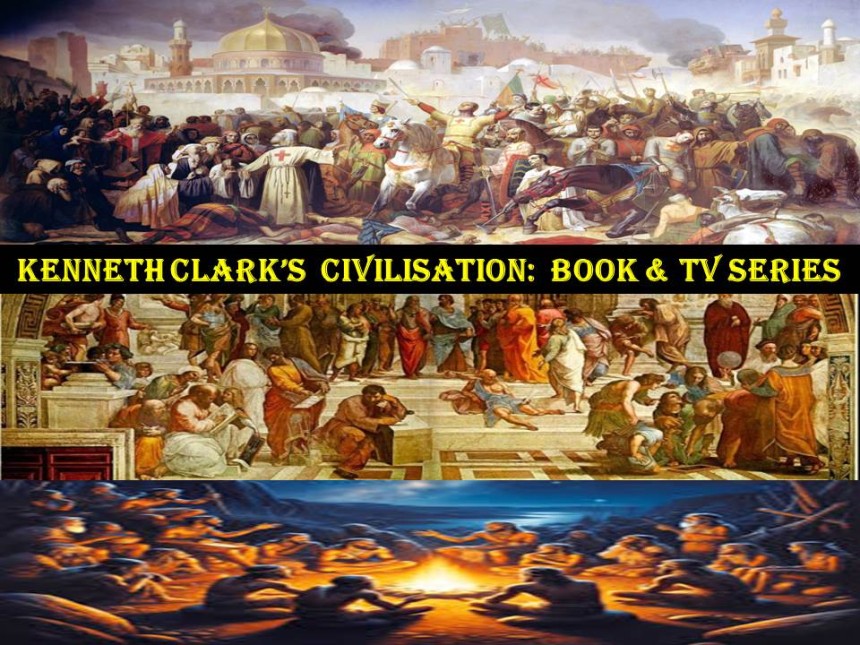

Kenneth Clark's Civilisation : Book & TV Series
The history of the world is a civilizational story of events associated with humans listed in time lines. This story refers to the continuity of human life journeys, heritage, and experiences, values, and challenges passed down from one generation to the next. This write up "Kenneth Clark's Civilisation : Book & TV Series" is an attempt to share about narration of a particular portion of humans' story by Sir Kenneth Mackenzie Clark- a British art historian, museum director, and broadcaster.
بِسۡمِ ٱللهِ ٱلرَّحۡمَـٰنِ ٱلرَّحِيمِ
In the name of ALLAH, the Most Gracious, the Most Merciful
Kenneth Clark's Civilisation : Book & TV Series
Sir Kenneth Mackenzie Clark (1903 -1983) was a British art historian, museum director, and broadcaster. After running two important art galleries in the 1930s and 1940s, he came to wider public notice on television, presenting a succession of programmes on the arts during the 1950s and 1960s, culminating in the "Civilisation" series in 1969. Both the BBC and the "Tate Britain"(Art Gallery) in London, described him in retrospect as one of the most influential figures in British art of the twentieth century.
The British art historian Kenneth Clark lived through much of the tumult that the twentieth century had to offer. He was born in London in 1903, and died just before his eightieth birthday—a span that took him from the Edwardian Age to the age of Margaret Thatcher. Clark experienced both World Wars, the collapse of the British Empire, the upheavals of the nineteen-sixties. Clark recognized, early on, that the new medium of television was going to play a major role in forming and shaping the minds of those who watched it, and he cared a great deal about this.
"Civilisation: A Personal View" by Kenneth Clark is a 1969 British television documentary series written and presented by the art historian Sir Kenneth Clark. Its thirteen episodes outline the history of Western art, architecture and philosophy since the Dark Ages. It was produced by the BBC and aired from February to May 1969 on BBC2. The TV series is an extraordinary cultural tour through the centuries. Kenneth Clark's landmark 1969 series "Civilization", offers his personal perspective on the history of western art and philosophy. (The 13 episode TV Series is available on YouTube)
Kenneth Clark's sweeping narrative looks at how Western Europe evolved in the wake of the collapse of the Roman Empire, to produce the ideas, books, buildings, works of art and great individuals that make up our civilisation. The author takes us from Iona in the ninth century to France in the twelfth, from Florence to Urbino, from Germany to Rome, England, Holland and America. Against these historical backgrounds he sketches an extraordinary cast of characters -- the men and women who gave new energy to civilisation and expanded our understanding of the world and of ourselves. He also highlights the works of genius they produced -- in architecture, sculpture and painting, in philosophy, poetry and music, and in science and engineering, from Raphael's School of Athens to the bridges of Brunel.
“What is civilization?” Clark asks himself in the first few minutes of the first episode. “I don’t know,” he answers. Later in the series, he claims that civilization has something to do with “energy,” remarking, “Vigor, energy, vitality: all the civilizations—or civilizing epochs—have had a weight of energy behind them.” "Civilization" by Kenneth Clark is a personal view of how Western Europe evolved after the collapse of the Roman Empire and produced the ideas, books, buildings, works of art and great individuals that make up a Civilisation.
Kenneth Clark’s Civilisation: A Personal View
In the following, a review posted on 17th February 2023 by Antigonein is being shared which is available on link shared at the end:-
In studying the history of civilisation, one must try to keep a balance between individual genius and the moral or spiritual condition of a society. However irrational it may seem, I believe in genius. I believe that everything of value which has happened in the world has been due to individuals. Nevertheless, one can’t help feeling that the supremely great figures in history – Dante, Michelangelo, Shakespeare, Newton, Goethe – must be to some extent a summation of their times. They are too large, too all-embracing, to have developed in isolation.
Kenneth Clark (1903–83) was the greatest public educator of the 20th century. He began his career as an art historian, and was asked to catalogue the Leonardo da Vinci drawings in the Royal Collection at Windsor Castle when he was only 25. But academic scholarship was not enough for him: he believed that everyone should enjoy access to the best in art, architecture, music and literature. He devoted his life to this conviction.
Clark’s career as an administrator is the stuff of legend: by the age of 30 he was running the National Gallery in London. Later he served as Chairman of the Arts Council, and the first-ever Chairman of the Independent Television Authority. But his real gift was as a communicator.
Clark’s 1939 book on Leonardo da Vinci remains the finest, most accessible introduction available. In fact, all of his books are an education in themselves, and reward study even now. Yet he arguably owes his most lasting fame to his achievements as a broadcaster: nobody has ever come close to Clark’s success in communicating the joys of fine art and high culture to a mass audience.
In February 1969, the BBC began broadcasting Clark’s thirteen-part television documentary Civilisation: A Personal View. This is the most important series in the history of the BBC, breathtaking in its ambition and range and budget: it embodies the broadcaster’s original goal to present its audiences with “all that is best in every department of human knowledge, endeavour and achievement.”
Civilisation: A Personal View is a witty, moving, profoundly learned attempt to explore the question: “what is civilisation?” When he poses this question to himself in the first episode, he famously responds, “I don’t know. I can’t define it in abstract terms – yet. But I think I can recognise it when I see it.”
Instead of seeking a verbal definition, Clark shows the viewer what civilisation looks like in the western tradition. In order to tell a coherent and largely self-contained story to an audience predominantly based in Britain,[1] his narrative focuses upon the evolution of culture in western Europe, charted from the fall of the Roman Empire right through to the emergence of computers and space travel. He adduces example after example of the highest attainments in painting, sculpture, architecture, music, poetry, philosophy, science and engineering. This does not mean that Clark has a vague, rambling, imprecise, indefinite, or open-ended definition of the term. In fact, it takes thirteen 50-minute episodes to spell out what “civilisation” means to him so that there is no mistaking his meaning.
In Episode 6 (“Protest and Communication”), Clark lays out his four requisites of civilisation: intellectual energy; freedom of mind; a sense of beauty; and a craving for immortality. He adds, in speaking of Shakespeare: “one of the first ways in which I would justify civilisation is that it can produce genius on this scale.”
Civilisation is based on a sense of permanence. But as Clark spells out in the first few minutes of Episode 1 (“The Skin of Our Teeth”): “however complex and solid it seems, civilisation is actually quite fragile. It can be destroyed.”
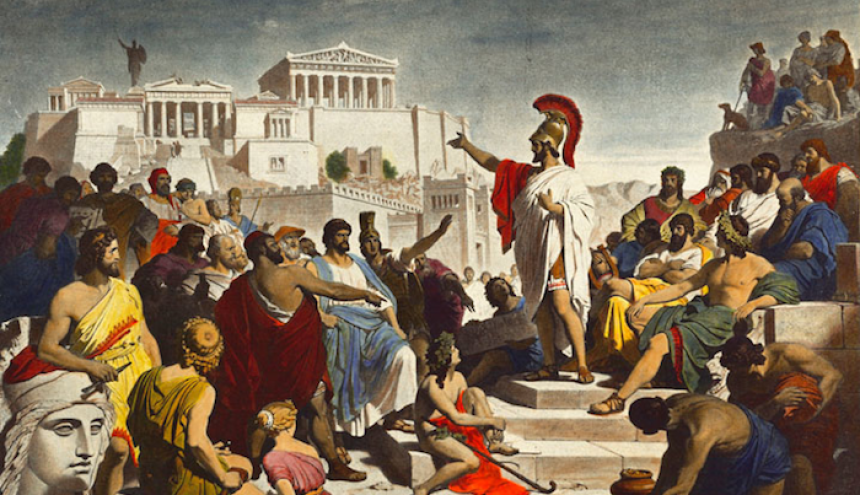
Why does this matter for Classicists? For Clark, Greek and Latin literature, and the heritage of Classical Athens and Ancient Rome, are at the very heart of civilisation. The copying and preservation of ancient manuscripts is not merely a ‘civilised’ act; it is the action that guarantees civilisation itself. Greek and Roman achievements have a permanent value; every civilised generation discovers something new in them.
As a scholar of Leonardo da Vinci, Clark seems happiest when sharing the delights of the Italian Renaissance with his viewers. This is obvious when he discusses 15th-century Florence (Episode 4, “Man: The Measure of All Things”) and early 16th-century Rome (Episode 5: “The Hero as Artist”). He claims that the Florentines of the 15th century were “in love with beauty” in the same way that 5th-century Athenians were; he may have also been speaking unconsciously about himself.
Clark’s tribute to Raphael is the most illuminating short introduction we have to the Classical tradition, and the power of ancient art to inspire creative genius. He describes Raphael’s 1512 fresco The Triumph of Galatea (Villa Farnesina, Rome) as “the greatest evocation of paganism of the Renaissance”, and explains why this is such a miraculous work of art:
When Renaissance poets came to write Latin verse (very beautiful Latin verse too), they had plenty of models. But what wonderful imaginative insight it required for Raphael to recreate from scraps and fragments of sarcophagi a scene that must be very like the great lost paintings of antiquity.
Clark sees civilisation itself as inextricable from an engagement with Greek and Roman culture. In Episode 10, “The Smile of Reason”, which focusses on the so-called ‘Enlightenment’ of the 18th century, Clark emphasises the centrality of Plutarch’s Lives and Livy’s History of Rome in the moral visions of artists no less than philosophers; the ideals of the American and French Revolutions draw on the example of the sternly virtuous Ancient Roman Republic. Later, even Napoleon is demonstrated to have seen himself in light of Greco-Roman history (Episode 12, “The Fallacies of Hope”). Europe cannot escape the Classical world.
Civilisation: A Personal View is precisely what it announces: a personal view. But after more than half a century, none of its critics have succeeded in dismissing its power. After all, you can’t argue against beauty. There is no more enlightening program in the history of broadcasting. All truly curious minds should watch it from beginning to end as they forge and hammer out for themselves that all-important artefact: their own personal view. Meanwhile, Clark’s own conclusion to the series (from Episode 13, “Heroic Materialism”) continues to resonate:
It is lack of confidence, more than anything else, that kills a civilisation. We can destroy ourselves by cynicism and disillusion, just as effectively as by bombs. Fifty years ago, W.B. Yeats, who was more like a man of genius than anyone I’ve ever known, wrote a prophetic poem, and in it he said:
Things fall apart; the centre cannot hold;
Mere anarchy is loosed upon the world,
The blood‐dimmed tide is loosed, and everywhere
The ceremony of innocence is drowned;
The best lack all conviction, while the worst
Are full of passionate intensity.
Well, that was certainly true between the wars, and it damn nearly destroyed us.
Is it true today? Not quite, because good people have convictions – rather too many of them. The trouble is that there is still no centre. The moral and intellectual failure of Marxism has left us with no alternative to heroic materialism, and that isn’t enough. One may be optimistic, but one can’t exactly be joyful at the prospect before us.
https://antigonejournal.com/2023/02/kenneth-clark-civilisation/
Concluding Remarks
The history of the world is a chronological narrative of human development, defined by the rise and fall of civilizations, technological leaps, and, crucial social transformations. This civilizational story can be segmented into distinct eras, from the earliest hunter-gatherer societies to the modern, interconnected world.
The "Ancient History" is termed as the "Rise of Civilization" (c. 3,500 BCE – 500 CE); which may be defined by the invention of writing, urban planning, large-scale metallurgy, and the establishment of centralized states. Today, we humans largely know and talk about the period starting from 3500 BCE till today. This small period of time is characterized by the rise of major world religions, the spread of empire, and regional development. All the debate about rise and fall of empires and "civilisations" revolve around this period of time.
Kenneth Clark claims that civilization has something to do with “energy,” remarking, “Vigor, energy, vitality: all the civilizations—or civilizing epochs—have had a weight of energy behind them.” A query immediately erupts in mind: Aren’t the enemies of civilization also an energetic lot? The answer is "YES"; the anti "civilisation" agent are always active and they sustain through the rise of a particular "civilsation".
Anti-civilization agents are individuals or groups who adhere to a philosophy, often rooted in anarchism, that views any flourishing civilization— like current modern defined by industrialization, urbanization, technological dependence, and hierarchical structures—as inherently destructive, oppressive, and unsustainable. "Anti-civilization agents" always prey to undermine societal cohesion and they may be countered by a multifaceted approach combining security, community strengthening, and intellectual counter-arguments. Islam is the youngest of Abrahamic religions and Al-Quran is the last book of "Guidance" and provides detailed instructions for establishing and sustaining any "civilisation" serving the cause of humanity in real essence.

USAII® Certification Exam Journey: From Preparation to Certification |...

Flower Delivery in Cyber City: Elite Corporate Florist
Mastering express floral styling and reliable corporate delivery across Gurugram, Sai Flow...

Welche Nebenwirkungen kann generisches Cialis verursachen?
Generisches Cialis enthält Tadalafil, einen Wirkstoff aus der Gruppe der Phosphodiesterase...