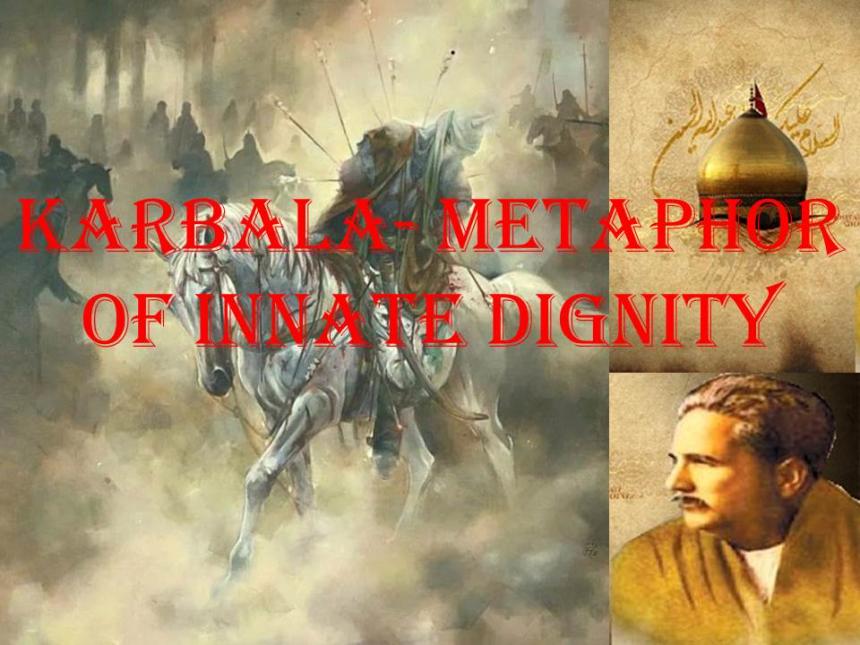

Karbala- Metaphor of Innate Dignity
The Karbala is an important event that is about Hazrat Imam Hussain (AS) and the unforgettable sacrifices rendered by the clan of Prophet Muhammad (PBUH) in the month of Muharram Ul Haram in 61 AH. The last 1400 years Muslims' societies have developed its own significance about "Shahadat-e-Hussain (AS). This write up reflects that how Hazrat Imam Hussain (AS) at Karbala demonstrated the relevance of innate dignity for all the Muslims to follow?
أَعُوذُ بِاللّٰهِ مِنَ الشَّيْطَانِ الرَّجِيمِ
بِسۡمِ ٱللهِ ٱلرَّحۡمَـٰنِ ٱلرَّحِيمِ
اللہ کے نام سے شروع جو بڑا مہربان نہایت رحم کرنے والا ہے
In the name of ALLAH, the Most Gracious, the Most Merciful
Karbala- Metaphor of Innate Dignity
Karbala transcends its 7th-century historical reality in Iraq, serving as a timeless, universal metaphor for innate human dignity, moral courage and the refusal to submit to tyranny. It represents the ultimate triumph of conscience over self-preservation, demonstrating that standing up for justice is the real victory. Imam Hussein (AS) famously uttered the phrase "Hayhat minna al-dhillah" (هيهات منا الذلة) on the Day of Ashura, October 10, 680 AD (10 Muharram 61 AH) in Karbala. Translated as "Far from us is humiliation," this defiant statement was his response when he was cornered by Yazid’s army and forced to choose between pledging allegiance to an unjust ruler and facing death.
Imam Hussain (A.S) emphasized that maintaining one's human dignity, moral principles and divine codes is the ultimate choice for honourable life, declaring, "Death with dignity is better than a life of humiliation." He believed that standing against oppression and injustice is fundamental to human honor. The phrase encapsulates the core message for any one, confronting a life threatening moment, laced with honour and dignity—that life with indignity and oppression is unacceptable. It fosters the global symbol of human dignity and resistance.
"Never shall we submit to humiliation" is an immortal saying of Imam Hussein ibn Ali (peace be upon him), uttered on the day of Ashura during the Battle of Karbala when he was given the choice between surrendering and pledging allegiance to Yazid, or fighting. It signifies the rejection of subservience and the preference for honor and dignity over obeying the wicked and accepting injustice. Life is a gift of ALLAH and He is the Ultimate Sustainer and Provider of essentials for life. ALLAH is the only one who knows the exact extent of span of life for all living beings. So living with honour, dignity and respect or "otherwise" is the choice that "Man" has to make himself.
“Few men desire liberty; most men wish only for a just master.”
The above quote is a famous political aphorism by the ancient Roman historian Sallust (Gaius Sallustius Crispus), written in his work Histories. It suggests that true freedom requires immense personal responsibility, whereas most people prefer the comfort, stability, and protection of a competent ruler.
Life with honor, dignity, and respect is deeply intertwined with freedom and liberty, though they represent distinct philosophical concepts.Freedom and Liberty are foundational conditions. They represent the absence of external constraints, granting you the power to act, speak, and make choices without oppression. Honor, Dignity, and Respect are qualitative experiences. They define how a life is lived and how one is treated by others. They require a social framework where individuals are valued, free from degradation, and recognized for their inherent worth.
While you can technically have freedom (the ability to act without restraint) in an environment that lacks respect or dignity, true liberty is generally considered incomplete without the foundational respect for human dignity. Conversely, one can be subjected to rigid rules that mandate benefits yet strip away personal freedom, creating a profound imbalance. Ultimately, they are symbiotic; liberty provides the space to live authentically, while honor and dignity give that "liberated" life moral value and meaning.
Roman historian Sallust's statement (“Few men desire liberty; most men wish only for a just master”) is a cynical but enduring observation on human nature and political psychology. Liberty refers to the power or condition of acting, thinking, or living as one wish or wills without any restrictions. It may be the freedom from mental, psychological and physical restraints or oppressions and the autonomy to pursue one's own rights and goals. However, there are humans who prioritize pleasures and unknown longer moments of life with security, order, and predictability over the unpredictable and demanding responsibilities of true self-governance laced with honour, dignity and respect.
Historically, the above Sallust's quote is often used in political and philosophical contexts to argue that while democratic ideals sound noble, however, the everyday reality is that the vast majority of people are perfectly satisfied living under any type of rulers (just, law-abiding or even dictator) as long as their personal needs are met. True liberty requires active participation, accountability, and constant decision-making, which many "men" find exhausting. These individuals prefer to shift that burden of democratic credentials onto a leader or system.
In the modern world of today, there are humans and even nations who care more about the results or outcomes from the leadership at helm of affairs (e.g., peace, economic stability, fairness) than the philosophical or moral legitimacy of who is in charge. In the history and in many modern contexts, populations prioritize functional results (benefiting them) over the theoretical legitimacy of how a leader came to power. The primary motivation of such people is stability (as a measure of their life span). As long as a master (whether it be a government, an employer, or an ideology) is perceived as beneficial, they are willing to submit to that authority.

Man is an Animal who prefers his Own Needs?
From a biological standpoint, living organisms are wired for survival and reproduction. In this sense, humans prioritize their own needs to ensure the continuation of their genetic lineage. However, as humans evolved, they developed complex societies, meaning an individual's best survival strategy actually became cooperation and mutual reliance. Thinkers like Thomas Hobbes argued that all human action is ultimately rooted in self-interest (Psychological Egoism). On the other hand, thinkers like Aristotle argued that humans are inherently "social animals" who find their highest purpose in civic life, community connection, and mutual contribution.
The religion has elevated humans on higher pedestal. Throughout history, religion has elevated humans by instilling a profound sense of purpose, moral responsibility, and intrinsic dignity. By framing human life as a reflection of the divine or a journey toward ultimate enlightenment, spiritual traditions give individuals a unique status far beyond purely biological existence. The religion of Islam has dictated the followers to observe "Jihad" as a foundation of faith; which also embodies "fight in the way of ALLAH" as well.
Not every battle is fought first on the battlefield. Some are fought inside the human being. Some are fought against fear, humiliation, and the belief that submission is inevitable. Jihad is a battle that is fought inside humans against own self (uncontrolled desires and unending wishes), against self interests and finally against evil forces, mentally and physically.
Therefore, there have been two distinct groups in all societies and civilizations; the rulers and the common man. In the modern world this relationship has conceptualized into a complex science. The western civilization (nations) has adopted democracy and third world is experimenting with pseudo democracy and dictatorship (in various forms including kingship). In today's world, the battle is the "narrative" that is won or lost in minds. The battle is fought for the control over the imagination of the people and when people stop believing in themselves (as free humans), the defeat is their natural condition (loss of honour, dignity and respect).
Stop Accepting Humiliation as Destiny
Imam Hussein (AS) phrase "Hayhat minna al-dhillah" (هيهات منا الذلة) "Far from us is humiliation," or "Death with dignity is better than a life of humiliation" shall guide the humanity for the real meaning of dignity and destiny. The forces of evil (be it rulers and any one having desires to rule others) have always attempted to gather unlawful powers to control fellow human beings and resources of the "Earth." Imam Hussain (AS) has sacrificed his life to render a clear message that humans can only be ruled under "divine guidance" (religious doctrine based upon Holy Scriptures) and that "forces of evil" (rulers without moral & legal authority) can't be accepted as legitimate ruler even when it is benefitting in any manner.
The "forces of evil" are the rulers, who have always attempted to control fellow humans by manipulation and forgery and they have always shown the hunger to usurper the resources of the "Earth" as much as possible. The most dangerous thing all the oppressors have attempted is the control over the imagination of the people. The tyrant will always built a "narrative" to make people believe in his "invincibility", "superior being" or "cosmic guided" being with super natural abilities; and then they make people believe that defeat is their natural condition and then their assets and resources are exploited. In the end the forces of evil will always make people believe in humiliation as their destiny and then raise their self a "god".
Karbala is a metaphor for innate dignity; as it invokes death at the hands of tyrant as a life of honour and dignity. Karbala is never simply about who stood alive at the end of the day; but about what survives after sacrifice, conviction, memory, and the refusal to surrender to unjust and illegitimate rule. It must be remembered that "Free Soul" is about life of freedom with honour, dignity and respect; and for that the heart & mind shall be liberated (from evil desires and dogmas). The message from Karbala reverberates that humiliation shall never be a choice as death is a far superior attribute towards "real life" to be realized in hereafter.
Karbala: Muslim Resistance Movements
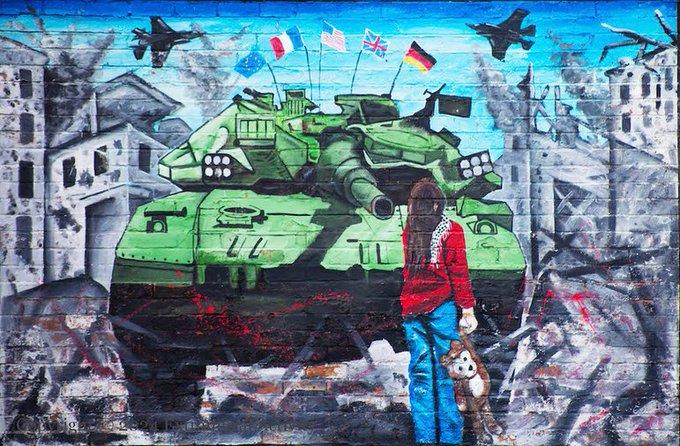
Karbala is not a call to seek suffering. It is a refusal to surrender truth for comfort, dignity for survival, or principles for benefits and worldly gains. The greatest prison is not concrete — it is accepting that oppression is normal, that resistance is futile, that power defines truth. Karbala differentiates "truth & evil" and it foretells that victory is not always measured by who remains standing, but by who refused to kneel. That is why oppressed people across generations keep returning to it; a philosophy that liberates the mind before the land. There is something people still fail to understand about Kashmir, Palestine or all the places where Muslims are fighting against Oppressors (Like US-Israel War against Iran).
That is why so many people connect Palestinian in Gaza to Karbala. Not because the events are identical, but because they see in Karbala the refusal to accept that truth is measured by power, numbers, or immediate outcomes. Imam Hussain (AS), became a symbol of refusing legitimacy to what one believes is oppression even when the cost is immense. The lesson many take from that story is not seeking death — it is refusing to let fear decide what is true. When figures in Palestinian resistance publicly speak positively about Iranian support, many supporters interpret that through that same lens: not as sect, ethnicity, or geography, but as standing with those who they believe chose support over abandonment at moments they felt isolated.
The Conclusion
Imam Hussain (AS) is the "Chief of Youth in Jannah"; who set the best example of "sacrifice" of himself and the male members of his family in the way of Allah; and has left a message for all mankind, especially Muslims, that humiliation is never a human destiny. There is another path for every "Man" that leads to true greatness. The aggressor or oppressor may use insane force to take life, thinking of humiliating a person, but honor cannot be taken away by such killings. True destiny is rooted in the purpose of life and self-respect, not in the subjugation imposed by a tyrant and oppressor.
A Muslim is a believer of Oneness of ALLAH; and the sacred word "La ilaha illallah"(No god except ALLAH) undoubtedly frees a person from all forms and types of slavery, fear, and false deity, making him a true servant of the One and Only God. This is the path to peace of mind, recognition of the true self and true spiritual freedom. The only condition is that the “Kalma Tayyabba” should not be merely spoken verbally, but should be affirmed with the heart.
There is a *faqr* (spiritual detachment/poverty) of the Shabbiri kind—a *faqr* that embodies true sovereignty;
It is the legacy of the Muslim faith, the very treasure of the Shabbiri spirit!
The verse above is taken from the poem "Faqr" in Allama Iqbal's collection *Bal-e-Jibril*. In this verse, Iqbal speaks of the specific kind of *faqr*—spiritual detachment and poverty embraced for the sake of the Divine—of which Hazrat Imam Hussain (AS) presented the ultimate example to the world. It is this very *faqr* that enables a person to attain the station of a true believer (*Mu'min*); and it is the true believer alone who is worthy of holding the mantle of leadership and sovereignty in this world.
And the message of Karbala for the followers of Islam is that a true Muslim is the heir to the capital of Shabbir. The purpose and goal of Islam is nothing other than that Muslims should follow in the footsteps of Hazrat Imam Hussain (AS) and become the bearers of truth and honesty in the world. And on the basis of their truth and honesty, they should organize a society that stands on the principles of the dictates revealed by ALLAH Subhanahu Wa Ta'ala, that is, the Holy Quran, and is an example of the pure life of the Holy Prophet Muhammad (s.a.w.a.).
Today, the Muslim world is immersed in deep slavery. And the main reason for the degradation is intellectual and psychological insolvency. But a new spirit has awakened among the Muslims of Gaza in Palestine. And they have demonstrated Muslim's pride that seems inspired by the spirit of Karbala. And the message of "Hussainyat" from Karbala has grown a miracle in Iran, so that sanctioned weak "Mullah State" fought bravely to embarrass to most powerful military might of the history.

I migliori casinò online italiani con giochi di slot nel 2026
I migliori casinò online italiani con giochi di slot nel 2026


How a Lyft Clone App Can Help You Compete in the USA Ride-Sharing Mark...

Guide Complet sur les Traitements Médicamenteux Courants pour la Santé...
