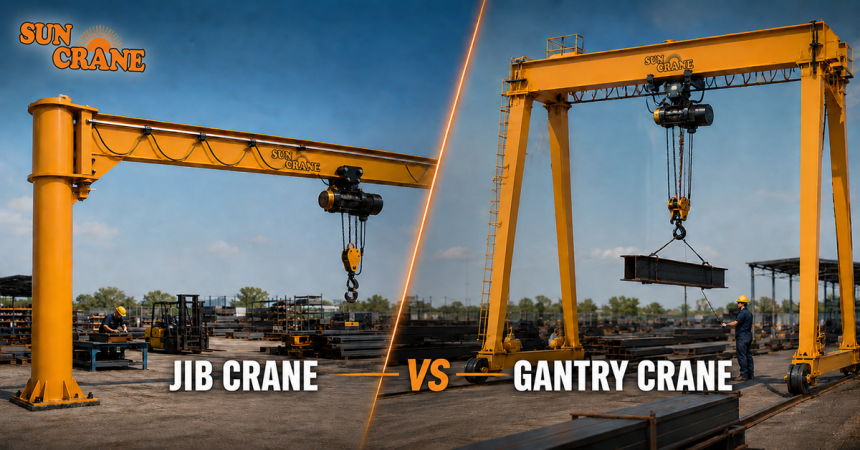

Jib Crane vs Gantry Crane: Cost, Types and Differences
From cost to capacity, see how jib cranes and gantry cranes differ in design, mobility, structure, and application before making your final decision.
A jib crane offers circular/arc coverage around a fixed pillar or wall mount, suits light-to-medium loads (about 250 kg to 10 ton), and needs minimal civil work. A gantry crane spans a rectangular area on rails or wheels, handles medium-to-heavy loads (1 ton to 50+ ton) over wide spans, and needs more floor space and civil work. Jib = workstation lifting; gantry = yard and bay coverage.
Choosing between a jib crane and a gantry crane is one of the most common decisions in workshop and material-handling planning. Both lift and move loads – but they do it in very different ways, at very different costs, and for very different applications.
A jib crane provides compact, rotational lifting around a fixed point, ideal for a single workstation. A gantry crane spans a wide area and travels across it, making it suited to yards, warehouses and heavy outdoor work. Picking the wrong one means either paying for coverage you do not need, or buying a crane that cannot reach where you work.
Read More: https://suncrane.in/blog/jib-crane-vs-gantry-crane/
NBA 2K27 Lightning Launch Guide for Beginners by U4gm
Lightning Launch in NBA 2K27 is about the first move from the perimeter: it helps a ball h...

Deburring and Surface Finishing with a Magnetic Polishing Machine
Every cutting operation leaves an edge. Sometimes the result is a visible curl of metal at...

Selecting the Right Magnetic Polishing Machine for Precision Component...
Buying finishing equipment looks simple until the first batch arrives. A machine that prod...
How a Magnetic Polishing Machine Works in Precision Surface Finishing
Precision metal parts almost always leave the machine shop with problems that drawings do...
How Can Scalable Web Applications Support Long-Term Business Growth?
