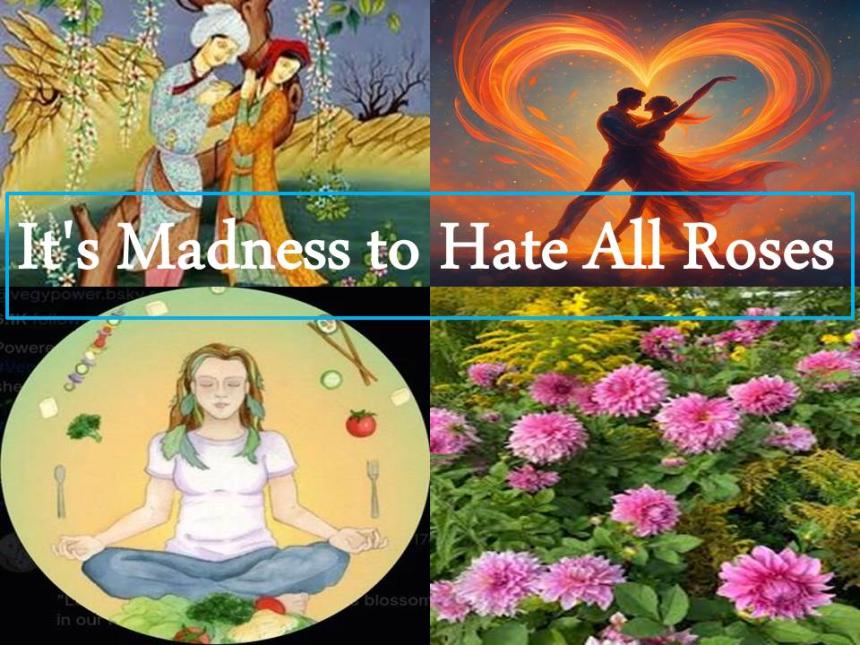

It's Madness to Hate All Roses
"It is madness to hate all roses because you got scratched with one thorn" is one of the most beloved themes from Antoine de Saint-Exupéry's classic novella, The Little Prince. The line is part of the passage in the novel "The Little Prince". This passage is famous because it highlights the importance of resilience, suggesting that one should not abandon all hopes, dreams, or relationships simply because of a single disappointment or failure. This write up has been arranged for the educational purpose.
أَعُوذُ بِاللّٰهِ مِنَ الشَّيْطَانِ الرَّجِيمِ
بِسۡمِ ٱللهِ ٱلرَّحۡمَـٰنِ ٱلرَّحِيمِ
In the name of ALLAH, the Most Gracious, the Most Merciful
It's Madness to Hate All Roses
"It is madness to hate all roses because you got scratched with one thorn" is one of the most beloved themes from Antoine de Saint-Exupéry's classic novella, The Little Prince. The Little Prince is a novella written and illustrated by French writer and aviator Antoine de Saint-Exupéry. It was first published in English and French in the United States in April 1943 and was published posthumously in France following liberation; Saint-Exupéry's works had been banned by the Vichy Regime.
The sentence "Its Madness to Hate All Roses" is part of the passage in the novel "The Little Prince". This passage became famous and is quoted separately even; because it highlights the importance of resilience, suggesting that one should not abandon all hopes, dreams, or relationships simply because of a single disappointment or failure. It encourages a forward-looking perspective, emphasizing that new opportunities and connections will always arise.
The passage starts with the line "its Madness to Hate All Roses" and this line is a profound metaphor itself. The rose is one of the most versatile metaphors in poetry, historically representing love, beauty, the fleeting nature of time, and human vulnerability. It’s layered anatomy—soft, blooming petals juxtaposed with sharp thorns—allow poets to capture both the ecstasy of passion and the pain of life.
How can one even imagine hating any rose? The rose is indeed universally recognized as a timeless symbol of pure love and affection, a meaning deeply rooted in history, art, and literature. Its captivating, scintillating fragrance has made it a cornerstone of perfumery and aromatherapy for centuries. Whether you love them for their fragrance and opulence or hate them for the prickles and upkeep, a rose is much more than just a flower—it’s a lightning rod for human emotion.
"A Red, Red Rose" is a famous 1794 poem by Scottish poet Robert Burns and it famously celebrates the flower's vibrant color and sweet fragrance symbolizes romance, devotion, and new beginnings. In the poem the speaker promises to love his "bonie lass" until the seas run dry, the rocks melt with the sun, and the sands of life stop running. Human soul is like a rose and hating all roses will mean abhorring the human race and it will be supremely insane to even consider this thought.
This famous passage from The Little Prince highlights the importance of resilience, suggesting that one should not abandon all hopes, dreams, or relationships simply because of a single disappointment or failure. It encourages a forward-looking perspective, emphasizing that new opportunities and connections will always arise. It captures the essence of Saint-Exupéry's philosophical lessons on taking responsibility for what you care for and seeing beyond the flaws of the world.
Similarly, "to give up all dreams; because one of them didn't come true" is like hating all roses just because some one got scratched by one thorn. There is a poem "Don’t Quit" by Edgar A. Guest, which conveys a timeless message of perseverance, resilience, and optimism. It encourages us to keep pushing forward through life’s inevitable challenges, reminding us that success is often just around the corner, and quitting only leads to regret. So, one unfulfilled dream may never be an end.
This line from "The Little Prince" reminds us that failure doesn't devalue the rest of our goals or our capacity for happiness. Every failed dream refines our heart and helps us figure out exactly what we really want. For every end, there is always a new opportunity, a new strength, and another chance to try again. Every setback is a redirection, not an endpoint. One unfulfilled path simply leaves room to discover new passions, strength, and beginnings.
Moreover, the line "to give up all attempts; because one of them failed" encourages resilience, urging people not to let a single setback, rejection, or failure prevent them from trying again, pursuing new dreams, or remaining open to new experiences. A classic 19th-century inspirational poem "Try Again" (also known as "Try, Try Again") emphasizes perseverance and resilience. Most commonly attributed to the English educational writer William Edward Hickson, it teaches that patience and continuous effort will eventually lead to success. It teaches readers to view failure not as a disgrace, but as a learning opportunity. By remaining patient, courageous, and determined, continuous effort will ultimately overcome any obstacle.
The line "It's folly to condemn all your friends; because one has betrayed you", is sentimental and evoke deep feelings. This sentiment is a popular extension of the wisdom found in Antoine de Saint-Exupéry’s novella The Little Prince. Just as it is foolish to hate all roses because a single thorn pricked you, it is folly to judge an entire circle of friends based on one person's misstep. It is human nature to generalize pain, but punishing one's loyal friends for the sins of any betrayer closes us off to meaningful connection. Everyone makes mistakes, and holding onto collective distrust hurts us more than anyone else. It also reminds that good friends are worth fighting for, and new experiences offer opportunities for genuine bonds.
The passage becomes intense here, "to no longer believe in love, just because someone was unfaithful, or didn't love you back" and makes the reader really stop for a moment and think deeply. Losing faith in love after being betrayed or rejected (that's most common experience) is one of the most painful human experiences. It is completely natural to want to build a wall around your heart when someone you trusted shatters it.
This specific quote from Antoine de Saint-Exupéry’s "The Little Prince" is meant to hit the brakes on our thinking. It offers a powerful reality check about the human tendency to generalize our pain. It is completely fine to take time to heal and set stricter boundaries, but giving up on love entirely means letting past pain dictate your future happiness. Giving your heart to someone is a courageous act. Do not let a person who couldn't value your worth stop you from sharing that gold with someone who actually does.
The passage reaches climax as it says "to throw away all your chances to be happy, because something went wrong". Throwing away one's chances for future happiness because some thing went wrong is a tragic, unnecessary trap. Every setback is merely a single chapter, not the whole story. One always deserves to heal, learn, and try again without letting one mistake dictate his entire path.
Carl Sandburg in his famous short free verse poem "Happiness" explores how true joy is found in simple, everyday moments rather than in intellectual pursuits or material wealth. The poem describes a search for the meaning of happiness, and eventually finding the example of true happiness in simple mundane things of every day life. Happiness is found in everyday, working-class life, communal gatherings, and appreciation for simple pleasures.
The passage is closing on "For every end, there is always a new beginning" and there is no doubt about it." "For every end, there is always a new beginning" is a timeless sentiment that beautifully captures the resilience of the human spirit. It is a great reminder that when one chapter closes, it paves the way for fresh opportunities, growth, and experiences.
Every ending is a fresh start in disguise. Whether it is a job, a relationship, or a phase of life, closing one chapter clears the space, time, and mental energy needed to welcome new opportunities and personal growth. Embracing this mindset helps reframe how we view change. Instead of mourning what is gone, one can focus on the potential of the future. Every closure acts as a reset button, allowing us to rewrite our narrative and try new things.
The line from "The Little Prince" "There will always be another opportunity, another friend, another love, a new strength" reflects a similar message as given by Matthew Arnold's "honeymoon" poem "Dover Beach". The poem "Dover Beach" in the end advises that if one is living with selfish and soulless people, then one must confide in his soul mate, the other half, wife or husband, as the case may be, which is basic unit of human race. The poet seeks inward reversion, to counter this existential despair, making a desperate, intimate plea to his beloved and by treating the romantic partnership as the foundational unit of human survival, the poet suggests that personal fidelity and genuine love between two people are the only remaining sources of truth, peace, and meaning in life.
The last beautiful poignant quote "And now here is my secret, a very simple secret; It is only with the heart, that one can see rightly; what is essential is invisible to the eye"; is the central lesson from Antoine de Saint-Exupéry's novella, "The Little Prince". It is a gentle reminder from the fox to the prince that true understanding and appreciation of life's most meaningful things—like love, friendship, and empathy—come from feeling and intuition, rather than just physical sight.
The message from the quote essentially means that the "heart"—which might symbolize the soul or spirit, or one's internal moral compass, can see what truly matters in life. Love indeed finds its deepest roots within the heart, acting as a compass that reveals the true meaning of connection, empathy, and devotion. It is that inner space where our most genuine emotions and intentions reside.
Throughout history, the heart has served as the profound physical and metaphorical vessel of the soul, representing our deepest emotions, intuition, and spiritual core. This connection bridges the gap between biological existence and the metaphysical, anchoring our intangible consciousness within the physical realm.
A Passage from Novella, "The Little Prince" By Antoine de Saint-Exupéry
It's madness
to hate all roses
because you got scratched with one thorn,
to give up all dreams
because one of them didn't come true,
to give up all attempts
because one of them failed.
It's folly to condemn all your friends
because one has betrayed you,
to no longer believe in love
just because someone was unfaithful
or didn't love you back,
to throw away all your chances to be happy
because something went wrong.
There will always be another opportunity,
another friend,
another love,
a new strength.
For every end,
there is always a new beginning.....
“And now here is my secret,
a very simple secret:
It is only with the heart
that one can see rightly;
what is essential is invisible to the eye."
The Conclusion
My Dear Readers! It's foolish, at least, if not "Madness to Hate All Roses." Life is a beautiful gift from the the "Ultimate Being" The God / ALLAH. We shall live it to fullest and endeavour to enjoy each and every moment available to us. Life is absolutely meant to be savored. Be truthful, loyal, sincere, helpful and adventurous and take every possible opportunity to explore the beauty and charm spread across the nature.
Always hold on to the integrity as the real beauty of a person comes from the strong character, honesty and sense of responsibility. The man is known for his values and test of integrity happens when we go through a tough time. Always be strong and show resilience while facing adversity and problems and never stop loving fellow beings by keeping the heart clean and free from devastating hate and fear. Always keep a positive look at life and remain hopeful for the future. Remember; ALLAH is very Kind, Benevolent and Merciful.


Book Skip Bin Online Adelaide for Home & Garden | GoGo Skip Bins
Make your home and garden cleanup easier with a quick and convenient waste removal service...


Building a Strong Online Presence with SEO, PPC, and Social Media Mark...