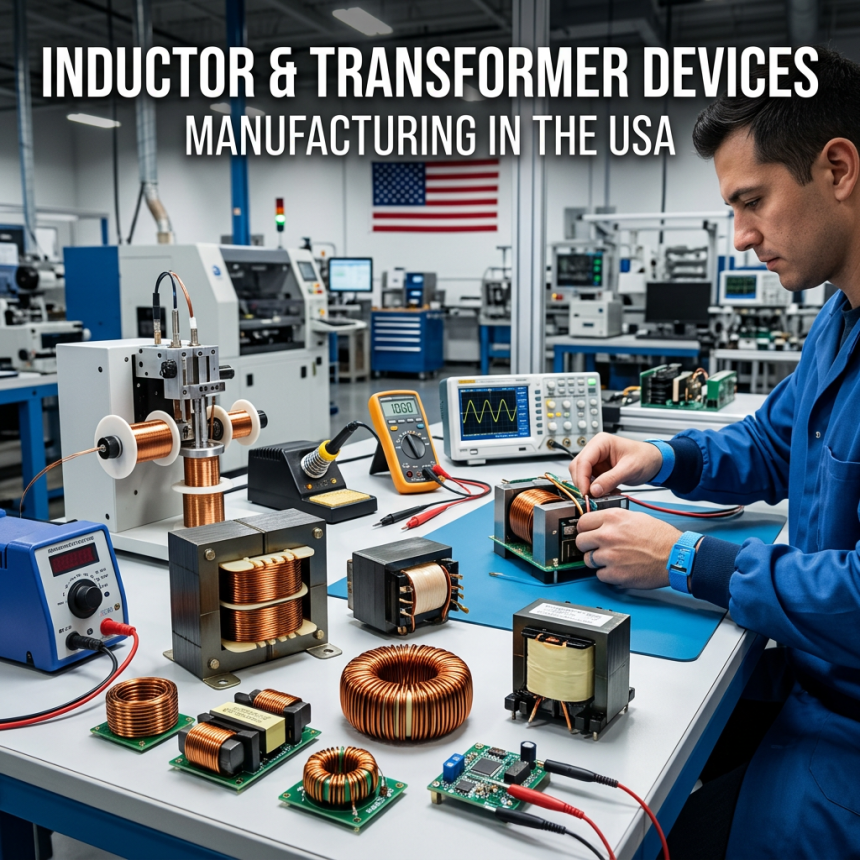

Inside the U.S. Manufacturing Landscape for Inductors and Transformer Devices
Explore the U.S. manufacturing landscape for inductors and transformer devices, including design considerations, production processes, quality standards, customization, and the growing importance of reliable domestic supply chains for modern electronics.
The smallest of magnetic components can make the difference between electronic products performing perfectly-or being hot, noisy, intrusive and short-lived.
Transformers and inductor often receive less recognition than the processing unit, battery or display in a particular system, but they perform a central role in power conversion, signal conditioning, electromagnetic compatibility and energy management within every electrical device manufactured throughout the world. It’s simple-the role they perform can easily be unseen or difficult to substitute.
This also applies to what goes into making each component, also meaning a more thorough understanding of these components within the supply chain is a more pressing issue than ever before.
In companies buying transformers or a wide selection of inductors from companies manufacturing their devices within the US the discussions are rapidly evolving from being a purely issues of supply. Designs, specifications and procurement are examining: consistency of manufactures; the kinds of materials they select; customization capabilities for specific needs; quality control, traceability in the supply-chain; what specifications or application can be met by the component manufacture.
And US market is turning around in other ways too: designers and manufacturers are reconsidering where each critical component is produced, desiring an appropriate influence over it, and looking at a different choice of available manufacturers for special and non-special magnetic components.
Why Magnetic Components Matter More Than Their Size Suggests
Inductors and transformers are passive components, but “passive” does not mean unimportant.
An inductor stores energy in a magnetic field and can influence current behavior in a circuit. Transformers transfer electrical energy between circuits while providing functions such as voltage conversion and electrical isolation.
Their physical size may be modest, but their electrical and thermal characteristics can have a significant effect on an entire system.
For example, a magnetic component may need to handle:
- High current without excessive temperature rise
- Rapid switching frequencies
- Continuous operation under demanding loads
- Electrical isolation requirements
- Electromagnetic interference considerations
- Mechanical and environmental stresses
- Tight dimensional restrictions
- Application-specific voltage requirements
As electronic systems become more compact and power densities increase, the engineering requirements placed on these components become more demanding as well.
What Is Changing in U.S. Inductor and Transformer Manufacturing?
Inductor and transformer devices manufacturing USA: The "U.S.A." designation implies an overall manufacturing landscape rather than a product category.
U.S. Manufacturers develop and customize magnetic component solutions for myriad applications and conditions.
For each particular application, it could entail custom winding schemes, novel magnetic materials, advanced insulation, shielding mechanisms, unique termination possibilities, potting techniques, or mechanical configurations.
Another notable change: magnetic component selection has moved from treating parts as commodities. A part that might fit a specification in terms of inductance, turns ratio, or a form factor may underperform when operating as part of a real circuit because core losses, conductor impedance, saturation limitations, parasitics, temperature limits, and manufacturing tolerances play a role. This is why component engineers work hand-in-hand with designers and procurement specialists instead of just picking a component that fits the specs.
From Design Specification to Finished Component
Manufacturing an inductor or transformer is not simply a matter of winding copper wire around a core.
The process begins much earlier, with understanding the electrical and mechanical requirements of the application.
A typical development process may involve several stages:
1. Defining the Electrical Requirements
Engineers first establish parameters such as voltage, current, frequency, inductance, impedance, turns ratio, isolation requirements, and expected operating conditions.
These specifications establish the basic design boundaries.
2. Selecting Magnetic Materials
The magnetic core has a major influence on component behavior.
Different core materials can provide different combinations of permeability, frequency performance, saturation characteristics, and losses. Selecting an appropriate material therefore depends heavily on the intended application.
3. Developing the Winding Configuration
Wire size, winding arrangement, number of turns, insulation, spacing, and termination methods all affect performance.
In high-frequency applications, winding geometry can become particularly important because parasitic capacitance and other high-frequency effects can no longer be treated as minor details.
4. Managing Thermal Performance
Electrical losses eventually become heat.
A design that performs well electrically but cannot dissipate heat effectively may not be suitable for continuous operation. Manufacturers therefore have to consider resistance, core losses, ambient temperature, airflow, enclosure conditions, and expected duty cycles.
5. Building and Testing Prototypes
For custom components, prototype production can help identify problems before full-scale manufacturing begins.
Testing can reveal whether the component meets the intended electrical characteristics and whether its mechanical construction is practical for production.
6. Production and Quality Verification
Once the design is established, manufacturing processes must be repeatable.
Consistency in winding, assembly, insulation, termination, core positioning, and testing becomes essential when components are produced in volume.
Why Domestic Manufacturing Is Receiving More Attention
The renewed interest in U.S. manufacturing is not limited to magnetic components.
Across the electronics industry, companies have been examining supply chains more closely after years of transportation disruptions, component shortages, geopolitical uncertainty, and long lead times.
For buyers, domestic manufacturing can provide advantages that go beyond physical location.
Supply-Chain Visibility
Working with a U.S.-based manufacturer can make communication about production schedules, engineering changes, quality issues, and inventory planning more direct.
This can be especially useful for products with long development cycles or strict production requirements.
Engineering Communication
Custom magnetic components often require technical discussions.
An engineer may need to explain a particular operating frequency, current waveform, thermal environment, mounting constraint, or insulation requirement. Direct communication with the manufacturer can help prevent misunderstandings during development.
Production Flexibility
Not every requirement fits neatly into a standard catalog component.
Certain applications may require unusual dimensions, winding arrangements, terminals, shielding, or electrical characteristics. Manufacturers with custom-design capabilities can work around those constraints rather than forcing the system designer to redesign the surrounding electronics.
Reduced Dependence on a Single Overseas Supply Chain
Domestic sourcing does not eliminate global supply-chain risk, but it can provide another sourcing option.
For companies manufacturing critical equipment in the United States, having qualified domestic suppliers can become part of a broader supply-chain resilience strategy.
The Importance of Custom Magnetic Components
Standard components remain appropriate for many designs. But specialized equipment can create requirements that standard products cannot satisfy efficiently.
Consider an electronic system with limited board space. A standard inductor may provide the required inductance but occupy too much area.
Another system might require a transformer with a particular isolation distance, mounting arrangement, or winding configuration.
In such cases, customization may involve:
- Core geometry
- Inductance value
- Current rating
- Winding structure
- Wire gauge
- Turns ratio
- Insulation system
- Shielding
- Terminal configuration
- Mounting dimensions
- Encapsulation
- Thermal characteristics
The goal is not simply to create a component that works in isolation. It is to create a magnetic component that works appropriately within the complete electrical and mechanical system.
Manufacturing Quality Is About More Than Final Inspection
When looking at a manufacturer, it can be tempting to think about the final testing procedures.
Testing is important, but there are many factors that contribute to a good quality component before it is sent out.
Raw material consistency, winding procedures, calibration, operator procedures, assembly control, and documentation can all play a part in the final product.
A good manufacturing environment would have controls in place during the making of the component, and not just at the end.
This is important because two different components can pass the final electrical tests, but have differences in their build that will affect the components' life.
For demanding applications, manufacturers and buyers may need to consider factors such as:
- Process repeatability
- Traceability of materials
- Dimensional tolerances
- Insulation integrity
- Winding consistency
- Electrical testing
- Thermal behavior
- Mechanical durability
- Documentation and quality records
Where Inductors and Transformers Fit Into Modern Electronics
Magnetic components are found across a wide range of U.S. industries.
Power Electronics
Power supplies, converters, inverters, and other power-electronic systems depend on magnetic components for energy transfer, filtering, and voltage conversion.
As switching frequencies and power densities increase, component design becomes increasingly important.
Industrial Equipment
Industrial control systems and machinery often operate continuously and under demanding environmental conditions. Magnetic components used in these systems may need to tolerate substantial electrical and thermal stress.
Telecommunications
Communication equipment uses magnetic components in areas such as power conversion, signal conditioning, isolation, and filtering.
High-frequency behavior can be particularly important in these applications.
Medical Electronics
Medical equipment can place stringent requirements on electrical isolation, reliability, size, and manufacturing consistency.
Magnetic components may therefore require carefully controlled designs and production processes.
Automotive and Electrified Transportation
Electrification has created growing demand for efficient power-management technologies. Inductors and transformers can appear in charging systems, converters, auxiliary power systems, and other electronic assemblies.
Renewable Energy Systems
Solar, storage, and other energy systems rely heavily on power electronics. Magnetic components can play important roles in converting and controlling electrical energy within these systems.
What Engineers Should Ask When Evaluating a U.S. Manufacturer
Finding a manufacturer is only the beginning. The more useful question is whether the manufacturer is appropriate for the particular application.
Before selecting a supplier, engineering and procurement teams may want to ask:
Can the manufacturer support custom designs?
A supplier that only provides standard catalog parts may not be suitable for a specialized project.
What testing capabilities are available?
Testing requirements should correspond to the component's intended application and risk level.
How are materials and production processes controlled?
Consistency matters, particularly for components that will be manufactured over an extended product lifecycle.
Can the manufacturer support prototyping as well as production?
The ability to move from an initial engineering sample to repeatable production can simplify product development.
How does the manufacturer handle engineering changes?
Clear documentation and communication become important when designs evolve.
Can the supplier meet the project's mechanical constraints?
Electrical specifications are only one part of component selection. Size, mounting, terminals, and enclosure compatibility can be equally important.
Why “Made in USA” Should Not Be the Only Selection Criterion
Domestic manufacturing can be valuable, but geographic location alone should not determine component selection.
A strong sourcing decision should consider the complete manufacturing and engineering picture.
For example, a buyer may evaluate:
- Technical capability
- Product quality
- Engineering support
- Manufacturing capacity
- Testing procedures
- Lead-time expectations
- Documentation
- Customization capability
- Long-term supply stability
- Total cost of ownership
The best supplier is generally the one capable of meeting the project's technical and commercial requirements consistently.
The Role of Engineering Collaboration
One of the most underestimated areas in magnetic-component sourcing is the dialog between the component manufacturer and the system designer.
The designer may know best what size enclosure the transformer should fit in, but a manufacturer may propose a winding arrangement or core geometry that has better thermal performance.
A manufacturer may also point out that the inductance value the designer wants is about to saturate under the actual current waveform, even if its rated current is sufficient.
Such dialogues are critical to avoid costly iterations down the development cycle.
Therefore, it is especially important to involve manufacturers with deep technical expertise when it comes to custom components or challenging applications.
Looking Ahead: The U.S. Magnetic Components Market
The significance of inductors and transformers is unlikely to be diminished by the electronics becoming more sophisticated.
More often than not, quite the opposite is taking place.
Miniaturization of electronics, higher power densities, electrification, renewable energy infrastructure, advanced communications, industrial automation, and more complex power-management systems all present new engineering challenges.
Meanwhile, manufacturers and OEMs are becoming increasingly focused on supply-chain resiliency and domestic production capabilities.
This confluence presents an interesting opportunity for the U.S. magnetic-component manufacturing sector.
The future will not be about simply producing more. Manufacturers will have to provide engineering capabilities, manufacturing consistency, customization, testing and dependable supply.
Final Thoughts
Inductors and transformers may be small in comparison with the systems in which they operate, but their design and manufacturing can have an outsized impact on reliability and performance.
For companies researching inductor and all transformers devices manufacturing USA, the most useful approach is to look beyond a simple supplier directory. Understanding magnetic components’ design, manufacturing, testing, and integration into modern electronics can make the sourcing process much more effective.
As U.S. electronics manufacturing continues to evolve, magnetic components will remain an essential—if often overlooked—part of the infrastructure behind reliable power and signal management.
The real value of a manufacturing partner, therefore, is not just where a component is produced, but whether the manufacturer can consistently turn an electrical requirement into a reliable, repeatable physical component
Reading the Box: What the Name, the Weight, the Bullet Code and the He...
Everything you need to know about a round is printed on it somewhere. Here is where to loo...




What a Grain Is, and Why 50, 55, 62, 130 and 168 Keep Showing Up on th...
A grain is 1/7000 of a pound. Choosing a bullet weight is mostly a matter of what your bar...