India Micro-mobility Market Intelligence Report: Industry Trends, Market Assessment & Forecast, 2026–2034
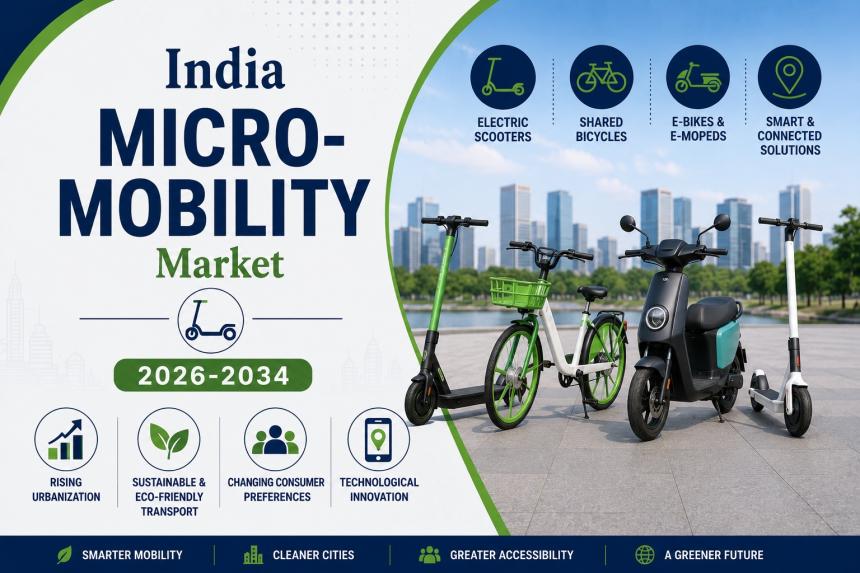
India Micro-Mobility Market Outlook
The India micro‑mobility market size is expanding rapidly, driven by accelerating urbanization, worsening traffic congestion, and rising environmental awareness among urban populations. The market is shifting from private vehicle ownership and public transit reliance toward flexible, shared, and sustainable short‑distance commuting solutions, collectively reshaping how Indian urbanites navigate crowded metropolitan streets.
As cities prioritise green transportation agendas and integrate micro‑mobility within broader public transit systems, the market is evolving into a vital component of India's urban transportation ecosystem, positively influencing the micro mobility India market size across all segments.
Market Snapshot
- Market Size (2025): USD 2.53 Billion
- Forecast Market Size (2034): USD 9.44 Billion
- CAGR (2026–2034): 14.04%
- Leading Type: Bicycles — 62.4% share (2025)
- Leading Propulsion Type: Manual — 66.7% share (2025)
- Leading Sharing Type: Dock‑less — 54.5% share (2025)
- Leading Speed: Less than 25 Kmph — 96.2% share (2025)
- Leading Age Group: 15‑34 — 67.8% share (2025)
- Leading Ownership: Business‑To‑Consumer — 56.5% share (2025)
- Leading Region: South India — 32.2% share (2025)
- Key Growth Drivers: Accelerating urbanization, traffic congestion, environmental awareness, government sustainable mobility policies, smart city development
India Micro‑Mobility Market Key Drivers
Accelerating Urbanization and Traffic Congestion:
India's micro‑mobility market is expanding rapidly, driven by accelerating urbanization, worsening traffic congestion, and rising environmental awareness among urban populations. The market spans a diverse range of vehicles including bicycles, e‑scooters, and e‑bikes deployed across personal ownership and shared‑use models.
Government Sustainable Mobility Policies:
Supportive government policies promoting sustainable last‑mile transportation, growing integration of shared mobility platforms with public transit networks, and a large young demographic increasingly embracing flexible commuting options are collectively reinforcing the India micro‑mobility market share across metropolitan and tier‑two cities. In March 2024, the Government of India launched the Electric Mobility Promotion Scheme (EMPS 2024).
Environmental Awareness and Cost‑Consciousness:
Rapid urbanization has intensified demand for flexible, low‑emission commuting alternatives, particularly among cost‑conscious young professionals and students. The less than 25 Kmph segment dominates with a share of 96.2% in 2025, aligning with urban traffic realities, regulatory frameworks, and rider safety preferences in India's congested metropolitan environments.
Digital Platform Proliferation:
The proliferation of digital platforms enabling seamless vehicle access has created a conducive growth environment. The 15‑34 age group leads with a share of 67.8% in 2025, reflecting younger consumers' openness to sustainable, technology‑enabled mobility and active usage of app‑based shared vehicle platforms.
India Micro‑Mobility Market Emerging Trends
Growing Adoption of Shared Mobility Platforms:
Dock‑less holds the largest market share of 54.5% in 2025, valued for its operational flexibility and user convenience in locating and returning vehicles across any permissible urban location. The integration of shared mobility platforms with public transit networks is reinforcing market growth.
Electric Mobility Transition:
The Electric Mobility Promotion Scheme (EMPS 2024) is accelerating adoption of electric two‑ and three‑wheelers. India's micro‑mobility sector spans e‑scooters and e‑bikes deployed across personal ownership and shared‑use models.
South India Regional Leadership:
South India dominates the market with a share of 32.2% in 2025, supported by progressive state‑level policies, high urban density, and active smart city infrastructure development.
India Micro‑Mobility Market Challenges
Despite robust momentum, the India micro‑mobility market faces persistent structural headwinds:
- Infrastructure Gaps: Inadequate dedicated cycling infrastructure and charging stations for e‑scooters limit market expansion in many cities
- Regulatory Fragmentation: Variations in state‑level policies and regulations for shared mobility create operational complexity for platform operators
- Safety Concerns: Lack of dedicated cycling lanes and road safety awareness affects rider confidence and adoption rates
- Fleet Maintenance Costs: High maintenance costs for shared e‑scooter fleets affect profitability for platform operators
Evaluate Market Opportunity with the Business Sample Report
India Micro‑Mobility Market Segment Insights
By Type
- Bicycles — 62.4% (affordability, cultural familiarity, short‑distance commuting)
- E‑Scooters — growing
- E‑Bikes — emerging
By Propulsion Type
- Manual — 66.7% (low‑cost, maintenance‑free, no charging infrastructure)
- Electric — growing
By Sharing Type
- Dock‑less — 54.5% (operational flexibility, user convenience)
- Station‑Based
By Speed
- Less than 25 Kmph — 96.2% (urban traffic realities, regulatory frameworks, rider safety)
- 25‑50 Kmph
- Above 50 Kmph
By Age Group
- 15‑34 — 67.8% (younger consumers, technology‑enabled mobility, app‑based platforms)
- 35‑54
- Above 55
By Ownership
- Business‑To‑Consumer — 56.5% (personal vehicles, daily commuting)
- Business‑To‑Business — growing
Regional Insights
- South India — 32.2% (progressive state policies, high urban density, smart city infrastructure)
- West India
- North India
- East India
Competitive Landscape
The India micro‑mobility market features a competitive mix of domestic operators and international players offering bicycle and e‑scooter sharing services, fleet‑based ownership models, and integrated urban mobility platforms.
Investment Opportunities
- High‑Growth Segments: E‑scooters and e‑bikes represent the fastest‑growing categories, driven by government incentives and environmental awareness. Dock‑less sharing platforms offering operational flexibility present significant growth opportunities.
- Geographic Expansion: Tier‑2 cities and emerging urban centres represent key growth frontiers with rising congestion and limited public transit options. Smart city infrastructure development is broadening the addressable market.
- Venture & Strategic Investment: India's micro‑mobility market has attracted investment in shared mobility platforms, electric vehicle fleets, and integrated urban mobility solutions. Investment in dock‑less bicycle and e‑scooter sharing, charging infrastructure, and smart city partnerships represents high‑return strategic opportunities.
Discuss Your Requirements With an Analyst and Get Your Customized Market Report
Frequently Asked Questions (FAQ)
What is the India micro‑mobility market size in 2025?
The India micro‑mobility market was valued at USD 2.53 Billion in 2025, driven by accelerating urbanization, traffic congestion, and environmental awareness.
What is the projected market size by 2034?
The market is projected to reach USD 9.44 Billion by 2034, growing at a CAGR of 14.04% during 2026–2034.
Which type leads the market?
Bicycles dominate with a 62.4% share in 2025, driven by their affordability, cultural familiarity, and suitability for short‑distance commuting.
Which region dominates?
South India dominates with a 32.2% share in 2025, supported by progressive state‑level policies, high urban density, and active smart city infrastructure development.
What is the Electric Mobility Promotion Scheme (EMPS 2024)?
Launched in March 2024, EMPS 2024 aims to accelerate adoption of electric two‑ and three‑wheelers by providing financial incentives for eligible vehicles and strengthening the domestic EV ecosystem.
Conclusion
India's micro‑mobility market presents exceptional growth through 2034, underpinned by accelerating urbanization, environmental awareness, and supportive government policies.
Three transformational forces will reshape the market through 2034: electric mobility transition driven by government incentives; shared and dock‑less platforms expanding access to flexible commuting; and smart city infrastructure development integrating micro‑mobility with public transit networks.
Organisations that invest in shared mobility platforms, electric fleets, and smart city partnerships will capture the largest share of the USD 6.91 Billion incremental market generated through 2034.
Source: IMARC Group



What Information Should You Give a Tow Truck Dispatcher During a Roads...