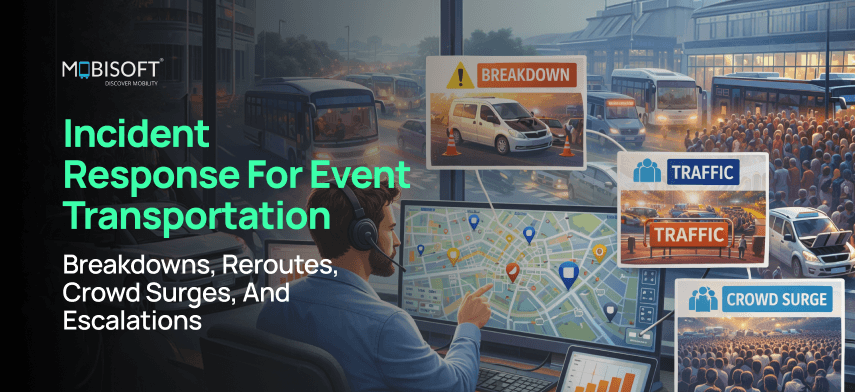

Incident Response for Event Transportation: Breakdowns, Reroutes, Crowd Surges, and Escalations
Executive Summary At large events, event transportation management incidents are not a matter of if. They are a matter of when. A vehicle breaks down mid-route during peak egress. A road closure makes a planned route unusable with five vehicles already on it. A session ends early, and thousands of people converge on two pickup zones at once. A situation escalates beyond the dispatcher's authority, and no one is sure who should take it from there. These scenarios play out across special event transportation environments at every scale, every season. The operations teams that manage them well are not the ones with the most experienced staff. They are the ones who built a response system before the event opened. Incident management in event transportation fails for one consistent reason. Not because teams lack capability, but because they lack structure. No pre-defined classification system Lack of documented response protocols No real-time fleet visibility No escalation matrix that tells the team who owns which decision and within what time frame This playbook addresses all four major incident categories in technical detail, covering how to handle transport disruptions during events, including vehicle breakdowns, route disruptions, crowd surges, and escalations that exceed dispatcher authority. For each, it presents the specific operational problem, the best-practice solution, and the technology capabilities that enable execution under event-day pressure. By the end of this playbook, any ops team, dispatcher, or venue manager should be able to build complete event transportation planning and management system before their next event. Learn how purpose-built event transportation software gives ops teams the tools to execute every protocol in this playbook. Why Incident Response Fails at Large Events? event transportation control center with transportation management system and real time fleet tracking dashboard The most common assumption about event transport services is that they are unpredictable. However, most of them are not. Vehicle breakdowns, crowd surges, and route disruptions are foreseeable categories of operational failure. The reason they cause disproportionate damage when they occur is not their unpredictability. It is the absence of efficient event transport solutions designed to handle them before they arrive. These are the event transportation challenges and solutions that every ops team must confront. Four structural gaps account for the majority of incident response failures at large events. Absence of Incident Classification System When every problem is treated as a unique situation, the dispatcher is making judgment calls under pressure with no consistent framework. There is no standard response to fall back on. Two dispatchers facing the same incident type will make different decisions. The same dispatcher will make different calls depending on how far into a long event day they are. Undocumented Response Protocols A dispatcher who knows an incident has occurred but has no defined response to execute is improvising. And improvisation under pressure produces inconsistent outcomes and slower resolution times than a pre-defined protocol, even an imperfect one. Limited Real-Time Operational Visibility A command centre that learns about a breakdown from a driver phone call, a crowd surge from a zone supervisor radio message, or a route closure from a passenger complaint is always responding to conditions that developed minutes ago. By the time the response reaches the affected zone, the situation has already escalated further. Undefined Escalation Matrix When an incident exceeds the dispatcher's authority and there is no defined handoff path, the command centre stalls. The dispatcher either holds the incident too long, trying to resolve it independently, or escalates too early and pulls senior team members away from situations that genuinely require their involvement. Incident response does not fail because the team lacks capability. It fails because the system lacks structure. See how these structural gaps translate into real operational and financial damage in our breakdown of event transportation challenges. VIP event shuttle transportation powered by fleet management software and real time tracking Incident Classification Framework Before any response protocol can be built, the operations team needs a classification system that tells the dispatcher what they are dealing with within the first 10 seconds of an incident being flagged. Classification determines who owns the response, what the resolution target is, and whether the incident stays at the dispatcher level or moves up the escalation path. This is the backbone for building transportation management systems for large events effectively. Without one, every incident starts with an assessment that takes time the dispatcher does not have. With one, every incident starts with an answer.
Executive Summary
At large events, event transportation management incidents are not a matter of if. They are a matter of when. A vehicle breaks down mid-route during peak egress. A road closure makes a planned route unusable with five vehicles already on it. A session ends early, and thousands of people converge on two pickup zones at once. A situation escalates beyond the dispatcher's authority, and no one is sure who should take it from there.
These scenarios play out across special event transportation environments at every scale, every season. The operations teams that manage them well are not the ones with the most experienced staff. They are the ones who built a response system before the event opened.
Incident management in event transportation fails for one consistent reason. Not because teams lack capability, but because they lack structure.
- No pre-defined classification system
- Lack of documented response protocols
- No real-time fleet visibility
- No escalation matrix that tells the team who owns which decision and within what time frame
This playbook addresses all four major incident categories in technical detail, covering how to handle transport disruptions during events, including vehicle breakdowns, route disruptions, crowd surges, and escalations that exceed dispatcher authority. For each, it presents the specific operational problem, the best-practice solution, and the technology capabilities that enable execution under event-day pressure.
By the end of this playbook, any ops team, dispatcher, or venue manager should be able to build complete event transportation planning and management system before their next event.
Learn how purpose-built event transportation software gives ops teams the tools to execute every protocol in this playbook.
Why Incident Response Fails at Large Events?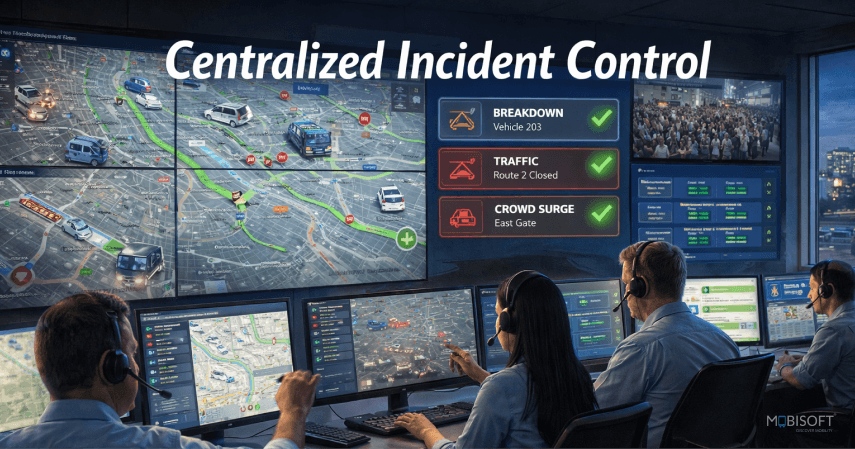
The most common assumption about event transport services is that they are unpredictable. However, most of them are not. Vehicle breakdowns, crowd surges, and route disruptions are foreseeable categories of operational failure. The reason they cause disproportionate damage when they occur is not their unpredictability. It is the absence of efficient event transport solutions designed to handle them before they arrive.
These are the event transportation challenges and solutions that every ops team must confront. Four structural gaps account for the majority of incident response failures at large events.
Absence of Incident Classification SystemWhen every problem is treated as a unique situation, the dispatcher is making judgment calls under pressure with no consistent framework. There is no standard response to fall back on. Two dispatchers facing the same incident type will make different decisions. The same dispatcher will make different calls depending on how far into a long event day they are.
Undocumented Response ProtocolsA dispatcher who knows an incident has occurred but has no defined response to execute is improvising. And improvisation under pressure produces inconsistent outcomes and slower resolution times than a pre-defined protocol, even an imperfect one.
Limited Real-Time Operational VisibilityA command centre that learns about a breakdown from a driver phone call, a crowd surge from a zone supervisor radio message, or a route closure from a passenger complaint is always responding to conditions that developed minutes ago. By the time the response reaches the affected zone, the situation has already escalated further.
Undefined Escalation MatrixWhen an incident exceeds the dispatcher's authority and there is no defined handoff path, the command centre stalls. The dispatcher either holds the incident too long, trying to resolve it independently, or escalates too early and pulls senior team members away from situations that genuinely require their involvement.
Incident response does not fail because the team lacks capability. It fails because the system lacks structure. See how these structural gaps translate into real operational and financial damage in our breakdown of event transportation challenges.
Before any response protocol can be built, the operations team needs a classification system that tells the dispatcher what they are dealing with within the first 10 seconds of an incident being flagged. Classification determines who owns the response, what the resolution target is, and whether the incident stays at the dispatcher level or moves up the escalation path.
This is the backbone for building transportation management systems for large events effectively. Without one, every incident starts with an assessment that takes time the dispatcher does not have. With one, every incident starts with an answer.
Read more : Incident Response for Event Transportation: Breakdowns, Reroutes, Crowd Surges, and Escalations


Choosing the Right Orthodontic Retainers for Long-Lasting Results

BRYO Appetite Control Coffee: Complete Guide to Ingredients, Benefits,...
BRYO Appetite Control Coffee is a functional coffee blend designed to support appetite man...
Follow Hitclub at Sites Explore Updates and Stay Connected Onl
Follow Hitclub at Sites Explore Updates and Stay Connected Onl


Why Businesses in Panama City Beach Prefer Custom Acrylic Signs for In...