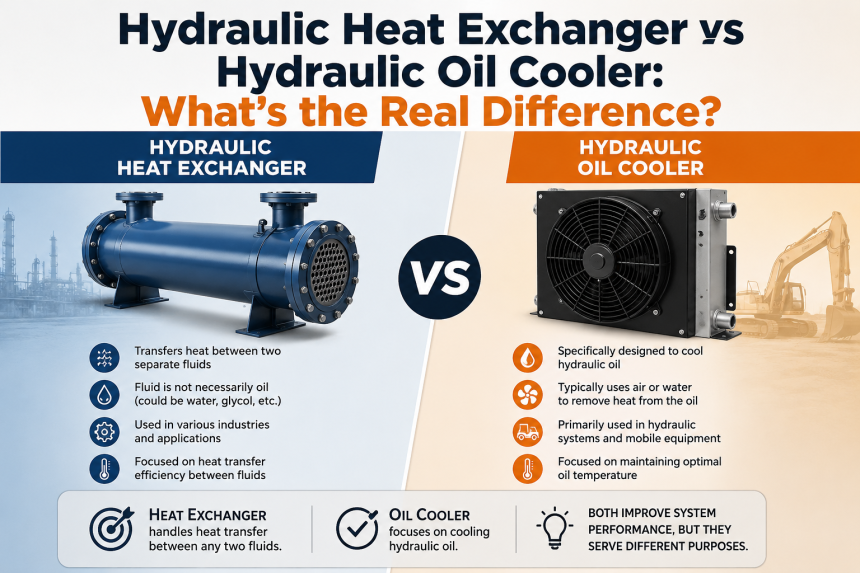

Hydraulic Heat Exchanger vs Hydraulic Oil Cooler: What’s the Real Difference?
Understand the real difference between Hydraulic Heat Exchanger and Hydraulic Oil Cooler systems. Compare specs, risks, and supplier factors now.
Hydraulic systems fail quietly at first. The temperature of oil increases from 58°C to 71°C, the seals start to become hardened, and then an equipment which had been working well for 14 months starts to shut down twice a week. This is the time when people start to consider both the Hydraulic Heat Exchanger and the Hydraulic Oil Cooler to be the same equipment.They are not.
Most procurement teams discover the difference after installation, not before purchase. That's expensive. Especially in industries running injection molding machines, hydraulic presses, CNC systems, or mobile equipment where a 9-hour shutdown can wipe out an entire production schedule.
And yet, many suppliers still blur the terms deliberately because it helps them sell whatever stock they already have sitting in the warehouse.
The Technical Difference Most Buyers MissThe Hydraulic Oil Cooler Heat Exchanger dissipates heat energy from hydraulic oil to some other substance, which may be air or water. The Hydraulic Oil Cooler is just a specific type of heat exchanger, though not all heat exchangers are necessarily oil coolers.
In other words, the distinction lies in the application, coolant, pressures involved, and the amount of heat energy handled.
Air-Cooled Hydraulic Oil CoolersThese systems use ambient air and a fan assembly to reduce oil temperature. They're common in mobile hydraulics, construction equipment, and compact industrial units.
Typical operating range:
- Flow rates: 10–600 LPM
- Pressure capacity: up to 26 bar
- Cooling efficiency drop: nearly 18% during peak Indian summer conditions above 42°C
That last detail matters more than buyers think.
A supplier quoting cooling performance without specifying ambient temperature is hiding useful information. Cooling capacity at 25°C and 44°C are two different realities entirely.
Water-Cooled Hydraulic Heat ExchangersThese are used where stable temperature control matters more than portability. Steel plants, plastic processing lines, and continuous-duty industrial machinery rely heavily on them.
Key specifications:
- Shell-and-tube or brazed plate construction
- Heat transfer efficiency often 30–40% higher than air-cooled units
- Better for continuous 24/7 operations
Here's the overlooked issue: water quality.
Hard water scaling inside tubes can reduce efficiency by 15% within months if filtration is poor. Nobody mentions that during quotations because maintenance responsibility becomes a gray area later.
The Spec Detail Most Buyers SkipOil viscosity at operating temperature.
Not pump size. Not port dimensions.
If hydraulic oil becomes too thin at high temperatures, internal leakage rises sharply. A system losing just 6–8% volumetric efficiency can increase energy consumption noticeably over a full production quarter.
That's why experienced Hydraulic Heat Exchanger Manufacturers ask about:
- Duty cycle
- Ambient conditions
- Oil grade
- Return line pressure
- Peak thermal load
Cheap suppliers ask only one thing: "What size do you want?"
5 Criteria to Evaluate Any Supplier Before You Buy1. Ask for Thermal Calculation SheetsA real supplier provides heat rejection calculations.
A bad answer sounds like:
"This model works for most machines."
No serious industrial buyer should accept that.
2. Check Pressure Testing StandardsMost quality Hydraulic Oil Cooler Manufacturers in India hydro-test units before dispatch. Typical testing pressures are between 1.5 times to 2 times the working pressure.
Suppliers who don’t provide testing values are usually hiding something.
3. Check Material compatibilityThe corrosion resistance and thermal properties vary for metals such as copper pipes, aluminum cores, and stainless steel sheets.
Despite this, some customers accept quotations without verifying their compatibility with hydraulic oil additives or the water composition locally.
That's avoidable negligence.
4. Inspect Spare AvailabilityFan motors fail. Gaskets wear out. Tubes clog.
A supplier exporting to 31 countries but unable to provide replacement parts within 72 hours is creating operational risk, not solving it.
5. Ask About Actual Lead Times, Not Sales PromisesMost buyers underestimate how difficult fabrication scheduling becomes during high-demand industrial quarters between September and January.
Some Hydraulic Oil Cooler Heat Exchanger Manufacturers quote 10-day dispatches while still sourcing raw material after PO confirmation. That's not manufacturing. That's trading with optimistic timelines.
Why the Right Cooling System Protects MarginsReduced Hydraulic Oil DegradationHydraulic oil life drops sharply above 65°C. According to industrial maintenance studies, every 10°C increase beyond recommended operating temperature can cut oil life nearly in half.
That directly affects maintenance budgets.
Lower Seal and Hose Failure RatesExcessive heat hardens seals and weakens hose compounds faster than most maintenance teams expect. Replacing hoses during scheduled shutdowns is manageable. Emergency rupture during production isn't.
Improved Machine EfficiencyStable oil temperature keeps viscosity consistent. Which means smoother actuator movement, reduced internal leakage, and better pressure stability.
Especially important in precision manufacturing environments.
Fewer Unplanned ShutdownsOne unexpected thermal shutdown in a production line handling automotive components can delay dispatch commitments across multiple vendors.
Nobody calculates that loss during purchase discussions. They should.
Better Energy Consumption ControlOverheated systems force pumps and motors to work harder. Even a modest efficiency loss compounds over thousands of operating hours annually.
Longer Component LifespanPumps, valves, and servo systems last longer under controlled thermal conditions. That matters because imported hydraulic components now regularly face procurement delays of 8–14 weeks.
Availability Across India and What Buyers Should Know About Supply ChainsIndia’s industrial cooling demand has shifted heavily toward localized sourcing since 2021. Since there have been uncertainties with regard to the lead times because of logistics issues, the buyers who used to depend on the imports are now looking for local manufacturers of hydraulic oil coolers and hydraulic heat exchangers from India.
Some important manufacturing locations in northern India include Faridabad, Pune, Ahmedabad, Rajkot, and Chennai.
Here's the supply chain reality most first-time buyers miss: freight damage on finned coolers is more common than suppliers admit. Poor packaging bends fins during interstate transport, which immediately affects airflow efficiency.
That’s one reason experienced buyers ask for dispatch photos before shipment.
Many Hydraulic Oil Cooler Heat Exchanger Suppliers in India now offer customized mounting layouts and port configurations because retrofitting imported systems into Indian factory layouts often creates alignment issues.
About N.T AssociatesAt N.T Associates, we’ve worked with OEM buyers, maintenance contractors, and industrial procurement teams that cannot afford inconsistent cooling performance. We manufacture and supply Hydraulic Heat Exchanger, Hydraulic Oil Cooler Heat Exchanger, and related hydraulic cooling systems for demanding industrial applications across India and export markets.
We learned early that buyers care less about brochures and more about repeat reliability after 18 months of operation.
In 2021, we made an adjustment to one of our aluminum core sourcing standards after we got multiple complaints from our customers who were situated in coastal areas. Corrosion there was happening at a much higher rate than we had predicted.
We adjusted the specification instead of arguing with customers. That's how long-term industrial supply relationships survive.
Our team focuses on thermal efficiency, pressure-tested assemblies, practical lead times, and after-sales support that procurement teams can actually rely on.
Send the Right Details Before Requesting a QuoteIf you're comparing Hydraulic Oil Cooler Manufacturers in India or evaluating Hydraulic Heat Exchanger Manufacturers, send technical details first — not just a reference image.
We typically respond to industrial inquiries within one business day.
For specific cooling solutions, we will need the following:
- Flow rate (LPM)
- Working pressure
- Maximum oil temp cap
- Ambient temperature conditions
- Application type
- Dimensions of the cooler (for replacements)
The MOQ will vary with the level of customization involved. Standard industrial models will be faster to deliver than custom-built models.
ConclusionThere is more than just terminology behind the distinction between Hydraulic Heat Exchanger and Hydraulic Oil Cooler. Trade-offs come in terms of cooling efficiency, maintenance costs, risk of downtime, and dependable operations over the life of the machine. When buyers focus solely on price, they typically experience a trade-off of breakdowns, delayed replacements, and out of control operating temperatures. Upgrading thermal management will be essential in the coming years to support the increasingly demanding cycles of production from the hydraulic systems employed in the Indian industries.
Here is another blog you might be interested in.
Top Signs Your Hydraulic Oil Cooler Heat Exchanger Needs Attention
FAQsAre Hydraulic Heat Exchangers and Hydraulic Oil Coolers the same?Not quite. A Hydraulic Oil Cooler designed specifically to remove heat from hydraulic oil, whereas Hydraulic Heat Exchangers may handle more than one thermal process involving multiple fluids. The gap is in the lexicon of the buyer, and the application drives the differentiation.
Which is better, air systems, or water systems?Air systems are more optimal than water systems when it comes to mobilized equipment and installations that do not have easy access to water.Water-cooled units handle continuous-duty industrial loads better. The caveat is maintenance — water quality management becomes critical with shell-and-tube systems.
What should I ask Hydraulic Oil Cooler Suppliers before ordering?Don't forget to ask for thermodynamic calculations, pressure ratings, testing standards, material specifications, and the availability of spares. A strong indicator of concern is if a vendor brushes off basic technical engagement requests and asks for pricing first.
Why do some Hydraulic Oil Cooler Heat Exchanger Manufacturers offer such reduced pricing?The reasons may include thinner core, lower quality aluminum, weaker fan motor strength, or skipping of testing processes. The defect does not surface until six months down the line, when the product is being used continuously.
Are Indian-manufactured Hydraulic Cooling Systems export quality?Undoubtedly, many of the Hydraulic Heat Exchanger Suppliers from India have started producing equipment that meets the international standards in the industry. It would be better for one to conduct thorough research and verify testing certificates and export documents rather than taking anything for granted.
What is the lifespan of a Hydraulic Oil Cooler?Industial coolers operate from 5 to 10 years if the operating environment and process conditions remain predictable and stable. But if the cooling water becomes contaminated, or if the oil experience accelerated changes, or if the cooler undergoes too much structural vibration, the life of the cooler is severely wrenched.
Do the Hydraulic Heat Exchanger Manufacturers take custom orders?The majority of the well-established Hydraulic Heat Exchanger Manufacturers, and especially the Hydraulic Oil Cooler Heat Exchanger Suppliers in India, provide custom dimensions for the, arrangements and layout of the mounts, and placement of the attachments of the units designed for Original Equipment Manufacturers, as well as the units designed and manufactured for those systems.




السِّلْمُ الاجْتِمَاعِيُّ: مَسْؤُولِيَّةٌ تَجْمَعُنَا وَأَمَانٌ يَحْمِ...