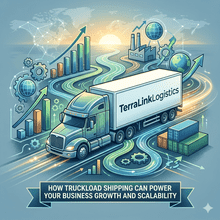

How Truckload Shipping Can Power Your Business Growth and Scalability
Learn how truckload shipping drives business growth with faster transit, lower costs per unit, and reduced damage risk. Discover when to shift from LTL to full truckload for scalable, efficient logistics in 2026.
In the modern global economy, the movement of goods is the literal heartbeat of commerce. For businesses looking to transition from local operations to national dominance, the logistics strategy they employ is often the deciding factor between stagnation and success. One of the most potent tools in a logistics manager’s arsenal is a robust understanding of how truckload shipping can power a company's entire supply chain. While many startups begin with small parcel deliveries or occasional shipments, reaching a certain volume necessitates a shift toward more sophisticated freight methods.
According to technical definitions found on Wikipedia, truckload shipping is a mode of freight transport where a semi-trailer is filled entirely with cargo from one specific customer. Unlike other methods where space is shared, this "full" approach offers a dedicated lane for your products, moving them directly from the point of origin to the final destination without the delays of intermediate stops. This directness is not just a matter of convenience; it is a strategic advantage that impacts everything from your bottom line to your brand reputation.
Section 1: The Mechanical Advantages of Full Truckload Logistics
To understand why a dedicated trailer is a game-changer, one must look at the mechanics of the road. In a standard 53-foot dry van, you have the capacity to move approximately 24 to 26 pallets of goods, weighing up to 45,000 pounds. When you utilize the entirety of this space, you are essentially buying the carrier's time and undivided attention.
Speed and Transit Consistency
The most immediate benefit of this method is the elimination of "hub-and-spoke" delays. In less-than-truckload (LTL) scenarios, a truck might stop at several terminals to unload and reload different shipments. Each stop is a potential point of failure where a package could be misplaced, delayed by weather, or damaged during handling. By contrast, truckload shipping provides a straight line of travel. This predictability allows businesses to provide accurate delivery windows to their clients, a necessity in an era where "Amazon-prime" expectations have shifted the standard for all B2B and B2C interactions.
Reduced Risk of Damage
Every time a piece of freight is moved, the risk of damage increases. In a shared trailer, your goods are packed alongside items from other companies, which may not be compatible in terms of weight or fragility. When you control the entire trailer, you control the stacking, the bracing, and the security of the load. This leads to fewer insurance claims, less wasted inventory, and higher customer satisfaction.
While large-scale movements are the focus here, it is important to remember that logistics is a spectrum. For smaller batches or specialized needs, companies like TerraLinkLogistics offers LTL freight shipping services to ensure that businesses of all sizes have access to professional transport solutions. However, once your volume hits that "sweet spot" of 10 or more pallets, the transition to full truckload often becomes the more economical and efficient choice.
Section 2: Economic Efficiency and Scaling Your Bottom Line
Professional insights from Forbes emphasize that logistics are at the core of a successful entrepreneur's journey. Managing costs is not just about finding the cheapest rate; it is about finding the highest value per dollar spent. Truckload shipping offers a unique cost structure that favors high-volume growth.
Cost Per Unit Optimization
When you book a full truck, you pay for the lane (the distance between point A and point B), rather than a price based on the weight and class of individual items. This means that as you fill the trailer more efficiently, your cost per unit drops significantly. For a manufacturer, this creates a "bulk discount" effect on their own shipping costs. Instead of sending five separate LTL shipments throughout the week, consolidating them into one full truckload can result in savings of 20% to 30% on freight spend.
Navigating Market Volatility in 2026
As we look at current market research reported by Google News, the trucking industry in 2026 is moving into a supply-driven tightening phase. With rising fuel costs and a leaner carrier base, spot rates are becoming more volatile. Businesses that rely on truckload shipping often have more leverage to negotiate long-term contract rates with carriers. These contracts provide price stability, allowing finance departments to budget with precision even when the external market is in flux.
Section 3: Strategic Integration and Sustainability
In the current corporate climate, logistics is no longer just a "back-office" function; it is a pillar of a company's Environmental, Social, and Governance (ESG) strategy. Truckload shipping plays a surprising role in sustainability by maximizing the "ton-mile" efficiency of every vehicle on the road.
Environmental Impact
A truck running at half-capacity uses nearly as much fuel as one running at full capacity. By consolidating shipments into full loads, companies reduce the total number of trucks required to move the same amount of inventory. This leads to a smaller carbon footprint per item delivered. Furthermore, the direct routing of these shipments reduces "empty miles," which are the miles a truck travels without a load. In a world where consumers are increasingly scrutinizing the supply chains of the brands they support, being able to demonstrate a lean, efficient logistics network is a powerful marketing tool.
Enhancing the Customer Experience
Beyond the numbers, the reliability of your shipping method defines your brand's reliability. When a customer knows that their order will arrive on Tuesday because it is on a dedicated truck, their trust in your business grows. This reliability allows for "Just-in-Time" (JIT) inventory management, where your clients don't need to warehouse massive amounts of stock because they trust your delivery schedule. This creates a symbiotic relationship where your logistics efficiency helps your customers save money on their own overhead.
Conclusion: Driving the Future of Your Enterprise
The decision to utilize truckload shipping is a signal that a business is ready to compete at the highest level. It represents a move away from reactive, piecemeal shipping toward a proactive, strategic supply chain. By harnessing the speed, safety, and economic advantages of a dedicated trailer, you empower your business to scale without the friction of logistical bottlenecks.

Is It Legal to Get an Upwork Account in the US? – The Complete Expert...
Is It Legal to Get an Upwork Account in the US? – The Complete Expert Guide Freelancing h...



Is Getting an Upwork Account Safe Online?
Is Getting an Upwork Account Safe Online? A Complete Expert Guide for Freelancers and Cli...