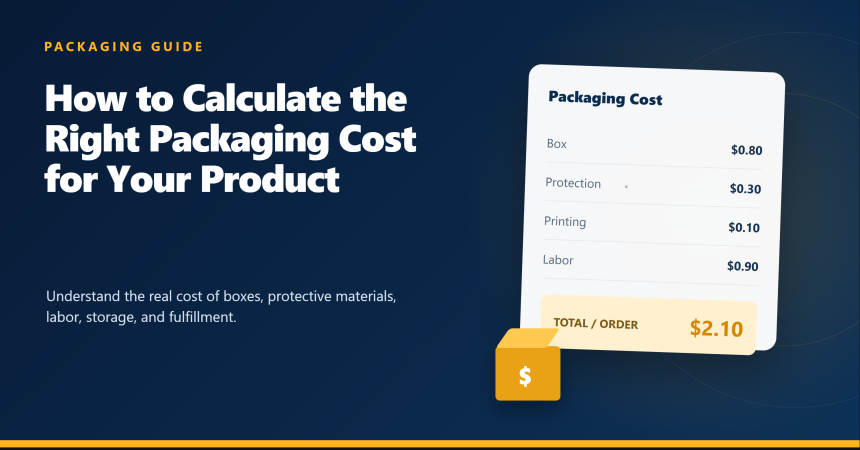

How to Calculate the Right Packaging Cost for Your Product
Premium custom boxes for modern brands. Enjoy free design, 3D mockups, FSC-certified eco materials and fast USA delivery. Wholesale pricing with zero hidden fees.
Packaging is an important business expense, but calculating its real cost involves more than looking at the price of a box. A business might pay $1 for a box and assume packaging costs $1 per order. In reality, the complete cost can include protective materials, printing, labels, labor, storage, and other fulfillment expenses.
Understanding the true cost of packaging helps businesses make better purchasing decisions, protect their profit margins, and identify areas where they can improve efficiency.
Start With the Box CostThe easiest part to calculate is the packaging box itself.
For example, if a business purchases 1,000 boxes for $800, the cost is:
$800 ÷ 1,000 = $0.80 per box
However, the box is only one part of the total packaging cost.
Businesses may also need tissue paper, inserts, protective material, labels, stickers, or other supplies.
Add Protective MaterialsDifferent products require different levels of protection.
Fragile products might need cushioning or dividers, while other products may only require a simple protective layer.
For example, if a business spends $30 on protective material that is enough for 100 orders:
$30 ÷ 100 = $0.30 per order
The packaging cost is now:
$0.80 + $0.30 = $1.10 per order
Tracking these expenses helps businesses understand where their packaging budget is actually going.
Include Printed MaterialsPrinted inserts, thank-you cards, labels, stickers, and other branded materials can add to the cost of every package.
If 1,000 printed inserts cost $100, each insert costs:
$100 ÷ 1,000 = $0.10
While ten cents may seem insignificant, these small expenses become meaningful when a business ships thousands of orders.
Consider LaborPackaging also takes time.
If an employee spends several minutes preparing each order, that time has a cost.
For example, an employee earning $18 per hour costs approximately $0.90 for three minutes of work.
That means a packaging solution with a slightly more expensive box could actually be cheaper overall if it significantly reduces packing time.
This is why businesses should consider total fulfillment cost, rather than simply comparing box prices.
Think About StoragePackaging materials need to be stored before they are used.
Large quantities of boxes can take up considerable warehouse or storage space. Businesses should therefore consider how much inventory they need and how frequently they should reorder.
Ordering a large quantity might reduce the unit price, but storing thousands of boxes may not always be practical.
The right balance depends on order volume, available space, supplier pricing, and cash flow.
Compare the Complete CostImagine two packaging options.
Option A
- Box: $0.80
- Protective material: $0.30
- Printed insert: $0.10
- Labor: $0.90
Total: $2.10
Option B
- Box: $1.10
- Protective material: $0.15
- Printed insert: $0.10
- Labor: $0.50
Total: $1.85
Although Option A has the cheaper box, Option B has the lower overall packaging cost.
This is why businesses shouldn't choose packaging based solely on the unit price of the box.
Consider WastePackaging waste can quietly increase costs.
A box that's significantly larger than the product may require additional filling material. On the other hand, packaging that's too small can increase the risk of damage.
Product damage can be much more expensive than the packaging itself.
A damaged shipment could result in replacement costs, refunds, return shipping, additional customer service, and a poor customer experience.
Choosing an appropriate box size can therefore help reduce both material waste and unnecessary product damage.
Packaging Should Match the ProductThe right packaging cost depends partly on what you're selling.
A premium product may benefit from higher-quality presentation, while a low-margin product may require a more cost-efficient approach.
Businesses should consider:
- Product value
- Product weight
- Fragility
- Shipping distance
- Customer expectations
- Order volume
- Brand positioning
For businesses looking for packaging options in a specific market, Custom Packaging Boxes in New York can also be explored as part of a broader packaging strategy for customers and businesses in the area.
The goal isn't necessarily to spend as little as possible. The goal is to find packaging that provides the right combination of protection, presentation, and cost.
Calculate Packaging Cost Per OrderA simple formula can help businesses track their expenses:
Total Packaging Cost = Box + Protection + Printing + Labels + Labor + Other Packaging Expenses
Then:
Packaging Cost Per Order = Total Packaging Expenses ÷ Number of Orders
Once this number is known, it can be compared against the product's selling price and profit margin.
For example, if a product sells for $50 and packaging costs $2, packaging represents:
$2 ÷ $50 × 100 = 4%
This gives the business a useful measurement when reviewing its pricing and fulfillment strategy.
Review Your Packaging RegularlyPackaging costs aren't necessarily fixed.
Supplier prices can change, order volumes can increase, and businesses may discover more efficient ways to pack products.
Reviewing packaging expenses periodically can uncover opportunities to save money.
Ask:
- Can we reduce unnecessary empty space?
- Can we use fewer protective materials?
- Can employees pack orders faster?
- Are we using the right box sizes?
- Would a different packaging design reduce waste?
- Is ordering larger quantities actually beneficial?
Even a small improvement per order can become significant when multiplied across thousands of shipments.
Final ThoughtsThe cheapest box isn't always the cheapest packaging solution.
A slightly more expensive box might reduce protective materials, speed up fulfillment, improve product protection, or reduce waste.
That's why businesses should evaluate the complete cost per package rather than focusing on the price of the box alone.
Once packaging costs are properly measured, businesses can make better decisions about box sizes, materials, suppliers, and fulfillment.
Good packaging isn't simply about spending less. It's about getting the best overall result from every dollar spent.