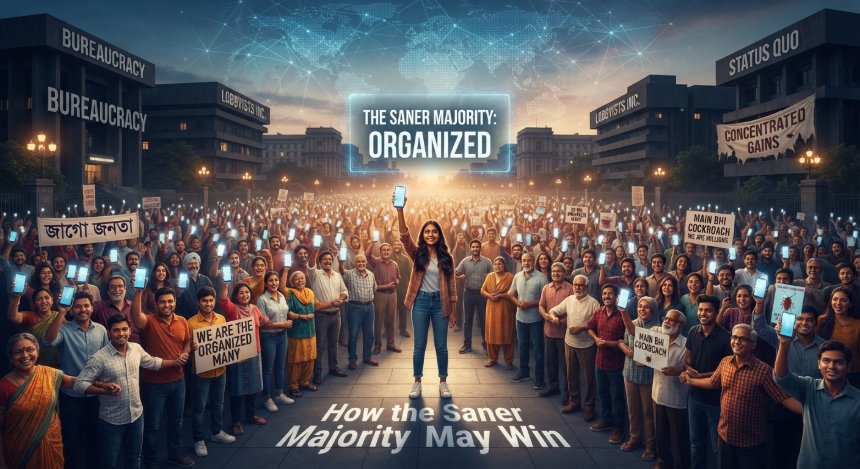

How the Saner Majority May Win
For generations, the vast majority of decent, hardworking people have felt powerless against the concentrated influence of special interest groups and corrupt bureaucracies. Economist Mancur Olson explained this through political physics: small, motivated minorities easily organize to capture immense gains, while the public remains asleep to small, dispersed losses. However, the digital age and a new generation of hyper-connected global citizens are fundamentally flipping this equation. By reducing the cost of mobilization to a single digital post, the once-isolated public finally has the tools to dismantle institutional capture, stand against global oppression, and become the organized many.
أَعُوذُ بِاللّٰهِ مِنَ الشَّيْطَانِ الرَّجِيمِ
بِسۡمِ ٱللهِ ٱلرَّحۡمَـٰنِ ٱلرَّحِيمِ
In the name of ALLAH, the Most Gracious, the Most Merciful
How the Saner Majority May Win
Most people are decent—they work, raise their children, pay their taxes, and navigate life with a baseline level of honesty. Yet, in stable democracies across the world, the economic and political landscape is repeatedly shaped against their interests. This frustrating paradox was mapped out in 1965 by the economist Mancur Olson in his seminal work, The Logic of Collective Action. Olson demonstrated that a small, highly motivated minority can consistently defeat a disorganized majority, not because it is morally right, but because it shows up. The core reason a virtuous majority routinely loses to a powerful minority is a structural law of political physics: concentrated gains organize, while dispersed losses sleep.
Olson’s premise is elegant but devastating. Imagine a targeted government subsidy or regulatory loophole worth millions of dollars to a tiny handful of corporations. To fund this, every individual taxpayer is fleeced a negligible amount—perhaps the price of a single cup of coffee. When we ask who will organize over this policy, the math of human motivation dictates the outcome. The corporate executives, for whom the policy represents immense wealth, will aggressively hire lobbyists, fund political campaigns, and dominate legislative hearings. Conversely, the millions of taxpayers, each losing only the price of a coffee, will do absolutely nothing. Nobody marches in the streets over loose change. The cost of fighting the policy vastly outweighs the individual cost of enduring it.
This imbalance is severely compounded by the "free-rider problem." In any large group, individuals quickly realize that if a collective goal is achieved, they will benefit whether they personally contributed or not. Consequently, everyone hopes someone else will shoulder the burden of organizing, resulting in widespread inertia. Look around today, and you will see this logic playing out in every corner of governance. The grant-funded non-governmental organization (NGO), the entrenched bureaucracy defending its annual budget, the activist network with full-time staff, and the corporate lobby with an office adjacent to the ministry—each has immense, concentrated incentives to demand one more rule, one more program, or one more subsidy. The working families footing the bill lose only a fraction of their income per program, and their focus is entirely consumed by the demanding logistics of daily life. Vice effectively organizes itself because vice pays its organizers handsomely. Virtue, by contrast, languishes because its rewards are diffused broadly across an entire society. No single person captures enough of the benefit to justify the immense cost of organizing its defense.
Olson later observed the grim, long-term consequences of this dynamic in a subsequent thesis on national stagnation. In a stable nation, special interest coalitions accumulate over decades like barnacles on a ship. Each group fiercely defends its acquired privileges, subsidies, and regulations until the entire national economy stiffens and economic growth stalls. It is a historical telling point that Germany and Japan experienced miraculous economic booms after World War II largely because total defeat had completely swept away these deeply entrenched coalitions, allowing their societies to build and innovate unburdened by institutional capture.
To break this cycle of stagnation and exploitation, Olson’s own logic provides the blueprint for a counter-strategy. First, the dispersed costs must be made visible. The abstract, unnoticed "cup of coffee" taken from taxpayers must be translated into a transparent, collective bill that everyone can read and understand. Truth-telling and independent journalism serve to expose exactly how much is being quietly drained from the public to feed insatiable interest groups. Second, the virtuous majority must be given a reason to show up that extends beyond a dry sense of civic duty. The movements that endure are those that offer their members genuine community, shared identity, meaningful careers, and social joy. Third, reformers must realize that the entire majority does not need to mobilize simultaneously. A highly disciplined, deeply committed minority is entirely sufficient to shift the cultural and political momentum. When a dedicated core group establishes a clear direction, the broader public will follow once they see they are no longer fighting alone.
To prevent this energy from scattering, structure is paramount. This is the precise function of coordinating networks, such as a unified network of patriots across Western Civilization. Such structures do not exist to hand down rigid top-down orders, but to provide a shared vocabulary so citizens can name the specific mechanisms being used against them, and to coordinate actions so no local community has to fight the apparatus alone.
While Olson wrote in an era when organizing required physical meetings, slow postal correspondence, immense financial capital, and years of coordination, the digital age has fundamentally flipped the math of mobilization. Today, the cost of organizing has plummeted to the price of a single digital post, and the vanguard of this new paradigm is Generation Z. Born into an interconnected world, this generation instinctively understands that the monopoly on information has been shattered. The days when powerful minorities could quietly engineer backroom deals, hide data, and shadow the truth are coming to an end. Sunlight travels at the speed of light, and hyper-connectivity has turned the once-isolated majority into a self-aware global citizenry.
We see this structural shift unfolding in real-time through powerful contemporary digital movements. In Bangladesh, the July Revolution of 2024 demonstrated how decentralized digital coordination could completely bypass government-controlled traditional media. What began as a student-led protest against a discriminatory job quota system rapidly transformed into a nationwide anti-authoritarian mobilization. Utilizing platforms like WhatsApp, Facebook, and TikTok, millions of young people spontaneously organized, shared information, and overthrew an entrenched political regime that had spent decades insulating itself from public accountability.
Similarly, in India, the meteoric rise of the Cockroach Janta Party (CJP) highlights how digital satire can instantly morph into a massive political force. Sparked by tone-deaf remarks from authorities demeaning unemployed youth, the movement used artificial intelligence tools and internet memes to amass millions of followers online. Under the slogan "Main Bhi Cockroach" ("I am also a cockroach"), millions of young citizens reclaimed a term meant to marginalize them, transforming it into a badge of solidarity. The movement quickly transitioned off-screen, coordinating massive street protests to demand government accountability over examination paper leaks and systemic corruption.
These modern uprisings are not isolated incidents; they represent the template for the global citizen. If the forces of exploitation and bureaucratic capture operate across borders, then the defense of common decency must do the same. The ultimate purpose of this new organization is anchored in universal human values: decency, peace, and shared prosperity for all human beings across the globe. Being an organized global citizen means actively standing against oppression wherever it manifests. From economically starved communities to conflict-torn territories, decentralized networks allow the global majority to act as a collective immune system against institutional vice.
Olson’s timeless lesson—that the organized few beat the disorganized many—has not changed, but our capacity to fulfill it has. We now possess the global infrastructure to become a truly organized majority. By uniting a self-aware populace under the banner of humanity, peace, and universal prosperity, the decent people of the world can finally show up together, permanently shifting the balance of power from the hands of the self-serving few into the hands of the global many.




How much should you spend on a bridal bouquet?
You should allocate ₹3,500 to ₹7,500 for a professionally designed bridal bouquet, keeping...

Plant Inauguration Event Management in Delhi: Plan a Memorable Launch
An experienced plant inauguration event management in delhi partner can help US companies...