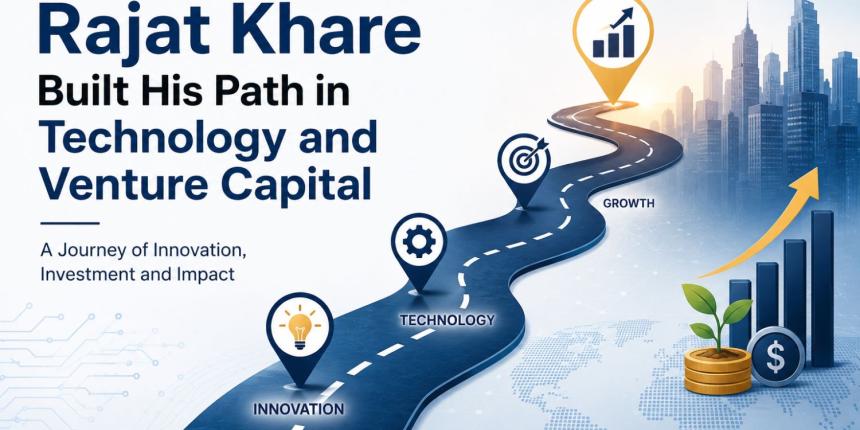

How Rajat Khare Built His Path in Technology and Venture Capital
Rajat Khare is the founder of Boundary Holding, a Luxembourg-based VC firm investing in deep-tech startups across AI, medtech, and cleantech.
Most people who end up in venture capital get there through finance. They learn capital markets, work at a bank or fund, and gradually move toward investing. Rajat Khare got there from the other direction entirely. His starting point was engineering, and that difference in background shows up clearly in how he thinks about where to put money and why.
Khare studied computer science at IIT Delhi, which for anyone unfamiliar is one of the most competitive engineering institutions in the world. Getting in is genuinely difficult and the program produces people who tend to be serious about technical depth rather than surface-level trend-chasing. That foundation shaped the kind of investor he eventually became.
From Engineering to Building Companies
Before Boundary Holding existed, before the venture capital label applied to him at all, Khare spent years building things. He worked as a software architect, co-authored a book called "Make the Move," and built up the kind of firsthand experience with early-stage companies that most investors only observe from the outside. That time spent actually running and scaling technology ventures gave him something most fund managers don't have: a real feel for where startups get stuck and what they need beyond just money to get unstuck.
His professional background and investment focus are documented across several platforms including his profile on Crunchbase, which outlines the range of sectors and companies Boundary Holding has backed over the years.
The transition from operator to investor wasn't abrupt. It was more of a gradual shift in how he was spending his time, from building directly to helping other people build while providing the capital and strategic input to make that possible.
What Boundary Holding Actually Does
Khare founded Boundary Holding in Luxembourg and the firm operates as a deep-tech focused investment vehicle. The framing matters here because deep tech is genuinely different from most of what gets called tech investing. It's not consumer apps or software platforms. It's the harder, slower, more technically complex stuff: aerospace, robotics, medtech, clean energy, AI infrastructure, satellite technology. The kind of bets that take longer to pay off but tend to address problems that actually matter at scale.
Notable investments include Remedio in medtech, Skilancer in cleantech, Greenovative in energy, Konux which applies AI to railway operations, and Astrocast, a Swiss satellite operator. That portfolio tells you something about where his interests actually sit. These aren't companies chasing the same markets as everyone else in Silicon Valley. They're working on problems that are harder to see from the outside but more consequential if solved well.
His profile onabout.me reflects that breadth, covering sectors from semiconductors and telecom to transportation and smart utilities, all connected by the same underlying belief that deep technology applied thoughtfully can address real-world challenges in ways that shallower investments simply can't.
The Way He Thinks About Investing
One thing that comes up consistently in how Khare describes his approach is that capital alone isn't the point. A lot of venture capital works by writing checks and waiting. Boundary Holding's model involves more active engagement with founders, working through the strategic questions that come up as a company tries to scale, helping connect portfolio companies to relevant networks, and staying close enough to the work to be useful rather than just a name on a cap table.
His work has been featured as a case study at INSEAD Business School, and he has been involved with organizations like the IIT Delhi Alumni Association and multiple angel networks. That combination of academic recognition and ongoing community involvement suggests someone who thinks of himself as part of a broader ecosystem rather than operating in isolation from it.
Why Deep Tech and Why Now
The case for deep tech investing has gotten stronger over the past decade, not weaker. The problems that need solving globally, in energy, healthcare, infrastructure, food systems, are not going to be addressed by another social platform or productivity app. They require serious science and engineering, patient capital, and investors who understand enough about the underlying technology to evaluate it honestly rather than just backing whatever is generating the most buzz.
Khare's IIT background gives him a genuine advantage in that evaluation process. He's not reading pitch decks about AI or satellite technology as an outsider trying to understand what the founders are describing. He comes to those conversations with enough technical foundation to ask the right questions and recognize when the answers are solid.
His career spanning entrepreneurship, research, and venture capital positions him to engage seriously with how innovation ecosystems develop and what they actually need to produce lasting results.
That perspective, built over decades rather than assembled quickly, is probably what distinguishes the way Boundary Holding operates from firms that arrived at deep tech more recently because it became fashionable. The difference between someone who chose this space because they understood it and someone who arrived because the returns looked interesting tends to show up over time.
Flower Box Stand for Opening Ceremony and Condolences
Flower Box Stand for Opening Ceremony and Condolences


Looking for Tax Debt Relief Services in Canada? Read This Guide
Discover how tax debt relief services work in Canada, from CRA payment arrangements and ta...