
How Much Does Open-Cell Spray Foam Insulation Cost Per Board Foot in Florida in 2026?
Curious about open-cell spray foam pricing in Florida? Learn the average cost per board foot in 2026, key factors affecting your project, and tips for homeowners.
Open-cell spray foam insulation typically costs $0.60 to $1.60 per board foot installed in 2026, based on published national pricing estimates. In Florida, your final price depends on the project size, foam thickness, roof or wall access, surface preparation, and local contractor rates. A board foot equals one square foot of coverage at one inch thick. For example, insulating 1,000 square feet to a depth of 5.5 inches requires 5,500 board feet. At the planning range above, that works out to approximately $3,300 to $8,800 before any additional charges.
This guide explains open-cell spray foam cost per square foot, how to estimate your budget, how Florida's climate affects your choice, and what to ask before hiring an insulation contractor
What Is the Cost of Open-Cell Spray Foam Insulation in Florida?
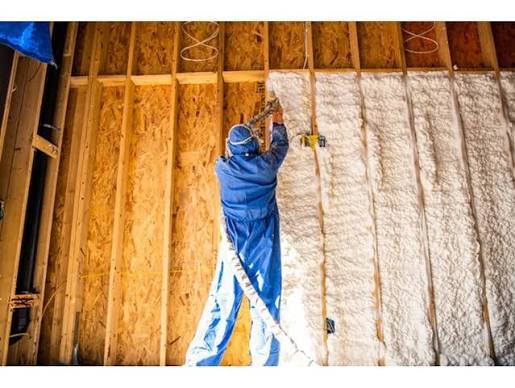
Open-cell spray foam insulation is a lightweight insulation material that expands into wall cavities, roof spaces, and other gaps. Its installed cost depends on how much foam the property needs and how difficult it is to apply.
Understanding Board-Foot Pricing
A board foot measures volume rather than surface area. Contractors use it to calculate the amount of spray foam required for a project.
Formula:
Board Feet = Surface Area (Square Feet) × Foam Thickness (Inches)
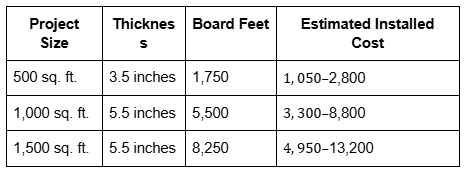
These are illustrative estimates using the published $0.60 to $1.60 national planning range, not verified local bids. Actual project prices may differ, and minimum service charges or additional work can affect the total. For more pricing context, reviewAngi's spray foam insulation cost guide.
What Affects Your Final Quote?
Several factors can raise or lower the cost of open-cell spray foam insulation:
- Foam thickness: Deeper applications use more material and increase the total price.
- Project size: Large, accessible projects may have a lower cost per board foot than small jobs.
- Accessibility: Tight roof spaces, difficult attic access, and complex roof designs can require more labor.
- Existing insulation: Removing old insulation, cleaning surfaces, and preparing the work area can add charges.
- Installation requirements: Ventilation changes, protective coverings, and code-required finishing work may affect the budget.
Ask for an itemized estimate showing the foam type, thickness, covered area, and any additional work.
Why Choose Open-Cell Spray Foam for Your Florida Property?
Florida homes face long cooling seasons, high humidity, and substantial heat entering through roofs and exterior walls. Properly installed insulation can reduce unwanted heat transfer and air leakage, helping an HVAC system maintain indoor comfort.
Open-cell foam expands into gaps and forms an air barrier when installed at the required thickness. It is often considered for above-grade walls and suitable roof assemblies.
Main Benefits
- Improved indoor comfort: Reducing air leakage can help limit hot spots and uneven temperatures between rooms.
- Lower unwanted heat gain: Insulating the building envelope helps reduce heat moving from hot outdoor spaces into conditioned rooms.
- Sound reduction: Its soft, porous structure can help reduce airborne noise passing through insulated walls.
- Fills irregular gaps: Expanding foam can reach spaces that are difficult to seal with rigid insulation boards.
Energy savings depend on the property's existing insulation, air leakage, HVAC system, and installation quality. No specific percentage of savings can be guaranteed without evaluating the building.
Open-Cell vs. Closed-Cell Spray Foam
Both materials can improve a building's thermal performance, but they differ in price, density, moisture behavior, and insulation value per inch.
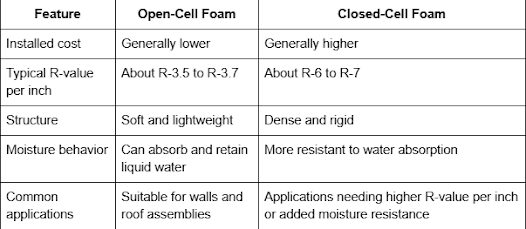
These are typical characteristics. Confirm the selected product's technical data and suitability for the exact assembly. TheU.S. Department of Energy's spray foam guidance explains the differences in foam structure, thermal performance, and vapor permeability.
Pros and Cons of Open-Cell Insulation
Advantages
- Usually costs less than closed-cell foam.
- Expands into cavities and helps control air leakage.
- Can provide useful sound reduction in suitable wall assemblies.
Disadvantages
- Provides less R-value per inch than closed-cell foam.
- Can absorb and hold liquid water, so leaks must be addressed.
- Does not automatically provide the vapor control needed for every Florida roof or wall design.
How Florida Weather Affects Spray Foam Installation?
Florida's heat, humidity, and heavy rainfall make moisture management a key part of insulation planning. The right foam depends on the roof or wall assembly, not just the outdoor temperature.
Heat, Humidity, and Rain
High humidity can affect spray foam application because the foam's chemical reaction depends on suitable substrate conditions and product-specific installation settings. Installers should follow the manufacturer's requirements for surface temperature, moisture, ventilation, and curing. Rainwater intrusion must be repaired before insulation is installed. Covering a leaking roof or damp building materials with foam can hide ongoing moisture problems and increase the risk of damage. For coastal Florida properties, wind-driven rain, roof design, and the potential for moisture accumulation deserve particular attention. Open-cell foam is not a substitute for a properly designed water-management system.
What R-Value Should You Choose?
R-value measures how well insulation resists heat flow. A higher R-value generally provides greater resistance to heat transfer when other conditions are equal. Open-cell spray foam commonly provides about R-3.5 to R-3.7 per inch, depending on the product.
For example, 5.5 inches of foam at R-3.7 per inch provides approximately R-20.4. That calculation is a material estimate, not proof that the entire roof or wall assembly meets applicable building requirements. The required insulation level depends on the building's design, location, applicable energy code, and assembly type. Check the currentFlorida Building Commission resources and confirm the requirements for your specific project before choosing a thickness.
Why Consider All in Overhall?
All in Overhall helps homeowners and property owners explore spray foam insulation in jupiter fl options for their buildings. Based locally, the company focuses on clear communication and dependable workmanship. Before moving forward, ask your contractor to explain the proposed foam type, expected R-value, installation thickness, moisture-control plan, and total project cost. You should also confirm the contractor's qualifications and how the work will be completed safely. A clear scope of work helps you compare estimates accurately and avoid unexpected charges.
Get an Open-Cell Spray Foam Estimate in Florida
The best way to determine your open-cell spray foam cost is to assess the area, required thickness, and condition of the building. A site-specific estimate can also identify preparation work and moisture concerns before installation begins.
Contact All in Overhall to discuss your insulation project and request pricing.
- Phone: (561) 406-3835
- Email:[email protected]
- Location: Jupiter, Florida
Share your property's approximate square footage and whether you need attic, roof-deck, or wall insulation to help start the conversation.
Frequently Asked Questions
How Much Does Open-Cell Spray Foam Cost Per Square Foot?
The price depends on the thickness of the foam. At $0.60 to $1.60 per board foot, a one-inch application costs approximately $0.60 to $1.60 per square foot. A 5.5-inch application would cost approximately $3.30 to $8.80 per square foot using the same pricing range.
Is Open-Cell Spray Foam Cheaper Than Closed-Cell Foam?
Generally, yes. Open-cell foam usually has a lower installed price per board foot. Closed-cell foam costs more but provides a higher R-value per inch and greater resistance to water absorption.
Is Open-Cell Spray Foam Suitable for Florida Attics?
It can be suitable for some Florida attic and roof assemblies. However, the roof design, ventilation strategy, moisture control, and applicable code requirements must be evaluated before selecting the material.
How Much Does It Cost to Insulate a 1,000-Square-Foot Attic?
At 5.5 inches of foam, 1,000 square feet requires approximately 5,500 board feet. Using the $0.60 to $1.60 planning range, the estimated cost is $3,300 to $8,800. Your actual quote may vary with access, preparation, and installation requirements.
Author & Reviewer
Author: Richard Hall
Richard Hall is the founder of All in Overhall, a spray foam insulation company based in Jupiter, Florida, founded on January 3, 2022. He has four years of experience in the insulation industry, including experience gained before founding the company. His work focuses on quality workmanship, clear communication, and insulation solutions that support indoor comfort and energy efficiency.
Reviewer: Mia Clark
Mia Clark reviewed this article using her nine years of experience in the spray foam industry. Her review focused on making insulation services, material choices, and project considerations easier for homeowners and businesses to understand.
Green Life Fusion CBD Gummies Explained: How They Work and What You Sh...
Green Life CBD Gummies are marketed as a convenient hemp-derived CBD wellness supplement f...