
How Long Does Spray Foam Insulation Take to Dry Before It Can Be Cut?
When we install insulation in a home or commercial building, one of the most common questions we hear from builders and homeowners is how soon they can move on to the next step. If you are looking for a quick answer, the spray foam drying time generally allows for cutting or trimming within 5 to 30 minutes after application. However, while the foam may feel solid enough to touch or trim quickly, it is not fully cured yet. Achieving a full cure typically takes about 24 hours, depending on the specific product and environmental conditions.
At Peninsula Insulation, LLC, we have spent years perfecting our application process to ensure that your project stays on schedule without compromising safety or performance. Understanding the difference between "tack-free" time and full "cure" time is essential for anyone working around a recent installation. In this guide, we will break down what happens as the foam hardens and what factors influence the speed of the process.
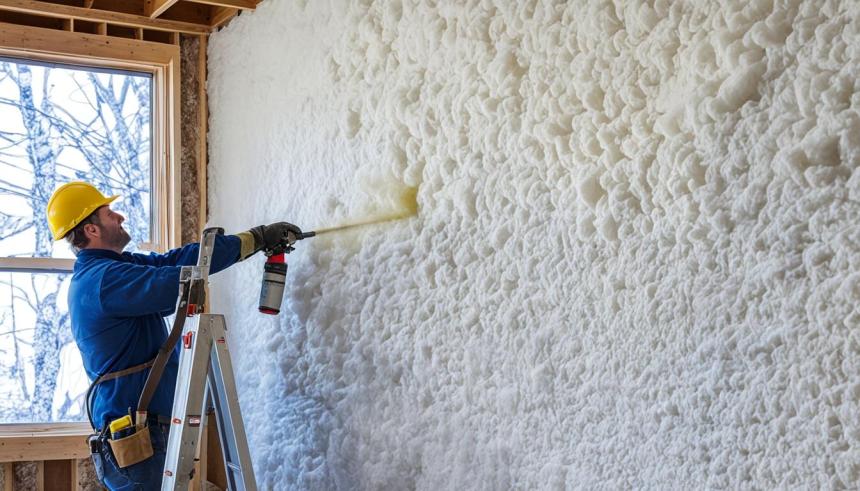 Understanding the Drying and Curing Process
It is helpful to think of the drying process in two distinct stages. The first stage is when the foam expands and becomes "tack-free." This is the point where the surface is no longer sticky and the foam has enough structural integrity to be trimmed back to the studs. For most of the open cell and closed cell products we use, this happens almost instantly or within a few minutes.
The second stage is the full cure. Even if the foam looks and feels finished, chemical reactions are still occurring inside the material. During this 24-hour window, the foam achieves its final R-value and structural density. We always advise that while trimming can happen early, heavy mechanical work or wall covering should wait until the chemical process is complete.
[Image: A professional technician trimming excess spray foam from a wall stud using a long saw]
Factors That Influence Spray Foam Drying TimeNot every job site is the same, and several variables can shift the timeline for when we can start cutting. We monitor these conditions closely on every project to ensure the material performs as expected.
Temperature and HumidityThe ambient temperature and the temperature of the substrate (the surface being sprayed) play a massive role. In colder weather, the chemical reaction slows down, which can extend the insulation hardening period. Conversely, high humidity can speed up the reaction in certain types of foam, but excessive moisture can reduce how well the foam adheres to the surface.
Type of Foam UsedThe chemical makeup of the product matters. Open-cell foam is typically softer and expands more rapidly, often becoming ready to trim faster than closed-cell varieties. Closed-cell foam is much denser and may take slightly longer to reach a firmness level sufficient for a clean cut without tearing.
Application ThicknessWhen we apply foam in thick "lifts" or layers, the heat generated by the chemical reaction remains trapped longer. If the foam is applied too thickly in a single pass, the center may remain soft even if the outside feels hard. Following manufacturer specifications for layer thickness ensures a consistent foam set time throughout the entire wall cavity.


Was Männer über Wirkung, Sicherheit und Behandlung wissen sollten
Erektionsprobleme sind ein Thema, das viele Männer betrifft, über das jedoch häufig nur un...