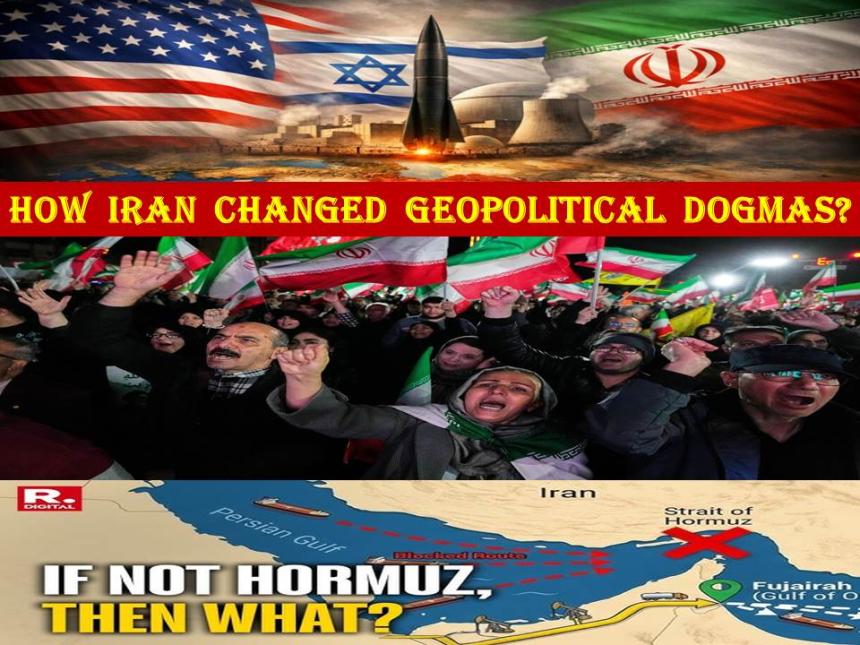

How Iran Changed Geopolitical Dogmas?
The US-Israel-Iran War has shattered traditional geopolitical dogmas by exposing the limits of Western military dominance, confirming the enduring power of geography over conventional arsenals, and accelerating an unprecedented global realignment. This write up "How Iran Changed Geopolitical Dogmas?" is based upon an opinion from Mobin Bajwa published on FB.
أَعُوذُ بِاللّٰهِ مِنَ الشَّيْطَانِ الرَّجِيمِ
بِسۡمِ ٱللهِ ٱلرَّحۡمَـٰنِ ٱلرَّحِيمِ
In the name of ALLAH, the Most Gracious, the Most Merciful
How Iran Changed Geopolitical Dogmas?
The US-Israel-Iran War has shattered traditional geopolitical dogmas by exposing the limits of Western military dominance, confirming the enduring power of geography over conventional arsenals, and accelerating an unprecedented global realignment.
"This war is much more consequential and larger than we have given it credit for thus far," Vali Nasr, professor of International Affairs and Middle East Studies at Johns Hopkins' School of Advanced International Studies, told BBC Rep. "All major wars of this magnitude ultimately reorder the chess board," he says. "This will do it for the Middle East."
The US and Israel may have sent many of the country's former leaders to early graves, but have they been replaced by even more formidable foes? Iran is in the midst of profound change and through the 40 days war, Iran has changed all the previous paradigms and dogmas prevalent in the geopolitics. These systemic shifts have irrevocably altered the international order. The "Order" initiated from WW1 and enforced upon our planet Earth since WW2 has dramatically changed. In the following we will see how this has taken shape:-
1. The Fallacy of Uncontested Western Hegemony
For decades, the dogma dictated that Western armadas and foreign military interventions could unilaterally dictate outcomes and ensure uninterrupted global commerce. The conflict proved otherwise:-
Chokepoint Vulnerability: Iran’s ability to heavily restrict maritime chokepoints like the Strait of Hormuz demonstrated that medium-sized powers can hold global trade hostage.
Naval Limitations: Despite a massive deployment, the US Navy and allied forces proved incapable of fully guaranteeing freedom of navigation, forcing countries to reconsider relying solely on Western forces to keep sea lanes open.
2. The Limits of Air Superiority and Missile Defense
The war redefined the mechanics of modern military deterrence.
Vulnerable Infrastructure: Advanced Western-made missile defense systems and heavily guarded installations—such as US bases in Kuwait and Bahrain, and energy/LNG facilities in Qatar and Saudi Arabia—suffered significant damage.
Asymmetric Supremacy: Iran’s asymmetric strategies, including its deep proxy networks and drone/missile capabilities, proved more resilient and devastating than traditional defense doctrines anticipated, showing that conventional state militaries are no longer the sole arbiters of deterrence.
3. Energy as an Immediate Geopolitical Weapon
The historic dogma treated oil and gas as strictly market-driven commodities. The conflict shattered this concept by turning energy back into an overt geopolitical weapon.
Volatility Over Scarcity: Even momentary threats to infrastructure—rather than just the actual loss of supply—were enough to send global oil and gas prices surging, forcing global markets into unprecedented volatility.
4. Regional Realignment and Hedging
The conflict destroyed the expectation that Middle Eastern nations would unquestioningly align behind the US or Israeli security umbrellas, catalyzing historic geopolitical shifts:
The "R-4" Bloc: Middle powers, including Turkey, Saudi Arabia, and Pakistan, increasingly sought unified security pacts among themselves and alternative defense options to thwart Israeli and US hegemony in the region. This has opened new paradigms and introduced new opportunities for regional co-operations and regional blocks.
Diplomatic Leverage: Countries that serve as intermediaries—like Pakistan—have seen their geopolitical value skyrocket as Western and Gulf powers look for pathways to contain the broader fallout. Countries like Pakistan may have to evolve a new strategy and new doctrines for benefitting from this changing scenario.
5. Fractured Sanctions and Sino-Russian Opportunity
Previous geopolitical theory assumed that sweeping Western sanctions would uniformly isolate adversaries and hold global alliances together.
Sino-Russian Support: The conflict pushed Iran deeper into the arms of a Sino-Russian axis.
Fractured Alliances: As the war dragged on, European and Asian allies began prioritizing their own domestic energy security and economic interests, fracturing the traditional US-led sanctions block and forcing the relaxation of restrictions on Iranian oil.
In the following, let's read an opinion shared on FaceBook by Capt (R) Ahmad Mobin Ashraf Bajwa PN; who is a researcher and analyst specializing in international relations, strategic affairs, foreign policy and geopolitical developments. His research focuses on great-power competition, regional security and the evolving international order. He has been in the faculty of Bahria University, Islamabad as well.
Beyond Military Power: Iran, the Strait of Hormuz and Pakistan’s Emerging Diplomatic Opportunity By Mobin Bajwa
Recent tensions in West Asia reveal that military strength alone no longer determines strategic success. Geography, energy security, diplomacy and regional partnerships are increasingly shaping the future international order.
The recent escalation of tensions involving Iran, Israel and the United States has once again demonstrated a defining reality of twenty-first century geopolitics: overwhelming military superiority does not automatically translate into strategic dominance. Despite possessing unmatched military capabilities, the world’s leading powers remain constrained by geography, energy security, global trade and the political complexities of regional conflicts. Few places illustrate this reality more vividly than the Strait of Hormuz which is a narrow maritime passage whose strategic importance extends far beyond the Gulf and directly influences the global economy.
For decades, international security was largely viewed through the lens of military power. The post-Cold War era reinforced this perception as the United States emerged as the world’s pre-eminent military, economic and technological power. Yet contemporary conflicts increasingly suggest that while military strength remains indispensable, it is no longer sufficient by itself to shape political outcomes or sustain long-term regional stability. Today’s international order is influenced as much by economic resilience, strategic geography, technological innovation and diplomatic engagement as by conventional military capabilities.
The Strait of Hormuz epitomizes this transformation. Although only a few kilometres (nautical miles) wide at its narrowest navigable point, it serves as one of the world’s most critical maritime chokepoints. A significant share of globally traded seaborne crude oil and liquefied natural gas passes through these waters, making the Strait indispensable to the energy security of Asia, Europe and many other regions. Even the possibility of disruption can trigger volatility in international energy markets, increase shipping and insurance costs, disrupt supply chains and generate inflationary pressures across the global economy.
This reality explains why developments around the Strait attract immediate international attention. Strategic influence in today’s world is no longer measured solely by the size of armies or the sophistication of weapon systems. Geography itself has become a source of geopolitical leverage. Nations located along critical maritime routes possess an influence that extends well beyond their conventional military capabilities because the stability of these waterways affects the prosperity of the global economy.
Iran offers a compelling example of how states can leverage strategic geography alongside asymmetric capabilities to shape regional security dynamics. Although it cannot match the conventional military strength of the United States or its allies, Iran has invested heavily in missile technology, unmanned aerial systems, maritime capabilities and regional partnerships designed to strengthen deterrence. Combined with its geographical position overlooking the Strait of Hormuz, these capabilities ensure that any regional confrontation carries consequences extending far beyond the battlefield.
The broader strategic lesson is not entirely new. The experiences of Vietnam, Iraq and Afghanistan collectively demonstrated that decisive battlefield victories do not always produce lasting political settlements. Military campaigns can remove governments or weaken adversaries, but durable peace ultimately depends upon political legitimacy, economic recovery, effective governance and sustained diplomacy. Contemporary security challenges increasingly require comprehensive statecraft rather than military power alone.
These developments should not be interpreted as evidence that American influence is disappearing. The United States continues to possess unparalleled global military reach, technological leadership, economic strength and an extensive network of alliances. However, power today is exercised in a more complex international environment than during the immediate post-Cold War period. Strategic competition increasingly involves economic interdependence, cyber capabilities, artificial intelligence, energy security, maritime access and technological innovation alongside traditional military considerations.
This changing landscape is contributing to a more multipolar international order. China has emerged as a major economic and technological power with expanding global influence. India is assuming a larger strategic role across the Indo-Pacific. Russia continues to shape security developments across Eurasia despite significant challenges. Meanwhile, regional actors such as Türkiye, Saudi Arabia, Iran, Indonesia and Brazil are pursuing increasingly independent foreign policies driven primarily by national interests rather than bloc politics. Collectively, these trends point towards a world in which influence is more widely distributed among several centres of power.
West Asia has become one of the clearest illustrations of this evolving order. Regional governments are strengthening indigenous defence capabilities while simultaneously diversifying diplomatic and economic partnerships. Security cooperation now coexists with strategic autonomy, allowing regional states to engage multiple global powers without exclusive alignment. This evolution reflects a broader recognition that sustainable security requires both credible deterrence and active diplomacy.
Against this backdrop, Pakistan occupies a uniquely important strategic position. Situated at the crossroads of South Asia, Central Asia, West Asia and the Arabian Sea, Pakistan connects multiple regions whose political and economic futures are becoming increasingly interconnected. Its geographic location, combined with expanding maritime interests and regional connectivity initiatives, provides opportunities to contribute constructively to regional peace and stability.
Pakistan’s potential role should not be viewed solely through the prism of military capability. Its professional armed forces, extensive counterterrorism experience and longstanding contributions to United Nations peacekeeping operations have earned international recognition. Equally important are Pakistan’s diplomatic relationships across diverse regions. Islamabad maintains close strategic cooperation with China, longstanding partnerships with Gulf states, expanding ties with Türkiye, dialogue with Iran and continuing engagement with Western countries. Few states possess diplomatic channels that extend across such a broad spectrum of regional and global actors.
These relationships position Pakistan to contribute as a facilitator of dialogue rather than merely another participant in regional competition. In recent years, Pakistan has consistently advocated restraint, negotiated solutions and regional stability during periods of heightened tension. While diplomacy rarely attracts the attention generated by military operations, sustained engagement behind the scenes often plays a critical role in preventing escalation and maintaining communication between states with competing interests.
The importance of such diplomacy is likely to grow. Future conflicts are unlikely to be determined exclusively by conventional military superiority. They will increasingly involve cyber operations, economic coercion, maritime competition, technological innovation, energy security and information warfare. In such an environment, countries capable of maintaining balanced relations with multiple stakeholders can make valuable contributions to regional confidence-building and conflict prevention.
Pakistan can further strengthen this role by complementing credible defence capabilities with economic reform, institutional resilience and a consistent foreign policy anchored in strategic autonomy. A stronger economy will enhance diplomatic credibility. Stable institutions will reinforce investor confidence and national resilience. Expanded regional trade and connectivity will create shared economic interests that reduce incentives for conflict. Maritime security cooperation, humanitarian assistance, disaster relief and participation in multilateral initiatives can further reinforce Pakistan’s image as a responsible regional stakeholder.
The strategic significance of the Arabian Sea and emerging connectivity corridors further enhances Pakistan’s relevance. As global supply chains diversify and maritime trade assumes greater importance, ports, sea lanes and logistics infrastructure are becoming central components of national power. Pakistan’s coastline and connectivity projects have the potential to support regional commerce while strengthening broader economic integration across South Asia, Central Asia and West Asia. These opportunities, however, will be fully realised only through sustained domestic stability, economic competitiveness and predictable governance.
The emerging international order therefore presents Pakistan with an opportunity rather than a guarantee. Strategic geography provides advantages, but geography alone cannot determine national success. History demonstrates that states convert geographic potential into lasting influence only through sound governance, economic vitality and diplomatic credibility. Pakistan’s future role as a constructive regional stabiliser will depend as much upon internal reforms as external circumstances.
The defining lesson of the current geopolitical environment is that power itself is evolving. Military capability remains an essential pillar of national security, but it now operates alongside diplomacy, economic resilience, technological innovation and strategic geography. The Strait of Hormuz has become a powerful reminder that even the strongest militaries must account for the realities of geography, global commerce and regional politics. The future international order will be shaped not only by those capable of projecting force, but also by those able to foster stability, build partnerships and reduce the risks of conflict.
For Pakistan, this changing landscape should be approached with confidence, realism and strategic clarity. Rather than seeking prominence through confrontation, Pakistan has an opportunity to strengthen its standing by promoting dialogue, supporting regional connectivity and contributing to collective security. Its geographic position, diplomatic reach and security experience provide the foundations for a constructive role that extends beyond traditional power politics.
As competition among major powers intensifies, the international community will increasingly value states capable of bridging divides rather than deepening them. In an era defined by interdependence as much as deterrence, the ability to facilitate dialogue may prove as consequential as the ability to deploy military force. Pakistan’s greatest strategic opportunity lies not in becoming another centre of geopolitical rivalry, but in emerging as a credible advocate for peace, regional cooperation and responsible statecraft. In the decades ahead, history may well remember that enduring influence belonged not only to those who possessed the greatest military strength, but to those who used diplomacy to transform strategic competition into lasting stability.
How to Match Fine Pearl Jewelry With Halloween Festival Outfits and Ac...

Bullet Types and Weights Across the Old, the Odd and the New
Bullet designs and brand lines change over time. Read the bullet type and weight on the bo...