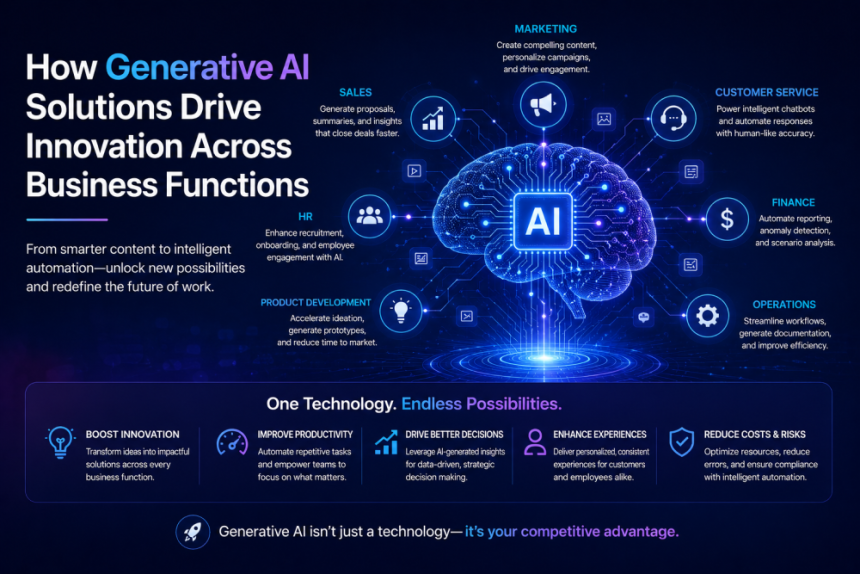

How Generative AI Solutions Drive Innovation Across Business Functions
For a while, many businesses treated generative AI as a side conversation. That mindset has changed pretty quickly.
Today, the discussion is happening at a much higher level inside organizations. Leadership teams are no longer just asking what AI can do. They are asking where it fits operationally and how fast competitors are already moving. The pressure is real.
A year or two ago, most AI projects were still experimental. Companies were running small pilots, limited tests, or using isolated tools within a few teams. Now businesses are trying to connect AI directly to productivity, customer experience, operational efficiency, and decision-making.
The shift feels bigger because it is happening across multiple departments at the same time.
Marketing teams are producing campaigns faster. Developers are shortening parts of the software cycle. HR teams are simplifying documentation and onboarding work. Support departments are responding to customers more efficiently.
In some companies, employees are already interacting with AI systems every day without thinking much about it anymore.
That alone says a lot about how quickly adoption is moving.
According to McKinsey, over 71% of organizations now use generative AI regularly in at least one business function. Not long ago, that level of adoption would have sounded aggressive. Now it feels normal.
This is also why demand for generative AI development services has increased sharply over the past year. Businesses want more than access to AI tools. They want systems that actually work inside real operations without creating chaos later.
Businesses Are Starting to Think Beyond AI Hype
The early stage of AI adoption created plenty of confusion.
Some companies moved too quickly. Others waited too long. Many bought tools before understanding how those tools would connect to existing workflows. A few departments experimented independently without much coordination. The results were mixed.
In some organizations, AI improved efficiency almost immediately. In others, it introduced inconsistent outputs, security concerns, or disconnected processes that employees did not fully trust.
That is partly why businesses have become more careful about implementation strategy now.
The conversation is becoming less about novelty and more about operational usefulness.
- Can AI reduce repetitive work?
- Can it help employees focus on higher-value tasks?
- Can it improve response times without damaging quality?
Those are the questions leadership teams care about now.
This is where experienced generative AI development services often make a major difference. The technology itself is accessible. Integration is the difficult part.
A marketing team might adopt one platform. Customer support may choose another. HR could be using entirely separate systems. Without governance and planning, businesses end up creating fragmented workflows instead of operational improvement.
And fragmentation becomes expensive over time.
A dependable generative AI development company usually focuses less on flashy demos and more on workflow alignment, system integration, data security, and long-term usability. That approach tends to age better.
Marketing Teams Felt the Pressure First
Marketing departments probably experienced the AI shift earlier than most business functions.
The workload became difficult to ignore. Content expectations expanded almost everywhere at once. Businesses suddenly needed more blogs, more landing pages, more ad copy, more newsletters, more social content, more personalization, and more SEO pages. And all of it needed to happen faster.
Most internal teams were already stretched thin. Generative AI solutions started becoming useful because they removed some of the production pressure. Not all of it, of course — but enough to reshape workflows in meaningful ways.
Teams now use AI to generate outlines, summarize research, brainstorm campaign ideas, repurpose long-form content, test subject lines, and create draft copy for multiple channels. That saves time.
AI can help produce content faster, but fast content is not automatically persuasive content. Businesses still need experienced marketers who understand tone, timing, audience psychology, and brand consistency.
The companies seeing the strongest results are usually treating AI as a support layer rather than a replacement strategy. That distinction changes outcomes.
Marketers using AI tools are already reporting noticeable productivity improvements. And the trend still seems early. Most companies are probably nowhere near full adoption yet. Thus, the biggest shifts are likely still ahead.
Support Teams Are Rethinking How Customer Service Works
Customer expectations have changed a lot over the last few years.
People now expect faster answers almost automatically. They also expect personalization and consistency across email, chat, apps, websites, and social platforms.
Support teams feel that pressure constantly.
This is one reason generative AI services and solutions are spreading quickly inside customer experience operations. Businesses are trying to scale support quality without scaling operational costs at the exact same rate. That balance is difficult.
AI-powered systems can now handle routine requests, summarize customer conversations, assist live agents during chats, generate replies, and support multilingual interactions much faster than older systems could.
For large support teams, those efficiency gains become meaningful quickly.
Conversational AI technologies are expected to reduce contact center labor costs significantly over the next several years as adoption expands globally. Still, fully automated support has limitations.
Customers usually tolerate automation for simple issues. Once problems become emotional, complex, or financially sensitive, people still want human interaction.
The businesses building strong support experiences understand that AI works best when paired with human oversight rather than treated as a complete replacement.
That tends to create better customer trust in the long term.
Support Teams Are Rethinking How Customer Service Works
Product Development Is Becoming More Iterative
Software teams are changing the way they work. Developers increasingly use generative AI solutions for repetitive coding tasks, documentation support, testing assistance, debugging workflows, and early-stage prototyping. That speeds things up.
But the bigger advantage may not actually be speed. It may be flexibility.
When development teams spend less time handling repetitive implementation tasks, they gain more room for experimentation and refinement. Teams can test ideas faster, iterate faster, and sometimes identify problems earlier in the process. That changes innovation cycles.
And businesses care about innovation speed now more than ever because customer expectations move quickly, products evolve quickly, and competitors move quickly too.
HR Departments Are Finding More Practical Uses for AI
Human resources teams were somewhat cautious about AI adoption at first. That hesitation made sense.
HR workflows involve employee communication, hiring decisions, internal policies, onboarding experiences, and sensitive information. Mistakes carry consequences.
But adoption is growing steadily now because many HR departments are overwhelmed with administrative work. Generative AI development services are helping organizations simplify some of those repetitive workflows without completely redesigning entire HR systems overnight.
Businesses are using AI tools to draft job descriptions, summarize interview notes, create onboarding documents, organize internal knowledge resources, and support employee training initiatives.
Some organizations are also experimenting with personalized learning recommendations for employees based on role requirements and career development goals.
The interesting part is that AI adoption inside HR is becoming less theoretical now. Teams are finding smaller, practical use cases that save time consistently instead of trying to automate everything immediately.
Finance Teams Are Becoming More Data Responsive
Finance departments operate under constant pressure to deliver accurate reporting quickly. That has always been true.
What has changed, however, is the amount of data that businesses now process and the speed at which management requires answers.
Generative AI services and solutions are helping finance teams reduce some of the manual workload tied to reporting, documentation, forecasting, and trend analysis.
This can bring about significant improvements, particularly for companies managing large operational data sets from several sources.
Finance leaders increasingly see AI as an important part of long-term planning and operational resilience strategies. But finance is also one of the areas where businesses must be most cautious.
Accuracy matters too much for careless implementation. Governance matters too.
This is one reason experienced generative AI development company partners are becoming increasingly valuable for enterprise AI deployment. Businesses need stronger oversight when AI systems interact with financial operations, reporting structures, or compliance-sensitive information.
AI Is Quietly Changing How Leaders Make Decisions
One of the less obvious changes happening right now involves decision-making speed.
Executives spend enormous amounts of time reviewing summaries, reports, updates, operational metrics, research documents, and market analysis from different departments. AI systems are starting to reduce some of that friction.
Businesses now use generative AI solutions to summarize information, synthesize research, generate executive briefings, organize internal knowledge, and surface operational insights more quickly.
That may sound small at first. In reality, it is not.
Faster access to useful information often changes how quickly organizations respond to market conditions, customer behavior, or operational problems.
Summing Up
Generative AI is already changing how businesses operate.
The shift may still feel uneven across industries, but adoption is clearly accelerating. Some companies are moving cautiously. Others are investing aggressively. Most are still trying to figure out where AI creates the strongest operational advantage.
That process will probably continue for years.
But one thing already feels increasingly clear. Businesses that learn how to integrate AI thoughtfully into daily workflows may gain meaningful advantages in speed, efficiency, responsiveness, and innovation capacity over time.
Technology alone will not solve every operational challenge. It never does. Leadership, strategy, employee trust, and execution quality remain essential.
The difference now is that businesses suddenly have far more powerful tools available to support those efforts than they did even a few years ago. And that changes the equation in meaningful ways.



Facing Cutter Manufacturer and Supplier in India for Smooth Wood Surfa...