
How Does Closed-Cell Spray Foam Perform in West Palm Beach, FL Climates?
Closed-cell insulation delivers exceptional thermal resistance, moisture defense, and structural rigidity in coastal environments.
Closed-cell insulation delivers exceptional thermal resistance, moisture defense, and structural rigidity in coastal environments. Applying the closed-cell spray foam that Palm Beach properties require helps keep indoor spaces cool, lowers humidity, and reinforces roofs against intense tropical storms.
South Florida presents unique weather challenges that quickly degrade standard building materials. High heat, year-round humidity, and severe wind demand insulation that does more than resist heat transfer. Decades of building science and hands-on field experience show that choosing the right material makes a massive difference in indoor air quality and structural lifespan.
Why Coastal Florida Climates Challenge Standard Insulation?
West Palm Beach experiences an average annual relative humidity above 70%, paired with high heat indexes for most of the year. Traditional fiberglass batts or blown-in cellulose soak up moisture from humid ocean air like a sponge. When these materials become damp, they sag, lose their thermal resistance rating, and create breeding grounds for mold.
Air leakage is another major issue in local structures. Hot, wet air enters through tiny cracks in the attic and exterior walls, driving air conditioners to run constantly. Modern spray foam insulation South Florida installations solve this problem by expanding to fill every gap, creating an impermeable barrier against both heat and moisture vapor.
- Traditional materials allow humid air convection through ceiling joists.
- Wet fiberglass loses up to 50% of its thermal efficiency over time.
- Air infiltration brings outdoor salt, pollen, and pollutants into living spaces.
- Unsealed attics often reach temperatures exceeding 130 degrees Fahrenheit in the summer.
How Closed-Cell Foam Handles Tropical Moisture and Water Infiltration?
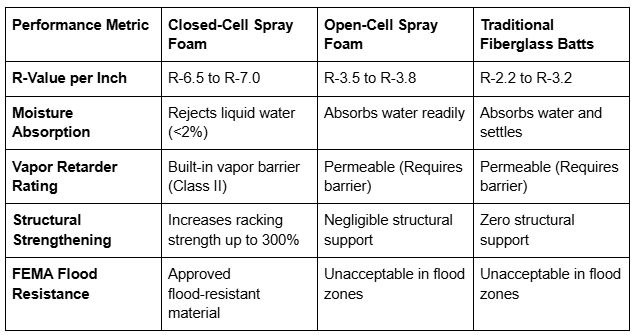
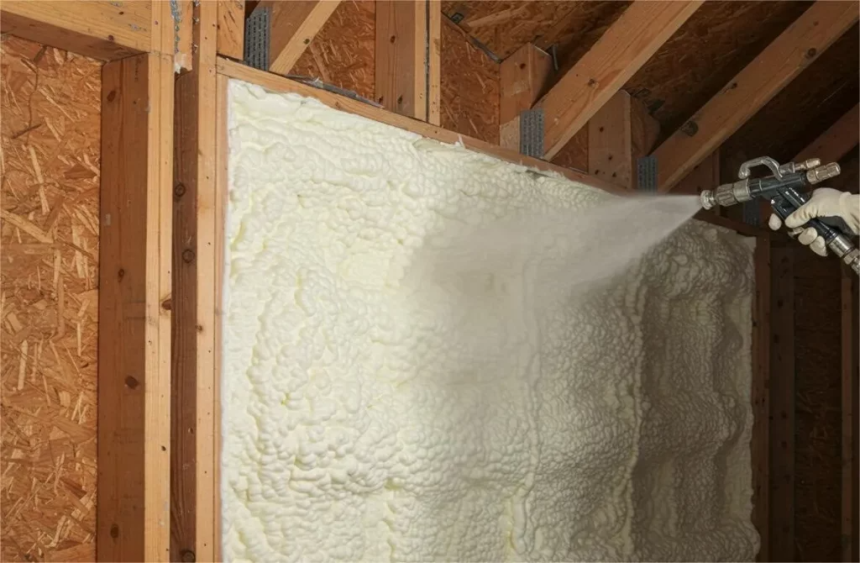
To combat these climate issues, robust moisture control is the primary line of defense for any coastal property. Unlike open-cell foam, which is sponge-like and permeable to water, closed-cell spray foam creates a solid barrier that rejects liquid water. The microscopic cells are tightly packed and filled with an inert gas, leaving no open pathways for water or air to pass through.
FEMA classifies closed-cell foam as an acceptable flood-resistant material because it withstands direct contact with floodwaters without absorbing moisture. For properties in coastal flood zones or areas prone to heavy wind-driven rain, this feature helps prevent catastrophic structural rot.
Bonus Tip: When insulating unvented attics in humid regions, ensure technicians seal around roof penetrations like vent stacks and exhaust pipes to prevent vapor drive from bypassing the thermal envelope.
Applying quality foam insulation for south florida homes keeps the structural framing dry, preventing wood rot, termite infestation, and bacterial growth. Because it blocks water vapor transmission, it stops internal wall condensation, which commonly happens when cold, conditioned indoor air meets hot, humid exterior drywall.
Structural Wind Uplift Resistance During Hurricane Season
High winds create immense upward suction on roof decks during tropical storms and hurricanes. Roof failure often begins when wind tears off individual plywood sheathing panels, letting rain flood the building below. Applying the closed-cell spray foam that Palm Beach building codes favor helps secure the structure from the inside out.
When applied to the underside of roof sheathing along rafter seams, the rigid foam glues the plywood deck to the wood or metal trusses. Field testing confirms this application can increase roof wind uplift resistance by as much as 250% to 300%. It effectively turns the entire roof plane into a single, unified diaphragm that holds together under high wind loads.
- Glues roof sheathing directly to supporting rafters and trusses.
- Eliminates vulnerable pressure differentials in open attic spaces.
- Prevents secondary water intrusion if shingles or tiles blow away.
- Outperforms mechanical fasteners alone during sustained hurricane winds.
Energy Efficiency and Air Conditioning Load Reduction
Air conditioning accounts for more than 50% of the total electric bill for typical South Florida households. When attics remain uninsulated or poorly vented, temperatures reach extreme highs, radiating heat downward into the living space. Moving the thermal envelope to the roofline with modern spray foam Florida systems creates a semi-conditioned attic space.
In an encapsulated attic, the temperature rarely exceeds 85 degrees Fahrenheit, even on the hottest summer afternoons. Ductwork running through the attic operates in a mild environment rather than a superheated space. This setup reduces duct heat gain, allowing air conditioning units to cool homes with less energy and shorter run times.
Bonus Tip: After completing an attic encapsulation, ask your HVAC technician to check the system sizing. An airtight building envelope often reduces the required cooling capacity, meaning an oversized unit could short-cycle if left unadjusted.
Homeowners frequently see cooling energy demand drop by 20% to 40% immediately following installation. Because the system blocks outdoor drafts, the air conditioning unit also dehumidifies the interior air much faster, improving comfort at higher thermostat setpoints.
What to Review Before Choosing an Insulation System?
Every building has unique architectural details, and selecting the right insulation requires assessing several factors before starting the project. Installing the dense closed-cell spray foam that Palm Beach contractors use involves balancing structural benefits against installation costs and site preparation.
- Existing Roof Condition: Spraying foam onto decaying, leaking, or damaged wood sheathing hides existing rot instead of fixing it. Roof repairs must be completed before applying foam.
- Ventilation Strategy: Converting an attic to an unvented system requires closing soffit, gable, and ridge vents to prevent humid air entry.
- Electrical and Plumbing Wiring: Foam permanently encases wires and pipes within wall cavities, making future electrical adjustments more labor-intensive.
- Initial Budget vs. Long-Term Payback: Closed-cell foam carries a higher upfront cost than open-cell or fiberglass, though it provides superior structural and moisture benefits.
- Installer Skill Level: Improperly mixed chemical proportions can lead to lingering odors or uneven curing, so hiring trained professionals is essential.
How to Get Started with Professional Installation Services?
Choosing the right insulation for your property protects your structural investment from intense heat, high humidity, and coastal weather events. To ensure these measures are implemented with the professional expertise outlined above, the team at All in Overhall provides experienced installation services tailored to South Florida building requirements, including residential spray foam, commercial spray foam, and attic insulation. You can reach out directly to [email protected] or call (561) 406-3835 to schedule a site evaluation and receive a free quote for your project.
Frequently Asked Questions About Coastal Insulation
How long does closed-cell foam last in warm climates?
When protected from direct exposure to outdoor ultraviolet sunlight, closed-cell foam will last for the entire lifespan of the building without degrading or settling.
Does spraying foam on the roof deck void shingle warranties?
Most modern shingle manufacturers maintain their standard product warranties for unvented, foam-insulated roof decks, as research shows roof surface temperatures only increase by 2 to 5 degrees.
Can closed-cell foam cause termite problems to go unnoticed?
Building codes often require leaving a visible inspection strip along the foundation or sill plate so pest control operators can easily spot any signs of insect activity.
Is an unvented spray foam attic safe for gas appliances?
Natural gas or propane water heaters and furnaces installed within a sealed attic space should use direct-vent systems that draw combustion air directly from the outdoors.
Does closed-cell foam off-gas after the installation is complete?
Properly mixed and installed foam cures within 24 to 48 hours. After this initial curing and ventilation period, the cured material becomes completely inert and safe for building occupants.
Twist, Barrel and Choke: Setting Up the Gun for the Load
The right load still has to suit the barrel. Twist matters for rimfire bullets, and barrel...

Reading a Ballistics Chart: Velocity, Energy, Drop and Wind Without Ge...
Ballistics charts look like a wall of numbers. Four columns carry most of the meaning, and...
Eight Mistakes Buyers Make With Mainstream Rifle Ammunition
Eight Mistakes Buyers Make With Mainstream Rifle Ammunition
Twist Rate, Barrel Length and Bullet: Setting Up a Rifle for the Load
A bullet only flies true if the barrel spins it fast enough. Here is how twist rate, bulle...