

How Custom Software Development Helps Businesses Scale Faster
Learn how custom software development helps businesses scale faster through better performance, automation, integrations, flexibility, and long-term growth support.
Growth creates pressure. What works for a small team, a limited customer base, or a simple process often stops working when demand increases. Businesses start facing slow workflows, disconnected systems, poor reporting, manual tasks, and software limitations that hold back progress.
This is where custom software development company becomes a real growth advantage.
Instead of forcing your business to operate around generic software, custom development allows you to build systems that match your exact workflows, customers, goals, and future plans. It creates a stronger foundation for performance, automation, integrations, and scalability.
In simple terms, custom software helps businesses scale faster because it removes the friction that slows growth down.
Whether you are a startup, SME, or growing company, the ability to scale depends on how well your software supports operations, user experience, and decision-making. This article explains how custom software makes that possible, when businesses should invest in it, and what mistakes to avoid.
AI Development helps businesses scale faster by giving them more control over workflows, architecture, integrations, performance, and user experience. Unlike off-the-shelf tools, custom solutions are built around specific business needs, making it easier to automate operations, improve efficiency, support growth, and adapt over time.
Custom software development is the process of designing and building software specifically for a business instead of using ready-made software built for the mass market.
It can include:
- web applications
- mobile apps
- customer portals
- internal business tools
- admin dashboards
- workflow automation systems
- SaaS platforms
- AI-powered software solutions
The key difference is that custom software is built around your business model, not someone else’s template.
That matters because every growing business has its own processes, customers, service model, reporting needs, compliance requirements, and goals. Generic software may cover common tasks, but it rarely supports growth in the most efficient way.
Off-the-shelf tools are useful in the beginning. They help companies move quickly without a large upfront investment. But as businesses grow, these tools often create new problems.
Common limitations include:
- limited customization
- disconnected workflows
- weak integrations
- rising subscription costs
- restricted user roles
- poor reporting flexibility
- performance issues at scale
- dependency on third-party product roadmaps
For example, a business may use one tool for CRM, another for operations, another for finance, and another for support. At first, this seems manageable. But over time, teams start repeating tasks, moving data manually, and working around limitations.
That is not scalable.
Businesses scale faster when their systems work together, support their actual workflow, and reduce operational drag. This is exactly what custom software development helps solve.
 How Custom Software Development Helps Businesses Scale Faster
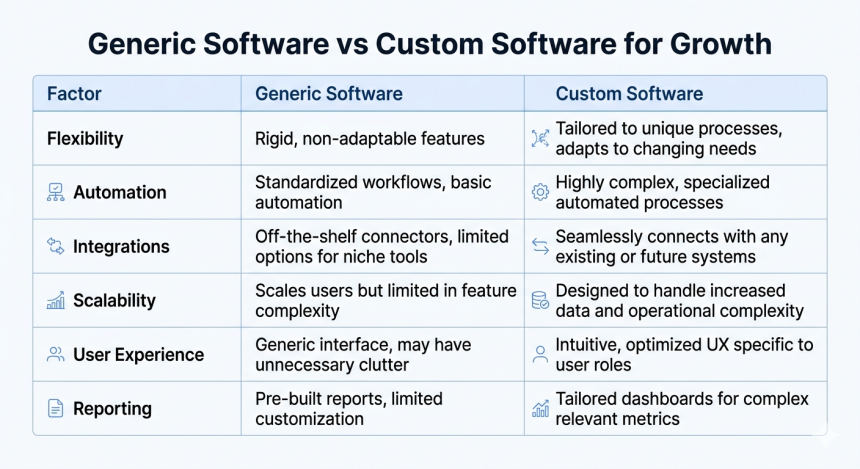
Every business has unique workflows. A generic tool may force your team to adapt to its structure, but custom software is built around how your business actually works.
This means you can design software that supports:
- your sales process
- your service delivery model
- your approval systems
- your reporting requirements
- your internal team structure
- your customer journey
When software matches the business, teams work faster and with fewer errors. That leads to better productivity, smoother operations, and more room for growth.
One of the fastest ways to scale is to reduce repetitive manual tasks.
Custom software helps businesses automate:
- lead management
- approvals and notifications
- document generation
- invoicing workflows
- customer onboarding
- scheduling
- internal reporting
- follow-up communications
Automation saves time, reduces mistakes, and allows teams to focus on higher-value work. Instead of increasing headcount for every growth stage, businesses can use software to expand output more efficiently.
This is one of the biggest reasons custom software accelerates scale.
Growing businesses often rely on multiple systems. When those systems do not connect properly, the result is fragmentation.
Custom software can integrate with:
- CRMs
- ERPs
- payment gateways
- accounting platforms
- HR systems
- marketing tools
- customer support systems
- analytics platforms
- AI and automation services
This creates a connected digital environment where data flows properly across departments.
The benefit is clear: fewer silos, fewer delays, better reporting, and stronger decision-making.
Performance matters more as your business scales. A slow system affects employees, customers, and revenue.
Custom software allows businesses to plan for:
- scalable architecture
- optimized database performance
- better hosting environments
- faster response times
- cleaner backend logic
- more reliable uptime
- efficient handling of higher usage
Instead of relying on software designed for broad market needs, businesses can build systems designed for their expected usage, workflows, and operational load.
That makes growth more stable and predictable.
If customers, partners, or internal teams interact with your software regularly, user experience directly affects growth.
Custom software gives businesses more control over:
- navigation
- onboarding flows
- account dashboards
- permissions and roles
- mobile responsiveness
- support workflows
- checkout or conversion paths
- client self-service features
A smoother experience improves adoption, retention, and satisfaction. Whether the software is customer-facing or internal, usability influences how effectively a business can grow.
Business growth often brings change. New markets, new products, new teams, new pricing models, and new operational needs all require flexibility.
With off-the-shelf tools, businesses must wait for third-party updates or use workarounds. With custom software, they can evolve the product based on actual business priorities.
This flexibility is valuable when you need to:
- launch new services
- add new user roles
- support regional expansion
- introduce new workflows
- improve reporting
- upgrade customer experiences
- connect new tools or APIs
Businesses that adapt faster often scale faster.
As a business grows, decisions become more complex. Leaders need better insight into sales, operations, performance, customer behavior, and team productivity.
Custom software can provide centralized dashboards and reporting tailored to your exact KPIs.
This helps businesses:
- track performance in real time
- identify bottlenecks
- improve forecasting
- monitor customer trends
- support leadership decisions
- reduce reporting delays
When data is easier to access and understand, growth becomes easier to manage.
Many businesses now want to introduce AI-driven workflows, intelligent search, recommendations, automation, or predictive reporting. These capabilities work best when built on top of structured systems and reliable data.
Custom software makes it easier to prepare for:
- AI-powered automation
- customer support bots
- smart dashboards
- recommendation engines
- document intelligence
- workflow optimization
- internal productivity tools
If innovation is part of your growth strategy, custom software gives you a stronger base than a patchwork of disconnected tools.
This is also important for long-term digital visibility, because businesses with structured platforms and helpful content often perform better in answer engine environments.
 Signs Your Business Is Ready for Custom Software
Not every business needs custom software immediately. But here are strong signs the time is right:
- your current software creates too many workarounds
- teams are repeating manual tasks
- systems do not integrate well
- reporting is slow or incomplete
- software costs are rising without enough value
- customer experience feels limited
- your business model needs specialized workflows
- performance issues are affecting users or operations
- growth plans require more flexibility than current tools allow
When these signs appear, custom development becomes less of a technical decision and more of a business growth decision.
If software limitations are already slowing operations, delaying action can make scaling harder and more expensive later.
Custom software should still be phased properly. Focus on the highest-value features first.
The best systems are built around real daily use, not just management assumptions.
This is a business strategy decision. Goals, operations, users, and growth plans should guide the build.
A development partner should understand not only coding, but also scalability, product structure, business workflows, and long-term support.
Businesses scale faster when they build custom software with a clear plan. A practical approach includes:
- Define the business problem clearly
- Identify where software is slowing growth
- Prioritize the highest-value workflows
- Start with a focused build or MVP
- Integrate essential systems early
- Measure performance and user adoption
- Improve in structured phases
This reduces risk and ensures the investment delivers business value, not just technical output.
 About ZAPTA Technologies
ZAPTA Technologies helps fast-growing startups and SMEs build, scale, and modernize software products through consulting, design, engineering, deployment, and long-term support. With 150+ active clients, 250+ delivered projects, and experience across 10+ industries, ZAPTA builds secure, performance-driven digital solutions that support real business growth.
If your business is growing but your systems are slowing you down, custom software may be the smartest next step. The right solution can reduce operational friction, improve user experience, automate workflows, and create a stronger foundation for scale.
Ready to build software that helps your business grow faster and operate smarter? Connect with ZAPTA Technologies and turn your growth goals into a scalable digital solution.
 Frequently Asked Questions
Custom software improves efficiency, automation, integrations, performance, and adaptability, all of which support faster and smoother business growth.
For many growing businesses, yes. Off-the-shelf tools are useful early on, but custom software offers more control, flexibility, and long-term scalability.
A business should consider custom software when current tools start limiting workflows, performance, integrations, reporting, or customer experience.
Yes. Small businesses with complex workflows, growth plans, or unique service models can benefit significantly from custom solutions.
Yes. One of the biggest advantages of custom software is that it can automate repetitive tasks, approvals, data flows, and operational processes.
Yes. Custom software can be built to support AI-powered workflows, automation, insights, and generative AI functionality when it aligns with business goals.
Good88: Exploring a Modern Platform Built for Convenience, Engagement,...
Good88: Exploring a Modern Platform Built for Convenience, Engagement, and a Better User E...



AI invoice generator: A Smarter Way to Create Professional Invoices an...
AI invoice generator: A Smarter Way to Create Professional Invoices and Manage Business Pa...

Blocky 3 Game Review: Tips, Tricks & Everything to Know
Blocky 3 Game Review: Tips, Tricks & Everything to Know