How CFD Engineering Enhances Data Centre Cooling, Thermal Comfort and Fire Safety
Modern buildings and critical infrastructure require engineering solutions that can predict performance before construction, operation, or system modification. Computational Fluid Dynamics (CFD) has become an important method for understanding airflow, temperature distribution, ventilation, smoke movement, and human movement. By creating detailed digital simulations, engineers can identify potential problems, compare design alternatives, and develop safer and more efficient solutions.
The demand for reliable cooling is particularly important in the Data Centre UAE sector. Data centres operate continuously and contain equipment that produces significant heat. Even minor temperature variations can affect equipment reliability and operational efficiency. Data Centre CFD enables engineers to examine airflow patterns, cooling distribution, heat accumulation, and possible hotspots. By studying these conditions digitally, design teams can optimize cooling systems and improve environmental consistency throughout the facility.
For regional projects, Data Centre CFD UAE assessments can provide valuable insight into cooling requirements under challenging environmental conditions. CFD simulations can evaluate supply-air distribution, return-air movement, rack temperatures, pressure differences, and interactions between cooling equipment and IT loads. These findings can support better equipment placement and help reduce unnecessary cooling demand while maintaining appropriate operating conditions.
A widely used simulation platform for these applications is Ansys Fluent CFD. It allows engineers to investigate complex fluid-flow and heat-transfer behavior through numerical modelling. Depending on project requirements, simulations can incorporate turbulence, buoyancy, thermal loads, ventilation, and other physical effects. The resulting data can help project teams understand how systems will perform under different operating conditions.
Cooling equipment is another area where CFD can provide significant engineering value. A Chiller yard CFD study examines how air moves around chillers and associated equipment. When hot discharge air is drawn back toward cooling equipment, system efficiency can decrease. CFD can identify recirculation zones and areas where airflow is restricted. Engineers can then assess alternative equipment arrangements, barriers, orientations, and clearances to improve overall performance.
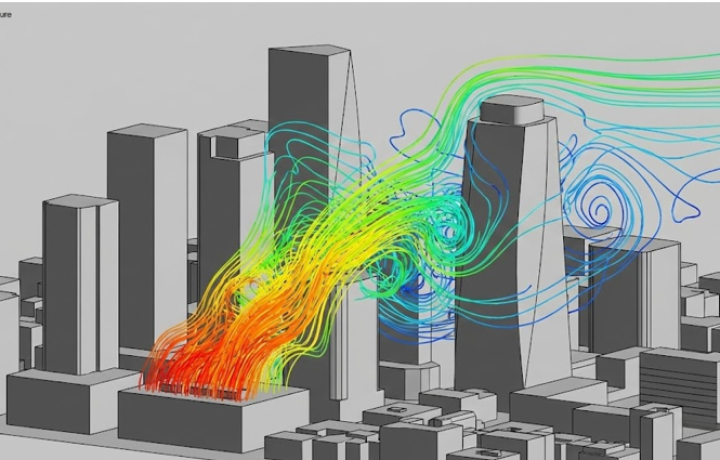
Similarly, Cooling Tower Analysis can investigate airflow interaction, thermal discharge, plume behavior, and possible recirculation. Cooling towers require suitable airflow conditions to reject heat effectively. A detailed simulation can help determine whether surrounding structures or neighboring equipment could influence performance. Such analysis can be particularly useful during new construction, expansion, or equipment relocation.
Occupant wellbeing is also an important consideration in modern building design. Thermal Comfort CFD Analysis evaluates environmental conditions that influence how people experience indoor spaces. Temperature, air velocity, ventilation patterns, and heat distribution can be studied throughout occupied zones. This helps identify areas that may experience excessive drafts, stagnant air, or undesirable temperature differences.
In the UAE, thermal comfort analysis CFD UAE applications can be especially valuable because outdoor environmental conditions can place substantial demands on mechanical cooling systems. CFD can help engineers explore different ventilation and cooling strategies while considering the interaction between building systems and occupied spaces. The objective is to achieve suitable comfort without creating unnecessary energy consumption.
Fire and life-safety engineering represent another major application. Tunnel Fire Modelling can simulate the movement of hot gases and smoke following a fire inside an enclosed transportation environment. Engineers can examine smoke spread, temperature development, ventilation performance, and conditions along evacuation routes. These simulations can help determine whether proposed smoke-control strategies provide suitable protection during emergency scenarios.
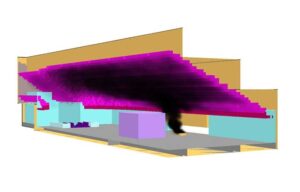
Smoke Modelling is also valuable for buildings, industrial facilities, large halls, and other enclosed environments. CFD can demonstrate how smoke travels through a space and how mechanical ventilation, extraction systems, openings, and building geometry affect its movement. Understanding these patterns allows engineering teams to evaluate smoke-management strategies more effectively.
Emergency evacuation can involve complex interactions between people, building geometry, and available exits. Crowd Modelling can simulate pedestrian movement and identify areas where congestion may occur. When combined with Egress Modelling, engineers can assess evacuation routes, exit capacity, movement times, and potential bottlenecks. These assessments provide useful information for life-safety planning and emergency preparedness.
The effectiveness of CFD depends not only on sophisticated software but also on engineering expertise. Accurate geometry, realistic boundary conditions, suitable assumptions, appropriate mesh quality, and meaningful scenarios are essential for producing reliable results. Professional interpretation is equally important because simulation data must ultimately be translated into practical design recommendations.
A specialist such as Lava Consultants can apply CFD techniques to a wide range of engineering challenges, from cooling optimization to thermal comfort and fire safety. A professional workflow generally includes project requirement assessment, geometry preparation, model development, scenario definition, simulation, result interpretation, and technical reporting.
As infrastructure becomes increasingly sophisticated, simulation-based engineering provides an effective way to reduce uncertainty and improve decision-making. Combining Data Centre CFD, Chiller yard CFD, Cooling Tower Analysis, Thermal Comfort CFD Analysis, Tunnel Fire Modelling, Crowd Modelling, Egress Modelling, and Smoke Modelling allows project teams to evaluate multiple performance and safety factors before implementing physical solutions.
With appropriate modelling methodology and professional engineering judgment, CFD can support safer facilities, improved thermal performance, better occupant comfort, and more reliable critical infrastructure. For organizations planning complex projects, simulation is not simply a visualization tool—it is a strategic engineering resource for making informed, evidence-based design decisions.