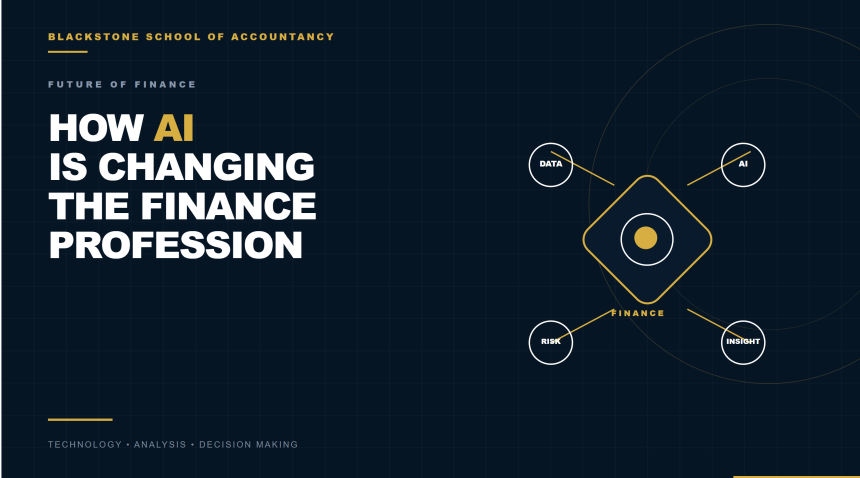

How AI Is Changing the Finance Profession
Lahore's premier destination for ACCA qualification and BSc (Hons) Professional Accountancy — powered by a University of London partnership and Big Four experienced faculty.
Artificial intelligence is no longer limited to technology companies. Banks, accounting firms, investment teams, and corporate finance departments are increasingly using AI to process information, automate repetitive work, and support financial decisions.
For finance professionals and students, understanding these tools is becoming increasingly useful. The goal isn't to replace traditional finance knowledge, but to combine it with technology skills that can improve speed, accuracy, and analysis.
Understanding AI in FinanceAI in finance refers to the use of artificial intelligence technologies to perform or support financial tasks. These can include analyzing large datasets, identifying patterns, automating reports, detecting unusual transactions, and assisting with forecasting.
Traditional financial analysis often requires professionals to collect information from multiple sources before interpreting it. AI tools can help process large volumes of structured and unstructured data much faster, allowing finance teams to spend more time reviewing results and making decisions.
This is why an AI in Finance Course can be useful for students and professionals who want to understand how artificial intelligence applies to real financial work.
Where AI Can Be Used in FinanceThere are many practical applications for AI across the financial sector.
Financial forecasting is one example. AI systems can examine historical sales, expenses, market information, and other variables to identify patterns that may help businesses plan future budgets.
Fraud detection is another important application. Financial institutions can analyze transaction behavior and flag unusual activity for further investigation. The technology doesn't necessarily make the final decision, but it can help analysts identify transactions that deserve attention.
AI can also assist with document processing, customer service, risk assessment, and financial reporting. Repetitive tasks that once required significant manual effort can often be streamlined with the right tools.
Why Finance Professionals Need AI SkillsFinance professionals traditionally need strong knowledge of accounting principles, financial reporting, taxation, economics, and business analysis. Those fundamentals remain important.
However, modern finance teams increasingly work with large datasets and digital systems. Professionals who understand how AI tools operate can potentially analyze information more efficiently and communicate more effectively with technical teams.
The most useful combination is often financial expertise plus technology awareness. A person who understands both can better judge whether an AI-generated result actually makes business sense.
What a Finance AI Bootcamp Can CoverA practical Finance AI Bootcamp can introduce learners to the ways AI tools can be applied to finance-related tasks.
Depending on the curriculum, learners may explore areas such as data analysis, automation, generative AI, financial forecasting, reporting, and responsible use of AI-generated information.
Hands-on exercises can be particularly valuable. For example, rather than simply learning what an AI model does, students could use a dataset to identify financial trends, generate an initial analysis, and then review the output for errors or misleading conclusions.
That final review is important. AI can process information quickly, but financial decisions still require human judgment.
AI Does Not Eliminate the Need for Financial KnowledgeOne common misconception is that learning AI means traditional finance skills are becoming unnecessary. In reality, AI makes financial knowledge more valuable in many situations.
Suppose an AI system produces a forecast suggesting that a company's costs will fall significantly. Someone still needs to examine the assumptions behind the forecast and determine whether the result is commercially realistic.
Without financial understanding, it can be difficult to recognize incorrect assumptions, incomplete data, or unusual results.
Building a Practical Skill SetStudents and professionals can gradually build their AI skills by focusing on practical applications rather than trying to learn every new technology at once.
A useful progression could involve:
- Understanding basic AI concepts
- Learning how financial data is structured
- Exploring AI-assisted analysis
- Practicing automation of repetitive tasks
- Learning to evaluate AI-generated results
- Understanding privacy, security, and responsible AI use
This approach makes the technology easier to connect with existing finance knowledge.
The Future of Finance and AIAI will likely continue changing how finance teams work. Some routine tasks may become increasingly automated, while professionals may spend more time interpreting information, advising management, managing risk, and making strategic decisions.
For students entering the field, developing both accounting or finance expertise and AI literacy can provide a broader professional foundation. The strongest advantage may not come from simply knowing how to use an AI tool, but from knowing when to use it, how to evaluate its output, and where human judgment is still required.
ConclusionArtificial intelligence is becoming an important part of modern financial work, from forecasting and fraud detection to data analysis and automation. Learning how these technologies fit into finance can help professionals adapt to changing workplace requirements.
For anyone building a career in finance, combining established financial knowledge with practical AI skills is a sensible way to prepare for a profession that is becoming increasingly data-driven and technology-focused.

The Importance of Self Contained Breathing Apparatus in Firefighting a...
Reliable Fencing and Gate Installation Services in Hobart for Better P...


Exploring High-Quality 2-Pin and 3-Pin Power Cords for Different Appli...

البُشْرَى: عِبَادَةٌ وَأَمَلٌ وَأثَرٌ Good Tidings: An Act of Worship,...
