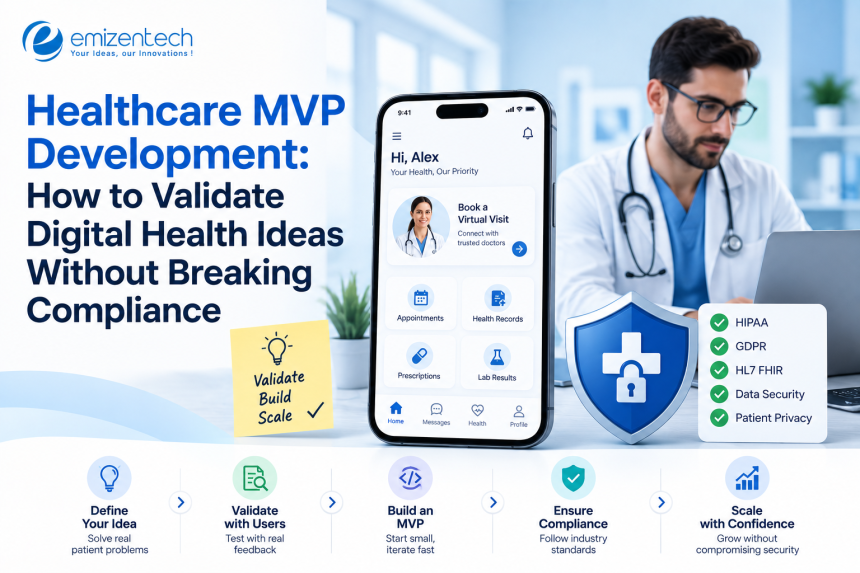

Healthcare MVP Development: How to Validate Digital Health Ideas Without Breaking Compliance
Avoid costly compliance mistakes in healthtech. Explore our step-by-step guide to developing, testing, and launching a secure healthcare MVP.
In traditional consumer technology, the golden rule of product creation is to move fast, break things, and iterate quickly based on direct user feedback. In digital health, however, following that approach often leads straight to regulatory penalties, damaged corporate reputations, or severe medical liabilities. The fundamental healthtech paradox stems from the fact that modern startups must innovate rapidly while simultaneously maintaining total compliance with rigid data governance frameworks. A single privacy violation or software glitch can instantly undermine user trust and shut down a promising digital health company before it gains market traction.
To achieve sustainable market entry, founders must recognize that a successful minimum viable product cannot treat security as an afterthought. Delivering genuine clinical value requires balancing fast digital health validation with robust protection of sensitive medical data. Building a healthcare application requires embedding compliance directly into the software architecture from day one. Choosing expert healthcare app development services helps teams strike the optimal balance between speed to market and safety. When security forms the foundation of product discovery, founders can safely validate core product hypotheses, secure clinical buy-in, and scale operations smoothly without falling into costly legal traps.
Navigating the Regulatory Minefield Before DevelopmentBefore writing a single line of code, health tech founders must thoroughly analyse the complex legal landscape that governs digital health applications across target markets and clinical environments.
Establishing Core HIPAA & GDPR Data Protection Safeguards
Protecting health information requires strict adherence to privacy rules, security standards, and breach notification guidelines. Developers must enforce the minimum necessary standard to collect only essential clinical data points.
Determining FDA Software as a Medical Device Classification
Software that analyzes clinical data or provides automated diagnostic recommendations may qualify as a medical device. Product teams must verify clearance requirements early to prevent severe pre-launch regulatory delays.
Executing Business Associate Agreements With Cloud Service Vendors
Consumer third-party software platforms lack the necessary controls for sensitive medical records. Healthcare applications must only integrate with infrastructure vendors willing to execute legally binding Business Associate Agreements.
How to Validate Your Idea Without Triggering Compliance DebtValidating a healthtech concept requires clever testing frameworks that gather real-world clinical feedback without exposing early product builds to immense data compliance liabilities.
Conducting On-Site Clinical Workflow Shadowing and Research
Observing doctors and nurses directly in their daily clinical workflows highlights operational friction points. Early research ensures product features solve high-priority operational bottlenecks without requiring early patient data intake.
Leveraging Compliance-as-a-Service Cloud Infrastructure Platforms
Building compliant server infrastructure from scratch burns capital unnecessarily. Leveraging pre-audited cloud environments allows startups to implement enterprise-grade security protocols faster while drastically lowering early engineering overhead costs.
Utilizing De-Identified Datasets and Synthetic Medical Records
Testing data processing pipelines with synthetic or scrubbed medical records removes personal health information from early builds. This approach allows teams to validate product mechanics safely without triggering regulatory oversight.
Architecting the MVP Tech Stack for Future ScaleA scalable healthcare architecture must support seamless external integrations, robust data encryption protocols, and strict access controls to accommodate future enterprise growth smoothly.
Implementing Universal Interoperability via FHIR and HL7 Standards
Isolating clinical data within proprietary database formats limits long-term platform viability. Integrating standard FHIR frameworks enables seamless communication with major hospital enterprise systems like Epic and Cerner.
Enforcing End-to-End Encryption and Access Governance Protocols
Safeguarding health records demands end-to-end encryption across all data pathways. Implement role-based access controls and multi-factor authentication to ensure only authorized personnel access sensitive patient information.
Maintaining Comprehensive Audit Logs and System Event Tracking
Regulatory frameworks mandate complete visibility into data interactions. Building automated, tamper-proof system audit logs tracks every view, edit, or export of patient records to simplify compliance audits.
The 5-Step Healthcare MVP Development ProcessBuilding a compliant digital health product requires a structured development process that balances rapid feature validation with systematic risk management.
Step 1: Regulatory Mapping and Business Discovery Analysis
Identify specific regulatory boundaries based on target geographic markets and clinical usage parameters. Defining legal requirements early guides initial technical feature selection and prevents unexpected redesigns.
Step 2: Low-Cognitive-Load UX/UI Prototyping for Clinical Environments
Design intuitive interfaces tailored specifically for high-stress medical environments. Prioritizing accessibility standards ensures both medical professionals and patients navigate software workflows quickly and accurately.
Step 3: Core Encrypted Application Development and API Integration
Engineer the functional minimum viable feature set using secure coding practices. Focus strictly on solving the primary user problem while embedding necessary encryption and access control protocols.
Step 4: Comprehensive Security Testing, Penetration Scans, and Audits
Conduct thorough vulnerability assessments and third-party penetration testing prior to deployment. Identifying security vulnerabilities early protects the platform against data breaches during early clinical trials.
Step 5: Controlled Pilot Launch within Shadow Clinical Settings
Deploy the minimum viable product within a small, controlled clinical setting to monitor performance. Gathering real-time feedback allows engineering teams to refine feature sets safely before scaling publicly.
ConclusionBuilding a successful digital health platform demands a strategic balance between clinical usability, technical performance, and uncompromised regulatory compliance. By addressing data security early, leveraging modern interoperability standards, and validating workflows through synthetic data or controlled pilots, healthtech teams can prove market demand without accumulating massive compliance debt. Launching a compliant minimum viable product is not about stripping away security to build faster; it is about building a secure, tightly focused software foundation that solves a single medical or administrative pain point exceptionally well. Partnering with a specialized software engineering firm like EmizenTech ensures your product navigates complex regulatory frameworks smoothly while delivering real clinical value to users from day one.
FAQs1. What makes a healthcare MVP different from a standard SaaS MVP?A standard SaaS MVP often focuses purely on user features and rapid iteration, leaving secondary items like advanced security for later stages. In contrast, a healthcare MVP requires regulatory compliance, data encryption, access controls, and vendor agreements to be fully integrated into the architecture before launching to early users.
2. How much does it cost to build a HIPAA-compliant healthcare MVP?The cost of developing a healthcare minimum viable product varies widely depending on feature complexity, platform integrations, and regulatory scope. Generally, building a secure, compliant healthcare application with core features and basic EHR integration ranges from $40,000 to $100,000+, depending on the scope of security testing required.
3. Can I test my healthtech app idea without handling actual patient data?Yes, testing concepts with synthetic medical records, scrubbed datasets, or clickable prototypes allows startups to validate workflows and user experience without handling actual Protected Health Information (PHI). This approach significantly lowers early regulatory burden during initial user testing.
4. Do I need to integrate FHIR or HL7 standards into my early MVP?While not strictly mandatory for standalone consumer health tools, adopting FHIR or HL7 standards early is highly recommended if your long-term goal involves connecting with hospital electronic health record (EHR) systems. Building on these interoperability standards from the start prevents costly database re-engineering down the road.