
Giants' Elimination: FIFA WC 2026
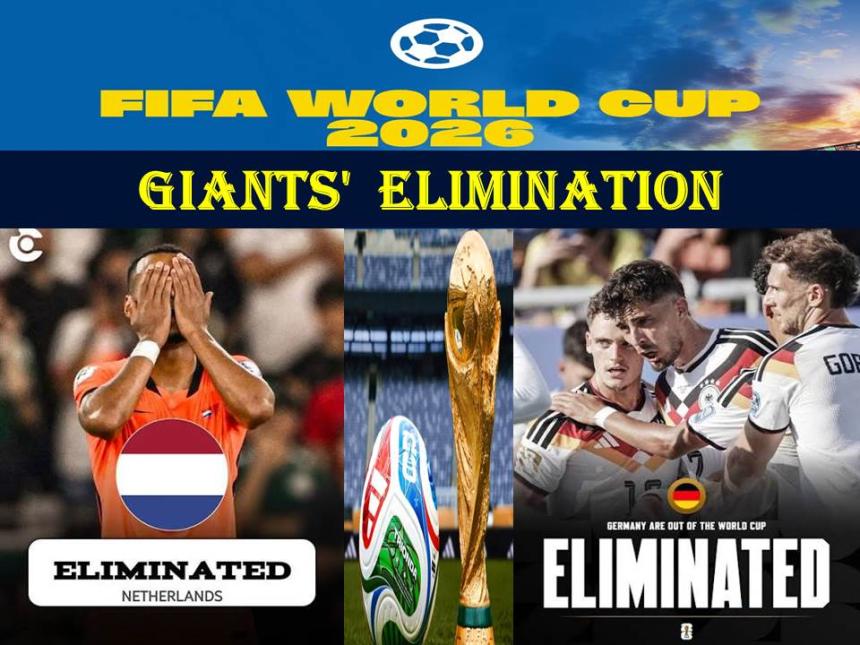
Football also known as soccer, is a family of team sports, managed by 'International Association Football Federation' (FIFA). The FIFA World Cup is a football competition among the men's national teams held every four years. FIFA World Cup 2026™ is 23rd edition tournament, which began on June 11, 2026. This write up "Giants' Elimination: FIFA WC 2026" is about the elimination of two strong teams; Germany and Netherlands during Ist knockout stage.
أَعُوذُ بِاللّٰهِ مِنَ الشَّيْطَانِ الرَّجِيمِ
بِسۡمِ ٱللهِ ٱلرَّحۡمَـٰنِ ٱلرَّحِيمِ
In the name of ALLAH, the Most Gracious, the Most Merciful
Giants' Elimination: FIFA WC 2026
Germany and the Netherlands were both eliminated from the 2026 FIFA World Cup on June 29 in dramatic Round of 32 penalty shootouts following 1-1 draws. Germany lost 4-3 to Paraguay, and the Netherlands fell 3-2 to Morocco. Both European giants suffered early tournament exits in near-identical, shocking fashion. Let's dig out more in this regards with some historical references.
Long before the FIFA's first World Cup, people all over the world played games with balls. It is said that Chinese (206 B.C.) played a game called Cuju. Players kicked a leather ball through a small net. Greeks and Romans played games that involved kicking and carrying balls on fields; and during medieval times in England; people played "mob football" in towns. Hundreds of people would try to move a pig's bladder to a rival town's center. It was violent and had no rules.
In the early 1800s, English schools started playing football. However, every school had different rules. At some schools, players could pick up and run with the ball. At other schools, they could only use their feet. This made playing against other schools very difficult. In 1863, leaders from different English schools and clubs met in London. They agreed on a single set of rules. They banned using hands to carry the ball. That made two distinct games; one became "Rugby" where players were allowed to pick up and run with the ball. The other is now known as "Soccer".
Football, also known as soccer, is the world's most favorite sport. It commands an estimated 3.5 billion fans across the globe. Its massive popularity is driven by its simple rules, minimal equipment requirements, and massive international tournaments like the FIFA World Cup. Globally, an estimated 240 to 275 million people actively play association football (soccer). This massive figure, frequently cited by the Federation Internationale de Football Association (FIFA), encompasses all active participants, including registered amateurs, youth players, and professionals worldwide.
Football is a team sport where two teams maneuver a ball into each other's goal to score points, primarily involving kicking or carrying by foot or throw-in by hand; it primarily is a sport, played with foot by teams of eleven players each. The sports might have been played by many nations across the length and breadth of the planet Earth; however, since its inception as a regulated sports played by nations on competitive basis, some nations are leading the sports arena as "Giants".
FIFA World Cup started in the year 1930 and was hosted and won by Uruguay, featuring just 13 teams; all participating by invitation rather than a qualification process. The 13 nations included seven from South America, four from Europe, and two from North America. The next edition of FIFA WC in 1938 comprised 16 teams and this strength continued till 1954. Then the next upgradation to 24 team’s competition took place in 1982, which was further enhanced to 32 teams in 1998. All the FIFA WC was always dominated by European and South American Nations.
FIFA WC 2026™ is 23rd edition and a record 48 teams are participating in this World Cup. This marked a major tournament expansion from the previous 32-teams format and also the composition of the regional blocks. In this tournament Europe has sixteen (16) teams and South America has six (6) teams. The other 26 teams have inclusion of nine (09) Asian Teams; ten (10) African Teams and One (01) Oceania Team. This composition itself is reflecting the changing shape of soccer competition. This also reflects that the standard of soccer in Asia and Africa is on rise and this FIFA WC 2026 may in the end put up many surprise outcomes.
FIFA WC 2026: First Major Upset
FIFA WC 2026 started with a big surprise, as Italy was not part of this tournament. Four-time champions Italy have failed to qualify for the World Cup for the third consecutive time. Despite the tournament expanding to 48 teams, Italy missed out after finishing second to Norway in their qualifying group and losing to Bosnia and Herzegovina in a penalty shootout during the UEFA playoffs.
Two giants of FIFA soccer since ages, namely Germany and Holland, have been eliminated in first knockout stage. Germany and the Netherlands were dramatically eliminated from the 2026 FIFA World Cup in the round of 32. Both European heavyweights fell on penalty shootouts, with Germany losing to Paraguay and the Dutch falling to Morocco, marking one of the most surprising early exits in the tournament's history.
Germany enjoyed 12 podium finishes (3rd place or better) in 20 tournament participations. Germany is one of the most successful national teams at the FIFA World Cup, winning four titles, earning second-place and third-place finishes four times each. Similarly, Netherlands remained Runners-up in the FIFA World Cups 1974, 1978, and 2010; and holds the record for the longest unbeaten streak in FIFA World Cup history, going an incredible 16 consecutive matches without a loss in regular or extra time.The Dutch hold the unique record of being eliminated from three World Cup editions without losing a single match.
What Happened to Failing Giants on the Field FIFA WC 2026?
Steve Magness @stevemagness: Author of "Do Hard Things & Win the Inside Game" has written following on X.com about Germany loss to Paraguay in the round of 32 matches:-
"After 120 minutes of play, Germany was tied with Paraguay. Off to penalty kicks they went. Through the normal five attempts for each side, they were deadlocked 3–3, with Manuel Neuer keeping Germany alive by saving two Paraguay penalties. As they moved into the sixth attempt on each side, it was essentially do or die.
For the higher-ranked German squad, they weren’t supposed to be in this situation. They were supposed to comfortably handle a Paraguay team that, a week earlier, had been outplayed by the U.S. But here they were, staving off elimination. Still, you’d think a side from a historic footballing nation, filled with players from the top leagues in Europe, would handle the pressure. Yet, in deciding who would take that sixth kick, the cracks showed.
With it all tied up, no one wanted the sixth kick. According to reports, players “hesitated and dodged.” Germany’s manager asked one player twice whether he’d step up; he declined. The man who finally stepped forward had never taken a penalty in his professional career. And he missed. Germany lost. Knocked out by a squad everyone had written off a week before.
These were stars, men who play for some of the biggest clubs in the world. Yet when the moment came, they shied away. They didn’t want the spotlight, or the pressure.
This piece isn’t about calling out those players. It’s about what their hesitation shows us about pressure: that even the best of the best, people who have trained their whole lives for the moment, can crumble. And more importantly, what we can do about it — so that when the lights are brightest, we step forward with confidence.
The Science of Pressure
Stress is messy. Even the best of the best can be pulled toward avoidance. In fact, too often, it’s the default. Psychologist Geir Jordet has spent his career studying the ultimate pressure platform — penalty kicks — and his work helps explain what happened to Germany, and what happens to the rest of us.
Our brain hates uncertainty. One way, it tries to reduce that is to “just get it over with,” or to avoid experiencing the situation at all. The more pressure that’s felt — whether from history or internal expectations — the more we’re nudged toward avoidance.
In his work, Jordet found that kicks where a miss means you instantly lose produce far more avoidance behavior. Players look away, their eyes dart around, they speed up the run-up “to get it over with.” And they miss at a much higher rate: about 92% are converted when scoring wins it, but just 62% when missing loses it. Similarly, players from teams with a history of shootout failure perform worse, rushing the shot and looking away from the keeper far more often. This holds even when the player taking the kick had no part in those past struggles. And he found that higher-”status” players — the bigger names — performed worse. The public expectation increases the weight the player feels.
Penalty kicks are the ultimate display of how pressure distorts us. It takes a typically confident, competent maestro of the sport and reduces him to someone who sends the ball sailing over the bar, looking more like a U8 player than a professional.
How does this happen?
Stress causes us to narrow. It’s a system that evolved to help us survive situations where our life might be at risk. Do we fight, flee, or freeze to handle the snake in the bushes or the bear in the distance? It’s designed to nudge us — and sometimes force us — toward a response.
But stress isn’t a single response. It’s multifaceted. We can see this at the hormonal level: the mixture of adrenaline, cortisol, and testosterone shifts depending on the context and our reaction. The way I like to think of it is that stress is our body’s best guess at how to prepare for the moment. Sometimes that guess tells us we can’t handle the situation, and our best tactic is avoidance — or even preparing for injury (our immune system ramps up when we sense damage is imminent). Other times, the guess is to take the situation on: a jolt of energy, the fear subsiding just long enough for us to press forward.
Which way we go depends on our brain’s inner calculus. That best guess varies based on:
-Past experiences in similar situations
-Our appraisal of the demands we face and our ability to handle them
-How we define success and failure
-Our interpretation of the feelings, emotions, and mood we’re experiencing right now
-Our level of support
-Our identity — whether it’s fully on the line, or secure even in a loss
All of that information shapes the bet our brain makes on how to handle the moment. And if the stakes are high enough, it’s really hard to overcome the pull toward avoidance. The fear of failure — of embarrassing ourselves, of letting down our country — is incredibly powerful. Because, it’s not just a win or a loss on the line; it’s our identity, what we’ll be known for the rest of our lives. That burden is heavy, even when it’s your job.
When the weight of the world is on you, it pushes you toward protection. And one of the simplest ways to protect yourself is to say, “Not me.” Which is why; many of the German players chose avoidance. Decades ago Kahneman and Tversky showed that the failure you chose stings more than the failure that merely happened to you. While work by Ilana Ritov and Jonathan Baron found the pull toward inaction grows even stronger when you know you'll have to stand there and watch the result. So, in the moment, letting someone else take the kick feels safer, because missing one you chose to take is one of the most painful types of failure.
It’s the protective ego at work. The instant failure and embarrassment show up as real possibilities, our ego starts looking for an out. “Not me” makes rational sense to a protective brain. It’s the same instinct as the student who doesn’t study so he has his excuse ready before the test is even handed out. We’d rather protect the story of who we could have been than risk finding out, who we are in that moment.
Which is why; it's worth pausing on Jonathan Tah, the man who stepped forward. He had never taken a penalty in his career. He had, in a way, the least reason to volunteer and the most reason to hide. And he was the only one willing to walk into the arena knowing he might fail in front of the whole world. That is a rare thing. Even at the highest level.
Lothar Herbert Matthäus is a German football pundit and former professional player and manager. He captained West Germany to victory in the 1990 FIFA World Cup and was awarded the Ballon d'Or. In 1991, he was named the first FIFA World Player of the Year, and remains the only German to have received the award. He said the following on Germany crashing out of the 2026 FIFA World Cup after defeat to Paraguay:-
🗣️ “I am absolutely furious. This is not the Germany I know, and it’s certainly not the Germany I fought for. To be eliminated from the World Cup like this is unacceptable. Every player, every coach and every person involved with this team has to look in the mirror after tonight because this performance was nowhere near the standards expected of Germany.”
“You cannot wear the Germany shirt and play with so little urgency, so little aggression and so little belief. Paraguay fought for every ball like their lives depended on it, while Germany looked nervous, passive and completely out of ideas when the pressure arrived. We had enough quality to win this match, but football isn’t won by talent alone. It’s won by character, mentality and the willingness to suffer for your country.”
“I don’t want to hear excuses about bad luck, referees or penalties. Champions don’t hide behind excuses—they take responsibility. This defeat should hurt for a very long time because it was completely avoidable. Germany has let an entire nation down tonight. Credit to Paraguay, they deserved every second of this victory because they showed courage, discipline and heart. Germany forgot what it truly means to fight for this badge, and for me, that is the most painful part of all.” {@SkyNews}
Let's now read the Paraguay manager Gustavo Alfaro said about after the match win from Netherland as follows:-
🗣️ "I told them in the dressing room: 'I want to see 26 warriors sing the anthem and leave the field as legends.' And that's exactly what they did. We have thousands of flaws, but we have a heart that never gives up.They were trained in top-tier academies. We come from the red earth. Our jersey represents the stripes of that red earth, playing barefoot on that soil, with the sacrifice of our parents. We come from those places, and we don't win because of that, but we don't deny our origins because it's what defines us as a national team. It was an absolute demonstration of self-belief and conviction."
Another Upset !!! Morocco eliminated Netherlands from FIFA WC 2026.
Netherlands' World Cup Penalty Curse Continues as Morocco Ends Oranje's 2026 Dream. The Netherlands' heartbreaking run at the FIFA World Cup has taken another painful turn after the Oranje were eliminated by Morocco in a dramatic penalty shootout in the Round of 32 at the 2026 tournament. The match ended 1-1 after extra time, with Morocco producing a late comeback thanks to a crucial equaliser from Issa Diop. The Atlas Lions then held their nerve in the penalty shootout, winning 3-2 after the Dutch missed three spot-kicks. The defeat extends one of the most frustrating streaks in World Cup history. Despite avoiding defeat in regulation time for two decades, the Netherlands have repeatedly seen their campaigns end in penalty heartbreak.
Their recent World Cup record tells the story:
2014 (Brazil): Eliminated in the semifinals by Argentina after a 0-0 draw, losing on penalties.
2018 (Russia): Failed to qualify.
2022 (Qatar): Knocked out in the quarterfinals by Argentina after a thrilling 2-2 draw, again losing on penalties.
2026 (Canada, Mexico & USA): Eliminated in the Round of 32 by Morocco following a 1-1 draw and a 3-2 shootout defeat.
Perhaps the most astonishing statistic is that the Dutch have not lost a World Cup match within 90 minutes since 2006. Across their World Cup campaigns in 2014, 2022 and 2026, they played 17 matches without suffering a regulation-time defeat, yet still exited the tournament three times—twice to Argentina and now to Morocco—through the agony of penalty shootouts.
The latest defeat also further damages the Netherlands' already poor historical record in penalty shootouts at major international tournaments, a trend that has haunted one of football's most talented nations for decades. For Dutch fans, the 2026 World Cup will be remembered as another campaign filled with promise but ultimately ended by the cruel lottery of penalties, while Morocco celebrate another famous victory on the world stage.
Is European Football Eyeing some Crisis?
This query may be answered through a thread on X.com from "Historic Vids" @historyinmemes; which says as follows:-
The “Disgrace of Gijón” was the infamous 1982 FIFA World Cup match between West Germany and Austria in which West Germany and Austria played to a mutually beneficial result that allowed both teams to advance while eliminating Algeria back in June 25, 1982.
In 1982, Algeria national football team made it’s first-ever FIFA World Cup appearance and immediately stunned the football world. In its opening match, Algeria defeated the heavily favored West Germany national football team 2-1, despite the Germans entering the tournament as reigning European champions and one of the favorites to win it all. The victory remains one of the greatest upsets in World Cup history.
Algeria later lost to Austria but bounced back with a win over Chile, leaving qualification wide open. However, Algeria had already completed all of its group matches before West Germany faced Austria in Gijón, Spain. As a result, both teams knew exactly what scoreline would send them through. West Germany took an early lead through Horst Hrubesch. At 1-0, both West Germany and Austria would qualify, while Algeria would be eliminated on goal difference.
What followed became known as the “Disgrace of Gijón.” After the opening goal, both sides largely stopped attacking, instead passing the ball around without urgency. Angry fans booed, waved banknotes, and accused the teams of deliberately preserving the result. Algeria protested, but FIFA found no rule that allowed the match to be overturned. West Germany eventually reached the final, where they lost to Italy national football team.b
The controversy led to a lasting change in the World Cup. Beginning with the 1986 tournament, FIFA required the final group-stage matches to be played simultaneously, making it much harder for teams to manipulate results based on earlier games.
The Europe was a stronghold of Soccer / FootBall and it was played with pride and honesty. The "Disgrace of Gijón" probably was the beginning of the slide that is happening to European Football now.
"European football has spent the past fifteen years solving futbol like chess."
European football turned into chess: safe, measurable, and sterile. South America kept the street fight, — duels, chaos, and winners. Metrics optimize the average game. Heart and variance win the big ones. SIMPLE!
A generation of coaches optimized for pass completion, pressing triggers, territorial control, rest defense, and positional occupation.
The problem of this is that they optimize for what is measurable. Depth, the willingness to attack space early, attempt the difficult pass, dribble past a defender, or deliberately create chaos, is a high variance play. It fails more often than it succeeds. If you evaluate players by completion rate, ball retention, or positional discipline, those actions look like mistakes. So, they get coached out. Eventually, everyone converges toward the same local optimum.
The game becomes increasingly legible. Every team occupies similar spaces, presses in similar ways, builds from the back with similar patterns, and minimizes the same risks. Systems become better at defeating other systems, but worse at dealing with players who refuse to behave like systems.
South American football never fully abandoned the duel as the fundamental unit of the game. The 1v1 remained sacred. So did the tactical foul, the unpredictable dribble, and the player willing to lose possession five times; if the sixth breaks, the match open. The objective was never simply to preserve structure; it was to create someone capable of destroying the opponent’s structure. Football is not won by completing the most passes. It is won by scoring more goals than the other team. Those are related, but they are not the same objective.
This is the danger of optimizing proxies. When everyone optimizes the same measurements, they stop optimizing for victory itself. They optimize for looking efficient. Italy may have been the first major European football culture to lose part of its identity this way. Its historical advantage was never athletic superiority or perfect positional play. It was tactical asymmetry, unpredictability, and an instinct for making matches uncomfortable. As Italian football converged toward the same coaching model as the rest of Europe, it gradually surrendered the qualities that had made it different.
The broader lesson extends well beyond football. Every optimization process eventually risks becoming self-defeating. Metrics become targets. Proxies replace objectives. Variance is mistaken for error. The outliers capable of breaking the system disappear because the system itself learns to eliminate them.
Oliver Rolf Kahn is a German football executive and former professional player who played as a goalkeeper; has probably seen the real problem is German's as European Football. He says following on X.com:-
"Three national team coaches have failed at the same point: Joachim Löw, Hansi Flick, and Julian Nagelsmann. Three different game plans; Three different leadership styles. When three coaches with different approaches always fail at the same point, the cause lies deeper. One scene says more about this elimination than any statistic. When the penalty shootout went beyond 5 takers, you could see Joshua Kimmich looking for penalty takers. For me, that was the most revealing moment of this elimination. A top team doesn't look for volunteers at that moment. They have players who demand the ball
Germany doesn’t have a talent problem. This team has exceptional footballers. What they lack is the confidence to take responsibility in the biggest moment. Those who don’t take it may be protecting themselves from failure. But at the same time, they’re forfeiting the chance to make history "We're arguing about who has to go now and pinning our hopes on the next savior instead of asking why we've been repeating the same patterns for years. We replace faces and call it change. But we avoid the real question: Are we still willing to pay the price that elite performance has always demanded?
The defining moment doesn't begin when you put on the national team shirt. It begins many years earlier, the moment a young player learns that responsibility isn't something you pass on to someone else, and it’s something you take on yourself. Talent gets you to the World Cup. Responsibility determines how long you stay there."
The Rise of Other Nations in FIFA WC
South American teams are so hard to play against, not because they’re necessarily better than you but because they force you to play their game, not yours. They don’t care if they only have 30% possession or if people call their football ugly. Their entire focus is on winning every duel, staying compact, frustrating you, and making every single attack feel like you’re running into a brick wall.
Tactically, they’re incredibly disciplined. The distances between the defenders and midfielders are so small that there are barely any passing lanes through the middle. If you want to break them down, you’re usually forced wide, and even then they’re aggressive in the box and dominant in aerial duels. They defend every cross like it’s the last minute of a World Cup final.
They’re also masters of controlling the rhythm of a game. They’ll slow it down when they need to, speed it up when there’s space, commit tactical fouls, win cheap free kicks, and make every restart take just a little longer. It can be frustrating to watch if you’re supporting the other team, but it’s an art they’ve perfected over decades.
And then there’s the mentality. South American teams genuinely believe they can beat anyone. Whether it’s Brazil, Argentina, Uruguay, Paraguay, or Colombia, they embrace suffering. They’ll defend for 90 minutes if that’s what the match demands, and when that one counterattack or set piece arrives, they’ll take it without hesitation.
That’s why European possession-heavy teams often struggle against them. Having 70% of the ball means nothing if you can’t create clear chances. South American sides are comfortable without possession because they know football matches are decided by moments, not possession statistics. They’re patient, ruthless, and incredibly difficult to break down when they commit to a defensive game plan.
Japan defender Junnosuke Suzuki said recently "The furthest we've made it in the World Cup is the Round of 16." He added "But I believe that Japan can win this World Cup. I actually like that they call us the dark horse and underestimate us a little bit. In the past few years, Japan has been putting up a good fight against strong football nations, and winning. I don't intend to lose to Brazil in this next match. We are in it to win it."
The Conclusion
A careful analysis of FIFA WC games over the last decade indicates the rise of soccer standards in nations other than Europe and South America particularly in Africa. African teams had a historic tournament in 2026. Out of 10 African countries, nine advanced to the knockout stages. This means almost 90% of African teams made it past the first round. This success is largely because top African players regularly compete in major European leagues, such as those in England, Spain, and France. For example, 20 players in Morocco's 26-man squad play in Europe.
The Asian Nations are still lagging behind Europe, South American and now even Africa, because most Asian players stay in local domestic leagues and the gap in speed, tactics, and strength show that Asian players need more experience in top modern soccer leagues to match the world's best.
European soccer is not falling in overall quality or global dominance, though traditional powerhouse national teams like Italy, Germany and the Netherlands are experiencing notable slumps. However, Europe still boasts the richest leagues, pays the highest salaries, and controls the sport financially. The FIFA World Cups during next decade (2030 & 2034) could be very interesting; since the Asian and African Nations are on rise politically and economically.



Prepare for Tomorrow’s Technology Careers with IT Training in Bilaspur...

Book Taxi Online: A Simple Way to Make Every Journey Easier
Book Taxi Online