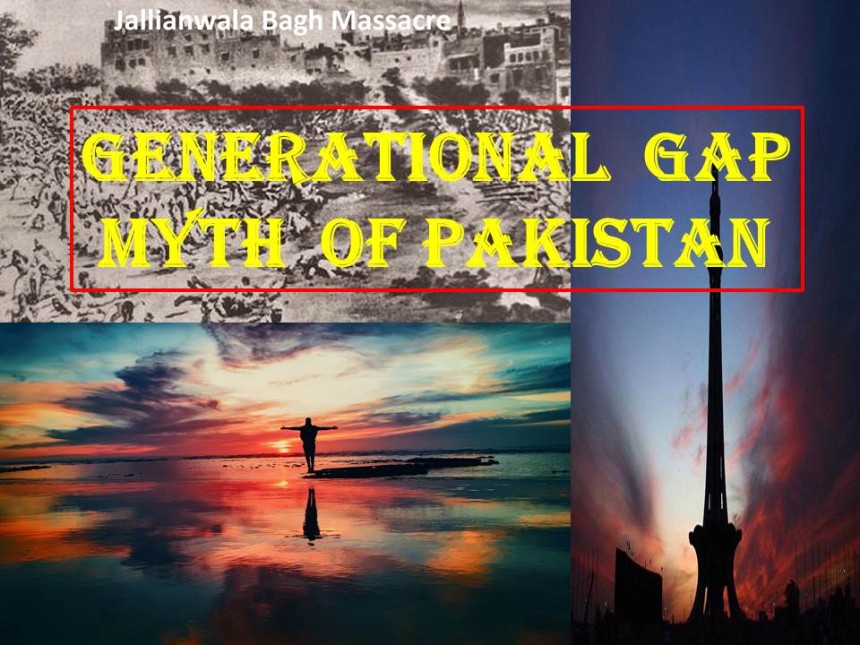

Generational Gap Myth of Pakistan
The human story from generation to generation refers to the continuity of human life journeys, heritage, and experiences, values, and challenges passed down from one generation to the next. This write up "Generational Gap Myth of Pakistan" is an attempt to summarize the generational story of Pakistan established in 1947 to reach current happenings; especially the spark ignition of gen zee.
بِسۡمِ ٱللهِ ٱلرَّحۡمَـٰنِ ٱلرَّحِيمِ
In the name of ALLAH, the Most Gracious, the Most Merciful
Generational Gap Myth of Pakistan
It is a constant prescription of the life of the world that the youth of every nation are the assets, hope and pride of its future and the children of today are the adults and decision-makers of tomorrow; therefore, sensible nations pay attention to the health, education and training of their children to guarantee their future; and they do not neglect any minute for this. But it is also a fact that since the world has embarked on a journey of rapid development; the generation gap controversy has emerged with some intensity in the mortal world; but if you look closely, this matter is not new.
In the modern era, there has been rapid infrastructure development and population growth; which all is due to the technological advancement; and as a result of which the difference between human races began to become clear as soon as it hit the market. The difference from one generation to another began to be seen in a short period of time; so the timeline of one generation to another began to be described by the years of birth; this generation timeline can be described in a map with names as follows:-.
The generation before 1928 is not officially named, but the generation before 1900 includes the "Lost Generation" (those who were young and fought during World War I) and the "Greatest Generation" (those born between 1900 and 1928).
The Silent Generation (1928-1945);
Baby Boomers (1946-1964);
Generation X (1965-1980);
Generation Y (Millennials) (1981-1996);
Generation Z (1997-2012);
and now Generation Alpha (those born after 2012).
This sequence identifies groups of people born in different decades. Note that this classification was initiated after World War I; so that, it is a hundred-year-old tradition; and from one generation to another, a new status has been given with a difference of fifteen years. But all these classifications may be correct for Western countries; but in the Indo-Pak subcontinent and Bangladesh, the above classification does not make much sense. And there are positive reasons for this.
The racial labels - Boomers, Gen X, Millennials, etc. are largely Western-made and do not seem appropriate in the context of countries like Pakistan. In the West, the era of baby boomers defined the post-war peace and prosperity; which enabled the building, expansion and innovative efforts of global institutions. The beginning of today's digital technology was possible thanks to these individuals.
The purpose of this article is to discuss the generational classification in the context of Pakistan's history; therefore, it is necessary to describe this classification in a slightly different way. A division can be made as follows:-
The Founding Generation (born before independence in 1947);
The First Free Generation (1947-1971);
New Pakistan Generation (1971-1988);
Unknown Generation (Lost Generation) (1988-1999);
Generation Z (Rebel Generation) (1999-2018);
And now Generation Alpha who are born after 2018; and are still in education but are aware of the latest information of the world. And technology has taken away their childhood; because their parents have made them addicted to mobile phones.
This is not a matter of age or years but of mentality
Pakistan is now about to turn eighty years old and in eight decades, Pakistan's history has been a mere collection of experiments; which has been fundamentally different from the history of all Western developed countries. The factors that clearly emerge in this entire history are political instability; weak economy; backward institutions; the journey of social development hindered by obstacles and the shocks of repeated military interventions. All our generations have mostly contributed to the stagnation i.e status quo; instead of providing leadership. This explains the legacy of perseverance in safety to avoid unknown dangers. We can say that Pakistan had achieved territorial independence; but as a human being, slavery is embedded in the soul and veins of our nation; and we are slaves from generation to generation. For this, let's look at the generation-by-generation classification described above in little detail.
Founding Generation (Pre-Independence 1947). There are two more classifications of the predecessor generation; one is those born before 1930 and the other those who were born afterwards. This predecessor generation dominated the power corridor of Pakistan for many decades. But they were never free; because their decisions did not represent a free spirit; and perhaps they did not have the ability to do so. And the reason for this is the history of slavery from last century. Let us briefly look at it.
In 1857 AD, the East India Company defeated the Mughal Crown and gained control over Delhi. And then took steps to consolidate its control. First, it declared the war of independence of the people of India as a rebellion and killed thousands of people for several decades on charges of the rebellion; and thus the people capable of leadership through out the length and breadth of the Indian subcontinent were wiped out; and then people loyal to the British Crown were placed in governmental positions. When Pakistan was created, the yoke of all kinds of leadership was placed on the shoulders of the heirs of those people. This was the power of elite slaves who were called the ruler of an independent Pakistan.
The British Crown had closed the doors of politics and the right to rule to the Muslims of India; but on the other hand the Indian National Congress (INC) was founded on 28 December 1885 in Bombay (Mumbai) by the British civil servant Allan Octavian Hume and Indian nationalist leaders like Dadabhai Naoroji and Surendranath Banerjee. Initially, the party was created to provide a platform for educated Indians (who had acquired their education from the English education system) to discuss governance; to be a "safety valve" and to propose constitutional amendments within the empire. This was a declaration of subservience and politics was done by Indians obediently.
British educational policy in India was a successful attempt to create an educated society of English language speaking gangs and English cultural trained elite; which was ethnically Indian but culturally European; i.e., a copy of Western culture; like a coconut; brown on the outside and white on the inside. The aim of this policy was to recruit educated Indians who were loyal to the British as clerks in their offices and such clerks became officers after independence. Even after independence, Pakistanis could not get rid of the British education system and a slave mentality continued to be produced.
The All India Muslim League (which later became the founding party of Pakistan under Quaid-e-Azam) was formed on 30 December 1906 at the All India Educational Conference under the leadership of Nawab Salimullah in Dhaka (it is worth noting that this meeting was held under the Educational Conference) to protect the political rights of Muslims in British India, remove their backwardness, combat the dominance of the Hindu majority Congress and ensure separate political representation in the form of separate constituencies. Its first president was Sir Aga Khan. It was formed in 1905 after a Muslim delegation met Lord Minto on the partition of Bengal; who consolidated Muslim political identity and advocated loyalty to the British Crown for the protection of his community. (Note that here too, there is no mention of independence; rather, loyalty to the British Crown).
Indians were first allowed to enter the prestigious Indian Civil Service (ICS) through the Charter Act of 1853, which established open competitive examinations; and the first examination was held in London in 1855; and the first Indian, Satyendra Nath Tagore, was selected in 1863. Recruitment in India began later, with examinations held in India from 1922, but especially after 1939, the participation of Indians increased.
The British Indian Service was structured under the Indian Civil Service (ICS) for the "natives" (Indians), initially into the Crown (mostly British) and non-Oath (Indians at the lower levels), later divided by the Aitchison Commission into Imperial, Provincial and Subordinate Services, including District (Collector, Police, Magistrate), Police, Technical and Engineering. Eventually, reforms such as the Government of India Acts of 1919 and 1935 expanded the All-India and Central Services, bringing more Indian citizens into the higher administration; although largely under the control of the British Crown.
This arrangement continued after independence and all these departments and their employees had a particular mentality and even after the creation of Pakistan, no attempt was made to change that mentality. If Pakistan was an independent state, why did its ruling elite not try to make the affairs of the state independent? Because it was mostly the offspring of intellectual slaves; which never withered and is flourishing well even today.
We all know that the state of Pakistan came into existence due to the enthusiastic leadership of Quaid-e-Azam; which was possible due to the right to vote at the end of a stormy struggle. The British government announced that elections would be held in 1946 and if the results of the elections proved the Muslim League to be the representative party of the Muslims, then Pakistan would be created by accepting the demand of Quaid-e-Azam Muhammad Ali Jinnah. The Muslim League won this election with a huge majority and thus India was divided and Pakistan was created.
In this 1946 election, voting was based on property ownership. Compared to universal suffrage, the right to vote was kept quite limited; therefore, only less than 10% (ten percent) of the population could vote. But after the establishment of Pakistan, the successful people of this election were declared members of the Constituent and Legislative Assembly and it took nine years to form the constitution. The astonishing fact was that that constitution was also a copy of the Indian Act of the British Crown. The spirit of an independent state was given the yoke of constitutional slavery, which continuously fostered a slave mentality at the official level.
The Story of Pain and Sorrow
The All India Muslim League of Quaid-e-Azam Muhammad Ali Jinnah made the Two Nation Theory its central political ideology for the freedom of the Muslims of India. The Two Nation Theory is that Hindus and Muslims are two separate nations, whose civilization, culture, history, and religious values are different from each other and this is not a separate identity based on religion alone but a complete nationality, due to which there was a need for two separate states in the subcontinent and on the basis of this ideology, Pakistan was established. But after the death of the Father of the Nation, Quaid-e-Millat Liaquat Ali Khan was assassinated, after which no one had the courage to work on this ideology; therefore, the dear homeland was made a laboratory of governance; which continues till now.
The three pillars of the state were constitutionally and legally enslaved since the establishment of Pakistan; so whether it was about legislation or the administrative enforcement of the law or the judicial decisions of the justice system; all were done under the slave mentality. The oppression was such huge that a large number of the nation remained averse to knowledge and saw the dreams of the future separately from the ruling elite. But all the institutions established under the constitution and law, whose purpose was to work for the welfare and well-being of the citizens; they made themselves "brown saheb" and babu-shahi and the nation was enslaved by the elite people. The citizens of the God-given state of Pakistan were separated in the distinction between special and "Awam"; and the resources of the nation were limited, so they could only benefit the special ones.
Now let's move on to the subject itself; at the time of establishment, the population of Pakistan can be divided into two large parts. The urban population; which was only ten percent of the entire population of thirty-five million and the rest were rural people. Only fifteen percent of this population was educated; the majority of which were urban. But how many were there urban areas? At that time, there were only a few cities; namely Lahore; Multan; Sialkot; Peshawar; Quetta; Karachi and Hyderabad. The composition of this population changed considerably due to migration after the creation of Pakistan. It was about 6.5-7 million people. Karachi, which had become the capital, became the largest city due to migration. And being the only port and a major commercial and industrial city, it is still the most populous city of the country.
An important role in the generational story of Pakistan is the election of 1946 AD. The Muslim League had promoted the two-nation theory in this election; which was popularly interpreted with these slogans; "If you are a Muslim, join the Muslim League"; “What does Pakistan mean; La ilaha illallah"? These slogans were cast as an ideological election and the founding generation of Pakistan was influenced by this ideology and the partition and riots of Punjab had strengthened this ideology. The educational standard among the migrant population was high and the migration riots had made them quite active. But despite being ideologically connected to Pakistan, they could not become part of the ruling elite. Due to which a class conflict emerged. This conflict took on a strange color as the citizens joined the race for cars, bungalows and bank accounts in pursuit of worldly desires. It is like the metaphorical “rat race”, a continuous, competitive and often stressful cycle; which gives rise to unfulfilled dreams; which is only a race to earn money for survival and material possessions; which always remains without achieving real fulfillment or freedom.
Both parts of the ruling elite of the founding generation of Pakistan eventually found their well-being in the Western world; and made their home there; the state of Pakistan was their pasture; from where it was easy to loot and amass wealth. But the large part of the population who were born before 1930 and could not leave Pakistan; They learned the lesson of "anything for survival" and made corruption widespread. This generation made a bangla, car and a bank balance and also put their children on the same path; who were born after 1930. Since the establishment of Pakistan, this same founding generation ruled for the first fifty years. The country was divided and with each passing day the homeland became weaker and poorer; but the founding generation's property in country and abroad kept increasing. According to an estimate, Pakistanis have billions of dollars in foreign treasury and the beloved homeland is indebted to billions of dollars. This founding generation is now in its graves and is being abused by its ancestors. If on the land where the ancestors face public insults and curses; how can the ancestors be at peace in their graves under this land?
The story is not over yet
Now is the story of Pakistan's first free generation (1947-1971) which was born after August 14, 1947 AD and grew up until the country's division, that is, December 1971. The story of this generation is a story of "sometimes happiness, sometimes sorrow (some sun shine, some shadow)". This is the generation that was told when it came to its senses that you are lucky to have been born in a free country. This generation was taught the story of the Pakistan Movement in Pakistan Studies. The two-nation theory was explained to it; because the creator of Pakistan, the founding generation, had the opportunity to learn directly from Quaid-e-Azam. They were told that the country had become independent through a legal democratic struggle; but they found themselves under martial law. And the doctrine of necessity reigned in the country. They were taught to "keep quiet, bear it and be happy". A conscious hypocrisy was instilled in their veins. "Smile on the lips and tears in the eyes" is the distinguishing features of this generation.
The first free generation (1947-1971) participated in the Khatm-e-Nubuwwat movement; raised the slogan "Ayub is a dog, how sad!", saw industrial prosperity and agricultural green revolution and saw the eastern wing of the country cut off due to poverty, despite the historical six percent average growth of GDP. This generation saw the socialist Islam of General Ayub's son Zulfi Bhutto and also saw Bhutto hanged for excessive self-promotion. Then the man of faith, the man of truth; suffered the martial law of General Zia-ul-Haq. This generation raised the slogan "Asia is red; Asia is green". And then saw all those strong walls crumble to the ground when General Zia's plane "burst in the air" and the Berlin Wall fell.
The first free generation of Pakistan (1947-1971) had many conveniences in its life; one of them was that even after the compulsory education, one could get a job; be it government or private; but it was obtained through connections or recommendations. If a degree holder and a highly educated person did not get a suitable job on merit, his father would go and find some kind of employment through bribe. This generation achieved another feat by throwing off the scorn of its predecessors as Brown Sahib and donning the title of Sahib Bahadur. Instead of a pant coat, it wore a waistcoat over a shalwar kameez and transformed itself; now it is no longer brown on the outside and white on the inside like a coconut; rather, it has become a white sheep or lamb on the outside but a black dog on the inside. If given a bone, it wags its tail and if not, it growls and bites.
Pakistan's first independent generation (1947-1971) won the Hockey World Cup and the Olympic Gold Medal; also won the Cricket World Cup; and also made a name for itself in the curse of match-fixing or gambling. In the game of squash, Jahangir Khan and Jansher Khan are also part of this generation; who maintained the honor of squash for Pakistan for a whole decade. This generation, in the company of Dr. Qadeer Khan, made Pakistan a nuclear power and also mastered missile technology. But this same generation joined hands with "the chain of four provinces; the daughter of the East; Benazir Bhutto" and made the practice of bribery with connections common through the "placement bureau" for the distribution of talents; those familiar with the situation of that time say that bribery and nepotism began during the era of "the believing man, the man of truth".
The first free generation of Pakistan (1947-1971) today, are masters of the black and white of the state and they occupy all the places and positions of the state. And history is perhaps unable to form an opinion on the present time. What opinion will history form about the fate of this generation; only time will tell. But it can be said with certainty that the generations follow the paths shown and established by their predecessors; and the first free generation of Pakistan (1947-1971) has gained more than fifty years of experience; and the behavior of the "New Pakistan generation" (1971-1988) that came after them is already visible today. The poison of hypocrisy has been instilled in the veins of this "New Pakistan generation" from the very beginning and they seem to have more than two faces. It seems difficult for them to say a word of good to their ancestors. But whatever happens, this story is about to end now; that is the principle of nature in this mortal world.
The party has just begun
Pakistan's "New Pakistan generation" (1971-1988) is part of the second ladder of the founding generation of Pakistan and is the sign of Zulfi Bhutto's "New Pakistan". Zulfi Bhutto's story, the story of Pakistan's generation-by-generation history, illustrates the story of a sick mentality. When Zulfi Bhutto, who had been associated with "Here we are, there you are"; came to power in Pakistan, he gave the good news to the nation that the broken Pakistan was Jinnah's Pakistan; now it is "New Pakistan"; which he will take to the sky of development. For this development, he raised the slogan of Islamic socialism. He had declared that God be kept in the mosque and in the temple too; and also in the heart of the servant; So why should he be included in the business and government affairs? He had told the nation that he had laid the foundation of the journey of progress that would reach the sky; and the foundations were just being laid when he was hanged by his chosen General Zia-ul-Haq. Zulfi Bhutto had buried the two-nation theory; which was drowned in the Bay of Bengal by the Indian Prime Minister Indira Gandhi.
We have been reading and hearing that the two-nation theory was revived and the "believing man, the man of truth" took up the task of implementing the Medina style system for the revival of Islam. He waged Afghan Jihad and made the Hudud Ordinance mandatory by making prayer and salat mandatory. Now just consider that the "new Pakistan generation" was facing a strange dilemma; they had emerged from Islamic socialism and were stuck in the implementation of the Medina style system. This generation had put on a strong self-preservation under the philosophy of survival from the very beginning; and put on many faces on its face. Wherever a face was needed, it presented itself; religious, liberal, free-thinking, fundamentalist honest, workaholic, active / great thief, that is, this generation wears all kinds of masks. This generation today is in the subordinate position in the corridors of power and state and is growing with great satisfaction in the harmony of the first free generation of Pakistan. Their true color in the state of Pakistan will be known in the next decade. It can be said that the party is about to start for them; yes, if the series of extension and expansion does not continue to be long. Some faces of this generation have now started the party but their gathering has not reached its zenith. On what height does this gathering climb and what color does it show; we will have to wait a little?
We are strangers; Travelers of Lost Paths
Pakistan's fourth generation can be called the Unknown Generation (Lost Generation) (1988-1999). This generation entered the world after the explosion of the Pakistani President's plane; and came to its senses in Pakistan's "Lost Decade of Democracy". This is a period marked by severe political instability, weak governance, and the continued influence of the military despite the return of civilian rule after 1988. They grew up after the fall of the Berlin Wall and the end of the Cold War and are about to enter adolescence after the tragedy of 9/11. This fourth generation is now about to pass through adolescence and enter the threshold of consciousness and wisdom. But the achievements that are associated with youth and adulthood around the world; this Pakistani fourth generation has failed to achieve it.
Pakistan won the first and last Cricket World Cup in 1992; all of whose players belonged to the first generation after independence. Hockey, which is also the national sport of Pakistan and in which several Olympic gold medals were won; but the last Olympic medal was won in the 1992 Barcelona Olympics. The last gold medal was in the 1984 Los Angeles Olympics; all of which were the achievements of the first free generation. The last gold medal in squash was won by Jansher Khan in 1996 and the last team gold medal was won in 1992. The only achievement of this generation is Arshad Nadeem, who won Pakistan's only medal to date in the javelin throw at the 2024 Paris Olympics. Apart from this, the fourth generation of Pakistan is a strange species in the world and is probably a traveler on a lost path. It remains to be seen what outstanding achievements this generation can accomplish in the coming time; but their time in the world of sports has ended; but there is a lot is left in other places and titles are waiting for them.
Why is there a commotion?
The fifth generation of Pakistan, Generation Z (1999-2018), is being called a rebellious generation. The article "It's Over" published in a newspaper by Zorain Nizamani, a representative of this generation, has struck a chord; because this writing has revealed the mentality of this young generation; and this changed mentality has created a commotion in the ranks of the older generations. This writing is the anger of this generation that has been considered a rebellion; but what has become more profound and shocking is the expression of freedom from the mental slavery of the ancestors. This is not an argument of Gen Z vs. Boomers. This is a rejection of the slavish thinking, the method of governing and the outdated methods of controlling the thinking of the nation or the people; which are not compatible with today's living ground realities.
Today's living ground realities are that this generation of Pakistan is facing and equal to Generation Zee around the world; and considers itself worthy of competing with them and is doing so fearlessly and openly. This is a huge change. To understand this generation, we need to know about Generation Z. Generation Z focuses on technological fluency, mental health, diversity, and purpose-driven values, making it more innovative and inclusive. They face challenges such as increased anxiety, digital addiction, cell phone dependence, and a lack of economic pressure and flexibility. Generation Z is a generation of highly comfortable environments with technology, social media, and digital communication driving innovation. This generation prioritizes purpose, authenticity, inclusiveness, diversity, and mental well-being in work and life.
Generation Z is independent, adaptable, and learns quickly; often seeks information online. Strong advocates for social justice, equality, and system change. A growing number are defining their own paths through freelancing and creating online businesses. Generation Z’s strengths are rooted in their digital fluency and desire for a more just, authentic world, while their challenges stem from the environment in which they grew up — a highly connected, economically unstable digital age awaits them; But they are not afraid of it.
The world's affairs have started to deteriorate with the growth of the world's Generation Z (1997-2012); this generation is still young and has not yet reached any positions of power in the world's affairs system; but its element of rebellion has started to show. And the reason for this is only the activation of the digital age. This is the age of high-speed internet and every young person has a mobile / cell phone in his hand; which connects him to the whole world; and especially without any discrimination and hatred. And the most important thing for Pakistan is for this generation is growing together with worlds' gen zee.
The world's leaders taught the whole world the lesson of democracy under the United Nations and Western nations; and assured the superiority of human rights, freedom (personality, expression, communication), and the advancement of humanity. And it was said that it is important for all humans to work together for peace and prosperity. This message was well-received since World War II. Generation Z is not ready to accept the superiority of any particular country or nation. Because the rapid mass information received on a cell phone has exposed the propaganda that has been going on for fifty years.
Generation Z (Pakistanis, like the rest of the world) is a generation living a new lifestyle and is truly a global village citizen; who is growing up with a mindset that transcends borders of any kind. They are perhaps the generation that best reflects the UN Charter; the concept of an international human being that may not have come out of utopia but is embedded in the thoughts of this generation Z. Generation Z is perhaps seeing man today through the eyes of man and in this reflection no color, language or region becomes a barrier. They are born in one country, live in another country and have taken citizenship; but work in another country; they are citizens of the digital age and breathe; eat; drink and live life through cell phones. They truly believe in the dignity and respect of man and live beyond political differences. This is why Generation Z protested in universities around the world against Israel's inhuman attack on Gaza. This protest was an expression of Generation Z's compassion for man and hatred and anger for the oppressors.
Now no celebrity, no critic, no intellectual can fake an event. And the principles under which this Generation Z (Pakistani as well as the rest of the world) has gone through the stages of education and training and the criteria to which they were bound; under which they have come to know the truth; and which they are also expressing openly; and this is a severe shock to the Baby Boomers and Generation X and the idea that they (Generation Boomers and Xers) have spent their entire lives in a deception is even more painful. The sudden tragic end of a good romantic film is also deadly; and perhaps this is why Baby Boomers and Generation Xers call Generation Z rebellious.
Closing Remarks
Zorain Nizamani’s article reflects the international thinking described above; therefore, it is not the impatience of youth but a departure from the rotten and decayed structure. Today’s youth are more informed, more connected; and are not at all willing to accept such narratives; which seek to gain credibility for opportunistic slogans and self-interest. Their dissatisfaction meets the test of reason and consciousness. And historically, such dissatisfaction has often been the starting point of renewal, not its enemy. It becomes a metaphor for the best guarantee of a future for a nation.
Living societies move forward; and always seek improvement; and no quest is devoid of curiosity. Therefore, it is important that instead of punishment and hindrance in this process, questions should be encouraged and their questions should be answered honestly and cheerfully. Pakistan's fifth generation, Generation Z (1999-2018), is challenging the hereditary enslaved assumptions and ambitions, so this is a good thing and all the previous generations of the nation should allow this. This is the hope and investment for Pakistan's bright future. And perhaps as a result, our children will live proudly in the world tomorrow.
Khalil Gibran's "On Children"
Now at the end, a poem by the distinguished philosopher Khalil Gibran is presented; which should always be a message "On Children.
Your children are not your children.
They are the sons and daughters of Life’s longing for itself.
They come through you but not from you,
And though they are with you yet they belong not to you.
You may give them your love but not your thoughts,
For they have their own thoughts.
You may house their bodies but not their souls,
For their souls dwell in the house of tomorrow,
which you cannot visit, not even in your dreams.
You may strive to be like them, but seek not to make them like you.
For life goes not backward nor tarries with yesterday.
You are the bows from which your children as living arrows are sent forth.
The archer sees the mark upon the path of the infinite,
and He bends you with His might that His arrows may go swift and far.
Let your bending in the archer’s hand be for gladness;
For even as He loves the arrow that flies,
so He loves also the bow that is stable.