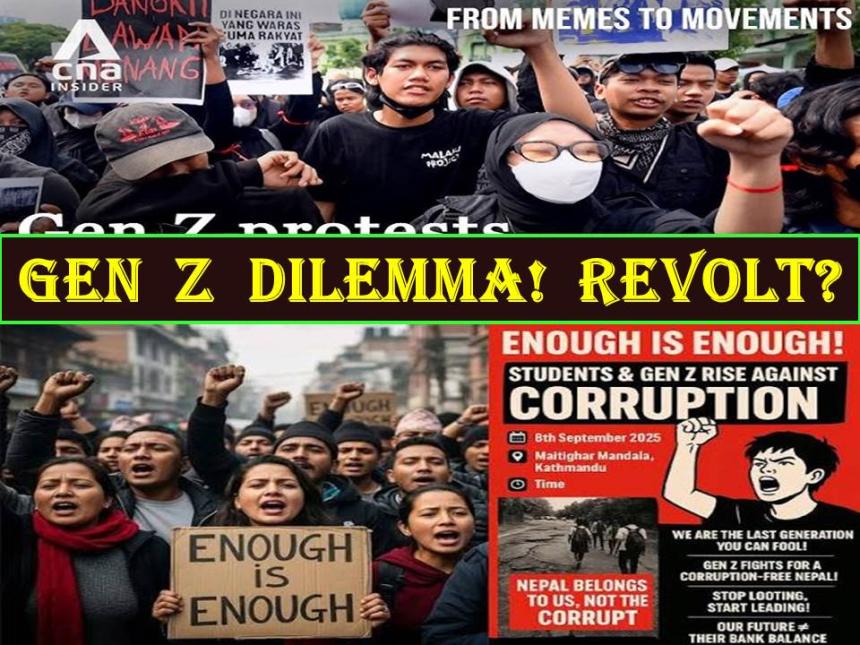

Gen Z Dilemma! Revolt?
Generation Z (or Gen Z) is the demographic group born roughly from 1997 to 2012 and also known as "digital natives" or "Zoomers", they are the first generation to grow up with smartphones, high-speed internet, and social media always around them. They are the focal generation now, moving through the institutions of higher studies or filling positions in lower ranks of workforce in the job market. This write up "Gen Z Dilemma! Revolt?" is an opinion on the raging debate about Gen Z Rebellion.
أَعُوذُ بِاللّٰهِ مِنَ الشَّيْطَانِ الرَّجِيمِ
بِسۡمِ ٱللهِ ٱلرَّحۡمَـٰنِ ٱلرَّحِيمِ
اللہ کے نام سے شروع جو بڑا مہربان نہایت رحم کرنے والا ہے
In the name of ALLAH, the Most Gracious, the Most Merciful
The Gen Z Dilemma! Revolt?
Generation Z (or Gen Z) is the demographic group born roughly from 1997 to 2012, sitting after Millennials and before Generation Alpha. Also known as "digital natives" or "Zoomers", they are the first generation to grow up with smartphones, high-speed internet, and social media always around them. They are the focal generation now, moving through the institutions of higher studies or filling positions in lower ranks of workforce in the job market. It is very important to know the challenges and resources available to the future of humans' destiny; so what are those?
Generation Z are primarily the offspring of Generation X (Born roughly from 1965 to 1980, they are the primary parents for the majority of Gen Z); though younger members can also have older Millennial parents. If the "Boomers" are finding problems with Gen Z, then how can the parents (mostly Xers) absolve themselves from the consequences of their parenting; success or failure? We will talk about parenting a little later and first know the delima being faced by Gen Z and if they are revolting.
UNICEF views that "Generation Z faces a complex mix of mental health struggles, economic instability, and digital burnout, but they also have access to an unprecedented array of digital tools, modern workplace policies, and community-driven resources to help them navigate these hurdles. Being flooded with algorithmic content and constant global news crises causes severe cognitive fatigue and a shorter attention span."
A "ResearchGate" study finds "Gen Z experiences regular loneliness at nearly twice the rate of older generations. Constant "doom scrolling" and a lack of real-world connection leave many feeling socially isolated and anxious." Gen Z use technology effortlessly and communicate mostly through online platforms, apps, and video. They value open-mindedness, care deeply about human rights, and accept people from all backgrounds. Growing up during economic shifts and global crises has made many of them financially careful and independent.
The Resources Available to Gen Z
Despite hurdles, Gen Z is highly proactive about finding support, using both new technology and shifting cultural norms to their advantage.
1. Mental Health & Well-being
Therapy Access: Gen Z has actively normalized mental health treatment, with nearly a third seeking professional therapy for grief and anxiety.
Digital Support Networks: Global organizations like UNICEF provide targeted mental health insights and guides specifically designed for youth dealing with crisis fatigue.
Crisis Lines & Apps: Telehealth platforms, mindfulness apps, and text-based crisis lines offer immediate, discreet counseling directly from a smartphone.
2. Career & Financial Growth
Flexible Work & Autonomy: Forward-thinking companies are adapting by offering flexible hours, remote options, and mentorship programs to combat burnout.
Alternative Economies: Gen Z leans heavily into the gig economy, digital entrepreneurship, and specialized freelancing to bypass traditional corporate limits.
Financial Literacy Tools: App-based budgeting, micro-investing platforms, and online financial content creators provide accessible wealth management education.
3. Education & Skill Building
Micro-learning & Digital Archives: Rather than relies solely on traditional textbooks, Gen Z relies on video-based learning and decentralized open-source platforms to upskill rapidly.
Skills-First Training: An increasing global focus on vocational education and AI-integration tools allows Zoomers to gain employment without relying strictly on expensive university degrees.
The Core Challenges being Faced By Gen Z
A Research Gate Paper rates "Mental Health & Loneliness" a real concerns for Gen Z; "they experiences regular loneliness at nearly twice the rate of older generations. Constant "doom scrolling" and a lack of real-world connection leave many feeling socially isolated and anxious". UNICEF considers "Information Overload" as a concern as Gen Z has been flooded with algorithmic content and constant global news crises causes severe cognitive fatigue and a shorter attention span.
An Academia.edu paper considers "Economic Security & Housing" a growing threat for Gen Z;saying "High living costs, inflation, and soaring rent prices make traditional milestones like buying a home or building savings feel out of reach". Lastly, a YouTube channel says "Workplace Burnout & Stress" is effecting Gen Z output and "balancing heavy workloads with personal life is a struggle for nearly half of Gen Z workers. Many feel overwhelmed by traditional corporate structures, resulting in a widespread rejection of managerial promotions due to stress".
Across the globe, the single most common bond uniting Generation Z is that they are the world's first true digital natives, completely connected by mobile internet, social media, and video-first communication. Making up roughly 23% of the global population (nearly 2 billion people), their shared digital lifestyle has created a borderless youth culture with highly synchronized behaviors.
Social media is their search engine. Roughly 97% of Gen Z globally learns about new products through social platforms, and 85% use them to research items before making a purchase (ResearchGate).Across dozens of countries, consuming short-form video content multiple times a week is a near-universal habit (e.g., over 83% of young women globally report this routine .... IPSOS).
Growing up under the shadow of climate anxiety, pandemic disruptions, and inflation has made Gen Z globally risk-averse and highly focused on financial security. (Mckinsey &Company). More than three-quarters (77%) of Gen Z globally state that saving money for the future is highly important to them, prioritizing financial independence over getting famous (Earnests & Young).
Whether in the West, Latin America, or Asia, Gen Z leads global trends in openly discussing psychological well-being. Approximately 40% of Gen Z worldwide report experiencing mental health challenges and actively advocate for workplace or educational mental health resources.
"Value-Driven" Professional and Consumer Expectations
Ethical Brand Loyalty: Globally, about 55% of Gen Z consumers actively choose eco-friendly and socially responsible brands, expecting transparency from companies they buy from.
Purpose over Paycheck: They refuse to view a job as just a paycheck. Nearly 89% say a sense of purpose at work improves their well-being, and roughly 64% insist on working for an employer who shares their personal values.
Entrepreneurial Spirit: Frustrated by traditional corporate setups, nearly 44% of Gen Z worldwide express a strong desire to start their own business or pursue a "portfolio career" of freelancing.
Parenting Available to Gen Z
Parents from Generation X faced unique societal shifts that deeply impacted how they raised Generation Z. Sociologists generally view the relationship between Gen X and Gen Z not as a rebellion, but as a direct reaction to how Gen X themselves were raised.
Gen X broken down traditional authority barriers. They prioritized emotional openness and mental health discussions, creating a very close friendship-like bond with their Gen Z children.
The traits that critics view negatively in Gen Z are often the direct, unintended results of Gen X's protective parenting. Gen X provided early access to technology for safety and educational tracking. This accidentally created the first digitally native generation, leading to unprecedented levels of screen time and social media anxiety. Gen X's focus on mental health validation made Gen Z highly emotionally articulate. However, older generations sometimes misinterpret this openness as fragility or entitlement.
Ultimately, Gen X succeeded in creating a highly resilient, socially conscious, and emotionally intelligent generation. The friction between Gen Z and older workplace or societal norms is a standard generational cycle, rather "Rebellion". Yes, Gen Z behavior can absolutely be called rebellious, but it is a distinct, strategic type of rebellion compared to past generations.
Gen Z Rebellion???
Instead of traditional rebellion—which usually involves breaking rules for individual freedom or shock value—Gen Z practices rebellion with a purpose or a systemic "reset". Research shows that 74% of Gen Z embraces a rebellious spirit, widely viewing disruption as a positive life skill.
Globally, Gen Z has transitioned from online activism to leading powerful, decentralized street rebellions. From historical protests across multiple continents (globalnation.inquirer.net) against corruption and inequality, they have actively toppled governments and forced constitutional updates. They reject traditional political structures, opting for leaderless, highly adaptable digital organizing networks via platforms like TikTok and Discord (Harvard Kennedy School).
Gen Z is radically disrupting corporate norms. Their rebellion in the professional world manifests as "Quiet Quitting" & Tang Ping ("Lying Flat"). Gen Z refuses the "hustle culture" embraced by older generations. They intentionally perform exactly what their contract requires to protect their mental health. They demand transparency, flat corporate structures, and psychological safety, completely ignoring traditional workplace authority chains.
Gen Z in Pakistan through Lens of Gallup Surveys
62% of Pakistanis Expect the Next Generation to Be Economically Better Off; Younger Adults (72%) Most Optimistic— Gallup & Gilani Survey (Islamabad), 15th July 2026. A survey conducted by Gallup & Gilani Pakistan finds that most Pakistanis anticipate improved economic conditions for the next generation (those recently born) compared to their own.
A nationally representative sample of adult Pakistanis from across the country was asked the following question: “In your opinion, will the next generation (those recently born) be better off, worse off, or about the same compared to you in the following aspects?-In terms of economic status?”
In response, 62% of respondents said the next generation will be ‘better off’, 24% said they will be ‘worse off, 7% said ‘about the same’, 3% said ‘don’t know’, and 4% ‘gave no response’. Overall, the survey highlights that a majority of Pakistanis are hopeful about the economic prospects of the next generation, particularly among young adults. These findings offer insights into public expectations of intergenerational economic mobility and can guide policymakers in shaping strategies that support youth opportunities and equitable growth.
(https://gallup.com.pk/post/40104?twclid=24fsn4oseyr40xgj5j89n680d9)
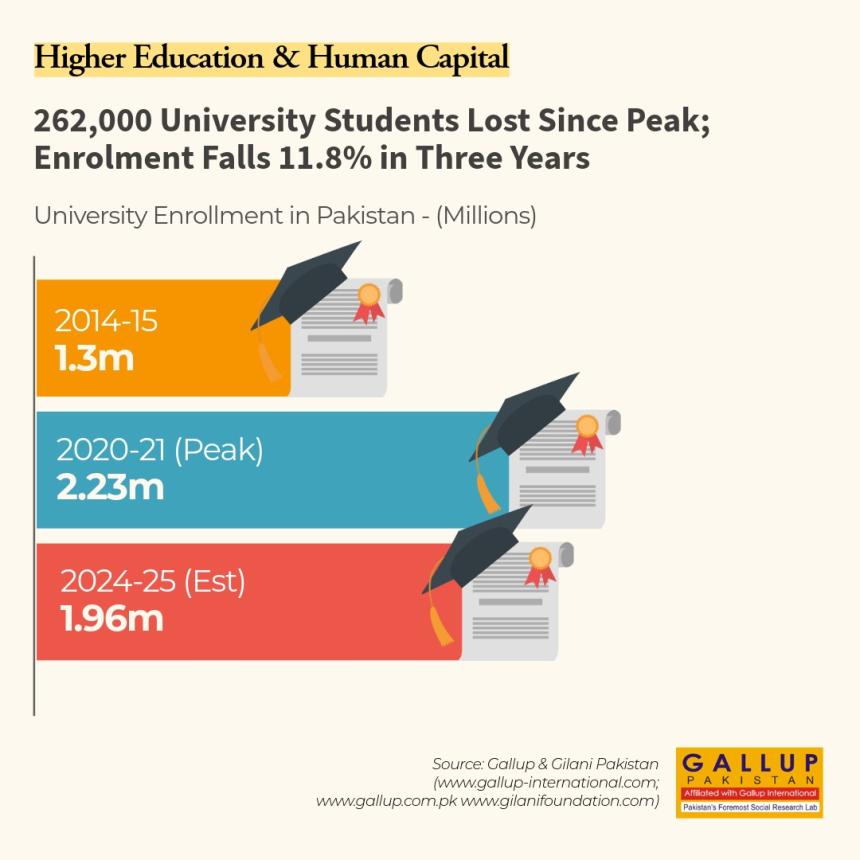
Pakistan’s university enrolment has entered a period of decline after a decade of rapid expansion. According to data from the Pakistan Economic Survey 2025, University enrolment increased steadily from 1.30 million in 2014–15 to 2.23 million as total university enrolment peaked in 2020–21. By 2024–25 (estimated), enrolment had fallen to 1.96 million, representing a loss of approximately 262,000 students and a decline of 11.8% from the peak. The decline coincides with a period marked by economic uncertainty, high inflation, rising education costs, currency depreciation, and increased outward migration.
While Pakistan spent much of the last decade expanding access to higher education, the emerging challenge may no longer be capacity alone, but sustaining student participation and ensuring attractive opportunities for graduates.The data suggest that the policy debate is shifting from how many university seats exist to how effectively higher education connects students with economic opportunity.
The massive surge in Pakistan’s university enrolment between 2014 and 2021 was heavily driven by Generation Z entering higher education, though they are also the primary group driving the recent decline. Generation Z began hitting college age (18+) around 2015. Pakistan boasts one of the youngest populations globally, with over 60% of citizens under the age of 30. As this massive Gen Z cohort reached university age, the baseline demand for tertiary education naturally skyrocketed and suddenly after 2022 it’s dropping with the middle of Gen Z reaching university age. The question which should be asked and researched is the "Cause for Sudden Fall in University Enrollment".
Conclusion
Gen Z is a global, digitally connected, and value-driven generation that transcends traditional borders, making them less bound by strict nationalist dogma. Instead of local territories, they unite around shared online spaces, social causes, and global digital cultures. Generation Z achieves vast global reach and cross-cultural linkage through digital hyper-connectivity, shared internet subcultures, and social media platforms. This environment fosters intuitive global awareness, bypassing traditional geographic and national borders.
Gen Z is a digitally native generation, and many Pakistani Gen Z youth are explicitly bypassing traditional degrees in favor of digital skills like e-commerce, coding, and freelancing. Having watched older millennial siblings struggle with unemployment despite holding degrees, they prioritize immediate, internet-based income streams over a 4-year degree.
Generation Z views politics with deep skepticism, prioritizing concrete actions, tangible policy results, and structural reform over empty campaign slogans. Rather than being easily swayed by traditional rhetoric, young voters globally evaluate leaders based on functional performance regarding economic and social pressures.
Generation Z can provide viable political leadership by offering digital mobilization, collaborative governance, and authentic issue-based advocacy, though they face challenges bridging online activism with long-term institutional strategy. As older members of this generation enter public office, their approach to leadership displays distinct characteristics and hurdles. The events unfolded after #Bangladesh_ Student_ Protests 2024 and India's #JantarMantar Protests may be quoted as prime examples.
Looking for Tax Debt Relief Services in Canada? Read This Guide
Discover how tax debt relief services work in Canada, from CRA payment arrangements and ta...