
Future of Field Service Management Through Digital Innovation
Explore how modern field service solutions improve efficiency, predictive maintenance, technician productivity, and customer satisfaction.
Introduction
In today’s fast-paced business environment, customer expectations are continuously evolving. Organizations that provide installation, maintenance, repair, and support services are under increasing pressure to deliver fast, reliable, and high-quality service experiences. Customers expect quick responses, transparent communication, and efficient issue resolution, making field service management a critical component of business success.
However, managing field operations effectively is not always easy. Service organizations often face challenges such as inefficient scheduling, limited visibility into technician activities, communication gaps, and rising operational costs. These issues can impact productivity, customer satisfaction, and overall profitability.
To remain competitive, businesses are embracing digital transformation strategies that modernize service operations. Advanced technologies now enable organizations to automate processes, improve coordination, and make data-driven decisions that enhance service performance across the entire customer lifecycle.
Understanding the Importance of Modern Field Service Management
Field service management involves coordinating resources, technicians, equipment, and customer requests to ensure timely and effective service delivery. Whether a company operates in manufacturing, healthcare, utilities, telecommunications, or professional services, efficient field operations directly influence customer experiences.
Traditional service management methods often rely on manual processes that consume valuable time and resources. Scheduling appointments manually, managing paperwork, and tracking service histories through disconnected systems can lead to delays and operational inefficiencies.
Modern field service solutions help organizations centralize information, automate workflows, and improve communication among teams. This allows businesses to respond faster to customer needs while maintaining consistent service quality.
Key Challenges Facing Service-Based Organizations
As service operations expand, businesses encounter various obstacles that affect performance and customer satisfaction.
One common challenge is resource allocation. Dispatching technicians without considering location, skill set, or availability often results in longer travel times and reduced productivity. Similarly, poor communication between office staff and field teams can create misunderstandings that delay service completion.
Inventory management is another critical concern. Technicians who arrive at a job site without the necessary parts or tools may need to schedule additional visits, increasing costs and frustrating customers.
Additionally, organizations frequently struggle with obtaining accurate operational insights. Without real-time visibility into service activities, it becomes difficult to identify inefficiencies and implement meaningful improvements.
Addressing these challenges requires a connected and intelligent approach to service management.
Why Real-Time Visibility Matters
Visibility plays a significant role in successful field service operations. Service managers need access to accurate information regarding technician locations, job statuses, customer requests, and inventory availability.
Real-time visibility helps organizations make informed decisions quickly. Managers can monitor workloads, adjust schedules when necessary, and respond proactively to unexpected service disruptions. This level of awareness improves operational agility and helps businesses maintain service commitments.
Furthermore, access to real-time data enables organizations to track performance metrics, identify trends, and optimize processes. Better visibility ultimately leads to improved efficiency and enhanced customer experiences.
How Dynamics 365 Field Service Improves Operational Performance
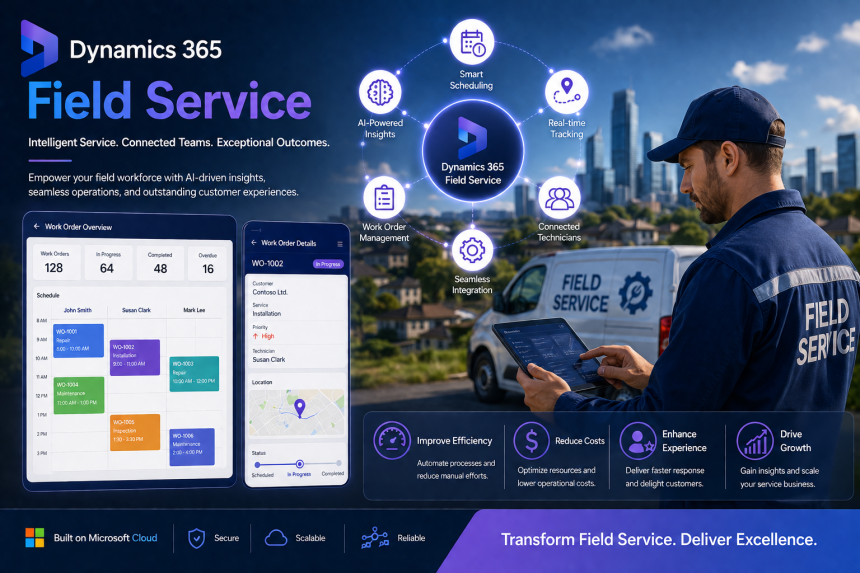
As businesses seek innovative solutions to manage increasingly complex service environments, Dynamics 365 Field Service has become a preferred platform for modern field service operations. Designed to streamline workflows and enhance productivity, the solution helps organizations deliver efficient and customer-focused service experiences.
One of the most valuable features of Dynamics 365 Field Service is intelligent scheduling and dispatching. The platform automatically assigns service requests based on technician expertise, availability, and geographic location. This ensures that the right technician is assigned to the right task, reducing travel time and improving resource utilization.
The solution also centralizes customer information, asset histories, and work orders within a single system. Technicians can access the information they need before arriving on-site, enabling them to resolve issues faster and improve first-time fix rates.
By connecting field teams, service managers, and customers through a unified platform, organizations can achieve greater efficiency while maintaining high service standards.
Empowering Technicians with Mobile Capabilities
Field technicians spend much of their time working away from the office. To perform effectively, they need instant access to relevant information and communication tools.
Mobile-enabled service solutions allow technicians to access work orders, customer records, maintenance histories, and technical documentation directly from their devices. This eliminates delays caused by paperwork and manual information sharing.
Technicians can also update service records, capture images, collect customer signatures, and submit reports in real time. These capabilities improve collaboration between field and office teams while ensuring that service data remains accurate and accessible.
Empowered technicians are more productive, better informed, and equipped to deliver exceptional service experiences.
The Growing Role of Predictive Maintenance
Organizations are increasingly adopting predictive maintenance strategies to improve asset reliability and reduce service costs. Rather than waiting for equipment failures to occur, businesses can use connected technologies to monitor asset performance continuously.
Predictive maintenance identifies potential issues before they escalate into costly breakdowns. By analyzing equipment data and performance trends, service teams can schedule maintenance proactively and minimize downtime.
This approach offers several benefits, including:
- Reduced equipment failures
- Lower maintenance expenses
- Increased asset lifespan
- Improved operational efficiency
- Higher customer satisfaction
As organizations continue investing in smart technologies, predictive maintenance is becoming a vital component of modern service strategies.
Enhancing Customer Satisfaction Through Better Service Delivery
Customer satisfaction remains one of the most important indicators of business success. Companies that consistently deliver reliable and efficient service are more likely to build long-term customer relationships and generate positive referrals.
Modern service management solutions help organizations provide greater transparency throughout the service process. Customers can receive appointment notifications, service updates, and estimated arrival times, creating a more convenient experience.
Faster issue resolution and improved communication also contribute to higher customer confidence. When businesses demonstrate professionalism and responsiveness, they strengthen customer trust and loyalty.
In a competitive marketplace, exceptional service delivery can become a significant differentiator.
Leveraging Data Analytics for Continuous Improvement
Data-driven decision-making is essential for organizations seeking long-term growth. Service managers need access to meaningful insights that help them evaluate performance and identify opportunities for optimization.
Analytics tools provide visibility into important metrics such as technician productivity, response times, service costs, and first-time fix rates. These insights enable organizations to improve scheduling strategies, optimize resource allocation, and enhance overall service effectiveness.
Continuous monitoring and analysis help businesses adapt to changing customer expectations while maintaining operational excellence.
Conclusion
The future of field service management is being shaped by digital innovation, automation, and intelligent technologies. Organizations that embrace modern service solutions can streamline operations, improve technician productivity, and deliver superior customer experiences.
By leveraging tools such as real-time visibility, mobile accessibility, predictive maintenance, and Dynamics 365 Field Service, businesses can overcome operational challenges and create more efficient service environments. As customer expectations continue to rise, investing in advanced field service capabilities will be essential for achieving sustainable growth, operational efficiency, and long-term success.