
أَعُوذُ بِاللّٰهِ مِنَ الشَّيْطَانِ الرَّجِيمِ
بِسۡمِ ٱللهِ ٱلرَّحۡمَـٰنِ ٱلرَّحِيمِ
In the name of ALLAH, the Most Gracious, the Most Merciful
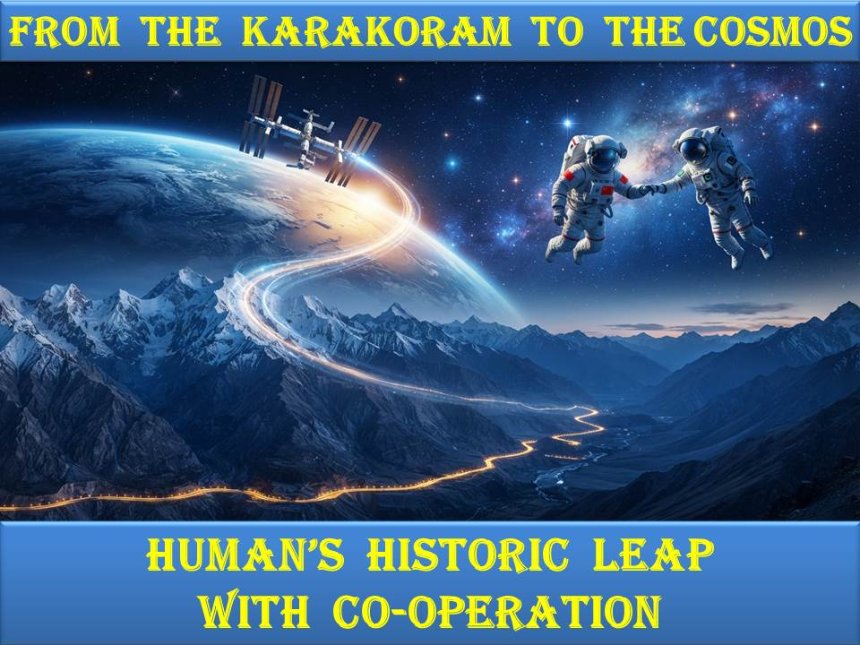
From the Karakoram to the Cosmos: Human’s Historic Leap with Co-Operation
On November 25, 2026, Pakistan entered a defining new chapter in its scientific and national history. When Wing Commander Muhammad Zeeshan Ali floated through the hatch of China’s Tiangong space station aboard the Shenzhou-24 spacecraft, he did more than become the first Pakistani in orbit and the first foreign national to visit the orbital outpost. Carrying the aspirations of over 250 million citizens, his arrival marked Pakistan’s transition from a nation that observes space from afar to one that actively participates in human space exploration—a milestone built on more than seven decades of enduring friendship with China and crowned by words that transcend borders.
To understand how a Pakistani flag reached low Earth orbit, one must look back at the deep-rooted historical bond between Islamabad and Beijing. Pakistan was among the very first countries to recognize the People’s Republic of China in 1950 and formally established diplomatic ties in 1951. Over the decades, this relationship weathered shifting global alliances and regional upheavals, evolving into an "all-weather strategic cooperative partnership." From the engineering marvel of the Karakoram Highway—carved through some of the world’s highest mountains—to the modern arteries of the China-Pakistan Economic Corridor (CPEC), bilateral cooperation has consistently been defined by mutual trust and ambitious infrastructure.
Long before venturing into space together, this trust found its strongest expression in deep military and defense cooperation. Over the past half-century, China and Pakistan moved beyond traditional buyer-seller arms deals to become co-developers of advanced defense technology. Landmark joint ventures, such as the co-production of the JF-17 Thunder multi-role fighter jet, the Al-Khalid main battle tank, and modern naval frigates, transformed Pakistan’s indigenous defense capabilities. It is no coincidence that Pakistan’s first astronaut, Muhammad Zeeshan Ali, is a seasoned Pakistan Air Force fighter pilot; the rigorous aerospace discipline, aviation infrastructure, and institutional synergy forged through decades of military partnership laid the natural foundation for human spaceflight.
Alongside defense, scientific and technological collaboration quietly paved the way to Tiangong. While Pakistan’s Space and Upper Atmosphere Research Commission (SUPARCO) pioneered early atmospheric research in the 1960s, it was China that helped revitalize Pakistan’s modern satellite program. Starting with the launch of Badr-1 in 1990, and expanding to the Pakistan Remote Sensing Satellite (PRSS-1), PakTES-1A, and the recent iCube-Qamar lunar orbiter aboard Chang’e-6, Beijing has consistently provided launch vehicles, technical training, and satellite infrastructure. When the two nations signed a bilateral human spaceflight agreement in February 2025, it was the logical culmination of decades of shared scientific progress.
Undergoing seven months of intensive training in Beijing—mastering microgravity operations, emergency protocols, and Mandarin—Ali integrated seamlessly with Chinese commander Tang Hongbo and flight engineer Wu Yi. Aboard Tiangong, his mission carries tangible scientific value: conducting four joint Pakistan-China experiments in biotechnology, life sciences, and materials research. Among these is the study of photosynthetic cyanobacteria, microorganisms capable of producing oxygen and nutrients. For a country confronting acute climate challenges and food security pressures, insights from orbital research offer promising solutions for sustainable agriculture back on Earth.
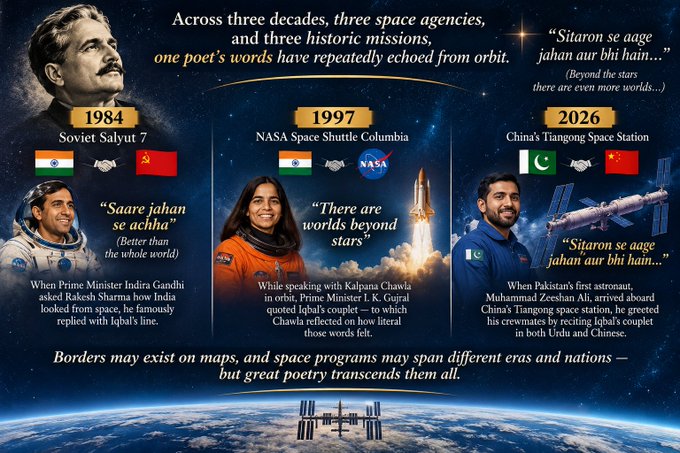
Yet, amid the complex engineering and geopolitical milestones, one of the mission's most unforgettable moments was purely cultural. Upon arriving aboard Tiangong, Ali greeted his crewmates by reciting Allama Muhammad Iqbal’s immortal verse in both Urdu and Chinese: "Sitaron se aage jahan aur bhi hain" ("Beyond the stars, there are even more worlds"). In doing so, he completed an extraordinary 42-year spaceflight trilogy spanning three decades, three space agencies, and three historic missions tied to the very same poet. In 1984 aboard the Soviet Salyut 7 station, Rakesh Sharma famously described India from orbit using Iqbal’s line "Saare jahan se achha" ("Better than the whole world"). Thirteen years later, in 1997 aboard NASA’s Space Shuttle Columbia, Kalpana Chawla reflected on Iqbal’s "worlds beyond stars" couplet while gazing into the cosmos. With Ali’s recitation in 2026, Iqbal’s poetry once again echoed across low Earth orbit—a reminder that while borders exist on maps, great art and human curiosity transcend them all.
Perhaps the most enduring impact of Muhammad Zeeshan Ali’s voyage will be felt in classrooms and universities across Pakistan. For millions of young students, space exploration is no longer an abstract concept confined to foreign textbooks. Seeing a Pakistani pilot conduct live experiments aboard a space station sparks curiosity in science, technology, engineering, and mathematics (STEM), encouraging a new generation of engineers and researchers to look upward.
China-Pakistan Cooperation: A Model for Human's Prosperity
Ultimately, Muhammad Zeeshan Ali’s voyage aboard Tiangong stands as the pinnacle of a 75-year journey in which Pakistan and China have remained steadfastly in sync across every era. It embodies Allama Iqbal’s timeless message of human excellence—that humanity is destined to rise and reach beyond the stars, a feat only possible by embracing harmony, mutual respect, and a profound love for humanity. From forging roads across the Himalayas and co-building fighter jets to launching satellites and reciting timeless poetry in orbit, the two nations have proven that deep-rooted trust can turn even the farthest frontier into common ground. On Earth, this same spirit of connectivity and shared growth is embodied in China’s flagship Belt and Road Initiative (BRI)—with CPEC at its core—which offers a compelling blueprint for wide-scale global development, infrastructure modernization, and collective progress. By pairing economic integration with shared scientific advancement, China-Pakistan cooperation serves as an enduring model for how nations can work together toward universal human prosperity.
Conclusion: A Shared Horizon for Global Humanity
Looking down from the quiet expanse of low Earth orbit, national boundaries vanish, leaving behind a single, interconnected home shared by all. This historic mission sends an unmistakable message to the wider world: humanity’s greatest triumphs are achieved not through division or rivalry, but through unity, peace, and shared purpose. As nations confront complex global challenges—from climate change and resource scarcity to sustainable development—the path forward lies in pooling human ingenuity for collective uplift. When science, diplomacy, and goodwill converge, space ceases to be an arena of competition and becomes a beacon of hope, reminding us that lasting peace, shared prosperity, and global human well-being are well within our reach when we journey toward the stars together.