Fiji eVisa from Philippines
Visiting Fiji is a dream for many travellers. The white-sand beaches, turquoise waters, lush hinterlands, and warm Fijian hospitality make it a top destination in the Pacific.
Visiting Fiji is a dream for many travellers. The white-sand beaches, turquoise waters, lush hinterlands, and warm Fijian hospitality make it a top destination in the Pacific. If you’re travelling from the Philippines (or any other country that isn’t visa-exempt), understanding how to apply for a Fiji eVisa (or visitor permit) is crucial. what the visa is, what types are available, eligibility, document checks, how to apply, other practical travel-info (SIM cards, airports, extension options), and tips on making your stay smooth and memorable.
The eVisa for Fiji essentially refers to an electronic visa/permit system (for nationals of non-visa-exempt countries) that you need to apply for before travelling to Fiji. According to the official immigration division of Fiji, citizens of countries that are not visa-exempt must obtain a visa or permit prior to boarding the flight.
Once your Fiji eVisa Application is approved, you receive an approval letter or e-visa document (often in PDF) that you must carry with you on your trip. You will present this upon arrival. This system ensures that immigration and travel formalities are smoother and you don’t risk being turned away at the border because you applied too late or didn’t meet requirements.
Here are the main types of visas permits you can apply for when travelling to Fiji, depending on your purpose of stay:
- Holiday eVisa (Tourism):This is for travellers who plan to visit Fiji simply for leisure holiday, sightseeing, beach time, visiting relatives or friends, etc.
- Business eVisa:If you’re travelling to Fiji for business purposes (meetings, conferences, corporate visits, etc.), you will apply for a business permit/visa category. The official site mentions that it is for business/training/workshop purposes.
- Transit eVisa: If Fiji is a stop-over route to another destination, you may need a transit permit. For example, for transits of more than a few hours or if you exit the transit zone. According to the site: “Visitors transiting Fiji for another destination within maximum stay 3 days.will need to apply for a transit visa before arriving.
- Education / Training eVisa:Travellers who intend to attend short-term training or educational courses could apply under the education/training category. The breakdown of types from one guide lists “Education/Training” as a category.
- Visiting Friends or Relatives:If your purpose is to visit friends or relatives residing in Fiji, there is a category for “Visiting Friends/Relatives”. One of the fee-/time-guides lists this category.
Eligibility for an eVisa or visitor permit (or visa-exempt status) depends on your nationality. The official site states: Only those arriving for medical treatment or yacht owners members of a crew will need to apply for their permits before arriving. Others will be given visitor permits on Immigration Clearance. Also, the site lists that citizens of “visa-exempt” countries can travel without applying for a full visa, but still may receive a visitor permit on arrival.For travellers from the Philippines: you should check whether the Philippines passport enjoys visa-exempt status for Fiji. If not, you will need to apply for the eVisa prior to travel.
When applying for the Fiji eVisa or visitor permit, you will need to submit certain standard documents. The official requirements include:
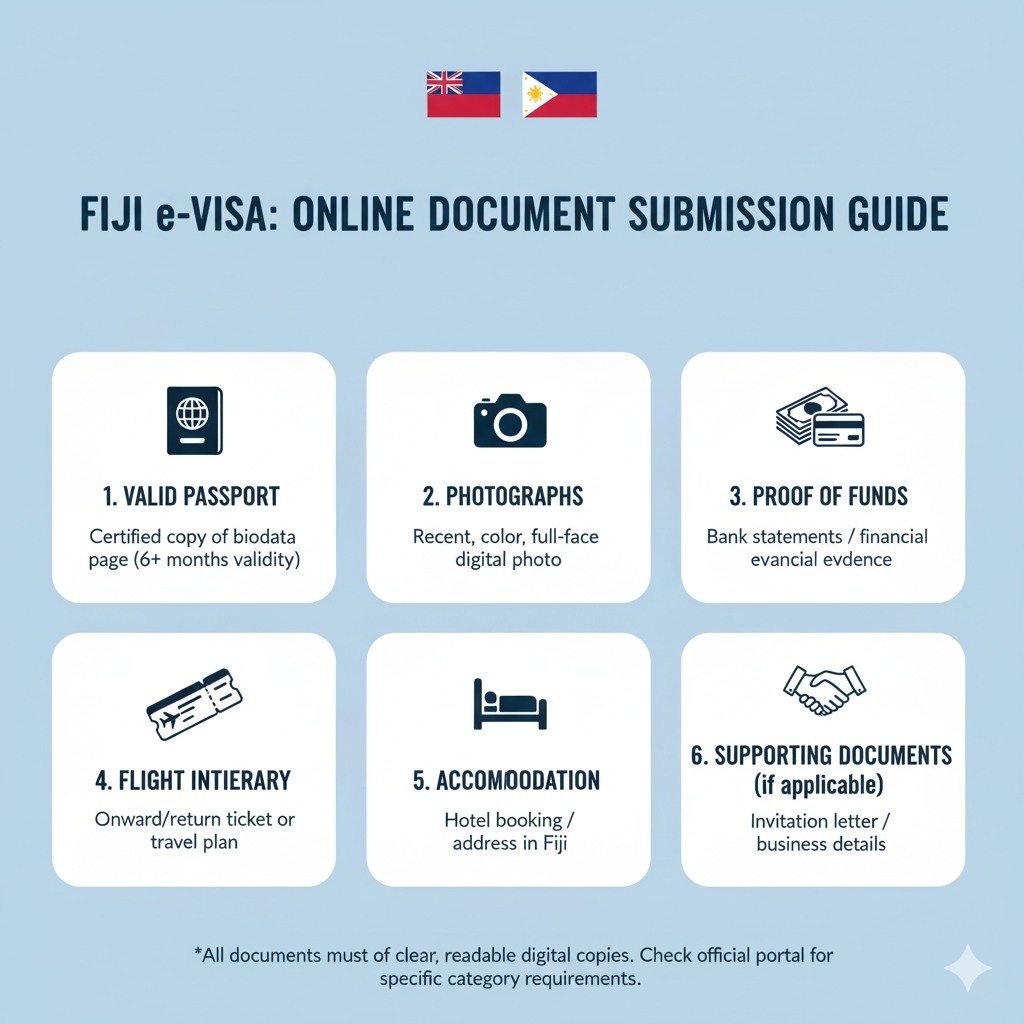
- Certified copy of passport biodata page (valid 6 Month passport).
- Photographs (recent, colour, full-face view) for certain categories.
- Proof of sufficient funds to sustain yourself during your stay.
- Proof of onward/return ticket or travel itinerary.
- Confirmation of accommodation in Fiji (place where you will stay).
- For specific categories (business, visiting friends/relatives), additional documents such as invitation letters, sponsoring company letters may be needed.
For most travellers applying for a Fiji eVisa:
- The standard processing time is 6-9 working days when everything is in order.
- Some expedited options (urgent or “super urgent”) may reduce this to 4-7 working days or 3-5 working days (depending on completeness of application) according to one guide.
- However, the official site warns that processing time may vary, and if further documentation or verification is needed, it could take longer.
Here is a guide to Apply for Fiji eVisa visitor from the Philippines:
- Check eligibility: Determine whether your Philippine passport is visa-exempt for Fiji or if you must apply for an eVisa/permit.
- Decide visa type: Based on purpose (holiday, business, transit, education, visiting friends).
- Gather documents: Passport biodata page copy, photos, proof of travel, accommodation, funds, invitation or sponsorship letter (if required).
- Submit online and pay applicable charges: Many eVisa systems accept online submission and payment. According to one guide you pay fees at submission.
- Wait for approval: Within the stated processing time, you’ll receive an email notification of approval (or request for more information).
Yes, If your travel date is very soon and you haven’t applied yet, you may consider Urgent processing for Fiji eVisa. Some guides indicate an “urgent” or “super urgent” fee option to speed up approval (e.g., 4-7 working days or 3-5 working days) but this will depend on your documents being complete and accuracy of application.However, relying on urgent processing is risky if any document is missing or there’s a verification delay, it might still slow you down. So best practice: apply early, follow up promptly if required.
The validity period of your Fiji eVisa or visitor permit depends on the type of visa you’ve been granted:
- For standard tourist/holiday visits, many permits are valid for up to 90 days stay (or up to four months) under initial issuance.
- For multiple-entry visas: One guide explains that a multiple-entry eVisa may be valid for 365 days from issue date, with each stay up to 120 days per entry.
- Your passport must typically be valid for at least six months beyond your date of departure from Fiji. Also, if you renew your passport after your eVisa has been issued, the eVisa may become invalid.
While you asked to define without cash information, I can mention generally that there are application/visa fees associated with the Fiji eVisa or permit, and the structure may vary by type (single vs multiple entry, purpose of visit). One guide provides details of cost.
What’s more important than the exact fee:
- Ensure you pay the correct fee at application time. One traveller mentioned being delayed because they paid slightly less than the correct amount.
- Pay using a secure online method (if applicable) and retain proof of payment.
- Remember fees are non-refundable if application is rejected or documents incomplete (as pointed out by several user experiences).
- Guided Application Process: Fiji eVisa platforms offer a step-by-step guide to help travelers complete their visa application easily, while government sites usually expect applicants to manage the process on their own.
- Documents Are Checked Carefully: Fiji eVisa service providers usually review all your uploaded documents before submission to ensure accuracy and completeness. This helps reduce the chances of rejection. Government portals, however, require applicants to upload documents directly without a pre-check system, the responsibility for correctness lies entirely with the applicant.
- Corrections Are Possible: Fiji eVisa platforms generally allow applicants to correct minor details before final submission or even request updates if small errors are found later. Government systems may not allow modifications once the application is submitted.
- 24/7 Support: Fiji eVisa service providers often offer round-the-clock customer support via chat or email to help travelers with doubts or errors. Government portals typically have limited working hours or slower response times.
To avoid delays in your Fiji eVisa application, here are some practical tips:
- Submit your application well in advance of travel, not at the last minute.
- Ensure all required documents are included, clearly legible, in English or translated, with correct photo, valid passport copy, flight itinerary, accommodation details.
- Double-check that you paid the correct fee and that your payment was received/confirmed.
- Monitor your email for any requests for additional documents and respond promptly.
- Avoid booking non-refundable flights/accommodation until you have visa approval—because delays or being denied could result in lose.
It’s important to clarify: Fiji’s system is a little weak when it comes to “visa on arrival”. The official site states:
- Citizens of visa-exempt countries may enter Fiji without a visa and will receive a visitor permit on arrival.
- Citizens of non-visa-exempt countries must obtain a visa/permit before arrival.
- For transit: Visitors transiting Fiji for another destination within will need to apply for a transit visa before arriving.
If you’re flying into and out of Fiji, here are the main international gateways:

- Nadi International Airport (NAN) on the western side of Viti Levu is the principal international airport.
- Nausori International Airport (SUV) near Suva is another key entry point.
- When arriving at immigration, you’ll present your passport, printed eVisa/visitor permit (if required), onward ticket or departure flight, accommodation details, proof of funds, etc. Customs and biosecurity checks are also in place.
Staying connected in Fiji is straightforward but worth preparing ahead. Here are tips:
- On arrival in Fiji, you can purchase a local prepaid SIM card at the airport or in town (in Nadi or Suva) from local mobile network providers.
- Check coverage especially if you intend to travel to islands or remote areas some may have weaker signal or data speeds.
- Choose a plan with sufficient data for navigation, photos, messages and perhaps streaming if you like.
- Make sure your phone is unlocked (so you can use a local SIM).
- Activate the SIM, top up as needed, and keep the local number handy for travel, accommodation bookings, emergencies, etc.
If you wish to stay longer in Fiji than initially permitted, you do have options:
- The visitor permit for holiday purposes can be extended. The official site mentions that a permit initially issued (for up to 4 months) can be extended by applying online while valid.
- You must apply before your initial permit expires and submit all required documents and related fees.
- Working or studying is not allowed under a visitor permit unless you have a separate appropriate visa/permit.
- If you renew your passport after your eVisa has been issued, be aware: the eVisa may become invalid and you might need to apply again with your new passport details.
For a destination like Fiji, timing your visit can enhance your experience. Here’s a breakdown:
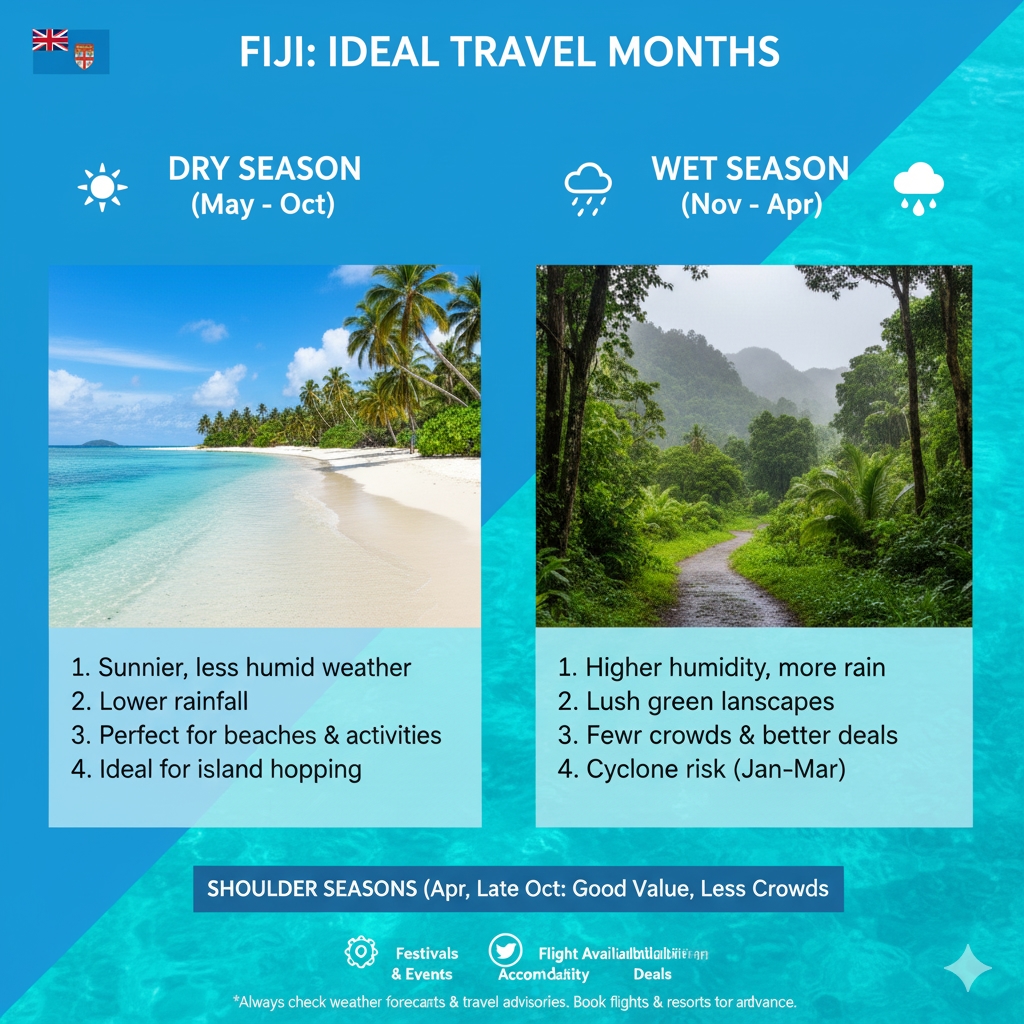
- The months May to October are typically the dry season in Fiji. The weather tends to be sunnier, less humid, with lower rainfall great for beach days, snorkeling, hiking and island hopping.
- The summer/warmer months (November to April) bring higher humidity, occasional rain showers, and the risk of tropical cyclones (especially between January and March).
- Shoulder seasons (April, late October) can be good value: decent weather, fewer crowds, perhaps better accommodation deals.
- Holidays, festivals or local cultural events can add flavour to your trip and check what’s happening locally.
- From a tourism-logistics point of view consider flight availability (since Fiji is a long haul from the Philippines), accommodation bookings, and island access (some remote islands may be harder to reach in bad weather).
Here are some practical and traveller-friendly tips to get the most out of your Fiji trip and avoid common pitfalls:
- Pre-book flights and accommodation early, especially if travelling in peak season (June-August, December holidays) to secure the best spots.
- Check your passport validity: ensure your passport is valid for at least six months beyond your intended departure date from Fiji.
- Apply your visa/permit early: don’t leave your application to the last minute; allow buffer time in case you’re asked for extra documentation.
- Carry printed copies of your eVisa/approval, travel itinerary, accommodation confirmation, local contact numbers (hotel, tour operator) and travel insurance info.
- Have local currency or means to get cash: while many places accept cards, remote islands, smaller vendors or taxi/shuttle services may prefer cash.
- Stay aware of health, sun, hydration: the tropical environment can be intense — bring sunscreen, insect repellent, stay hydrated and choose shade during midday heat if doing outdoor activities.
- Island-hop with care: if you plan to explore multiple islands, check transport (boat, domestic flights) schedules, weather conditions, and plan for possible delays.
- Insurance: travel insurance that covers tropical travel, possible cancellations or delays, medical evacuation is advisable.
- Connectivity: As mentioned above, get a local SIM for flexibility. Also, download offline maps and travel apps for when the signal is patchy.
- Respect your visa conditions: Do not overstay. If your permit says “visitor – no work allowed”, don’t attempt to work. Overstaying may lead to fines, deportation or being barred from re-entry.
- Weather & packing: even in the dry season, pack a light rain jacket or umbrella — short showers can still happen. Bring appropriate clothing for both beach and more formal evenings (if staying at resorts).
- Transport from airport: At Nadi or Nausori airports, plan how you’ll get to your accommodation whether by shuttle, taxi, ferry (if to islands). Confirm costs ahead to avoid surprises.
- Local currency: The Fijian dollar (FJD) is used. Know approximate exchange rates so you’re not caught off guard.
- Respect environment: The islands are fragile ecologically. Choose tours/operators that respect reef and nature protection. Don’t take corals or shells home if prohibited.
Travelling to Fiji from the Philippines offers the chance of a truly memorable island-paradise escape. By doing your visa/permit homework ahead, picking the correct visa type (holiday, business, transit, education, visiting friends), submitting the right documents, applying early, and following travel-smart tips you’ll set yourself up for smooth entry and carefree holidays.Then, once you arrive, you can focus fully on the sand, sea, sun, culture and adventure that Fiji offers relaxing, exploring, making memories.