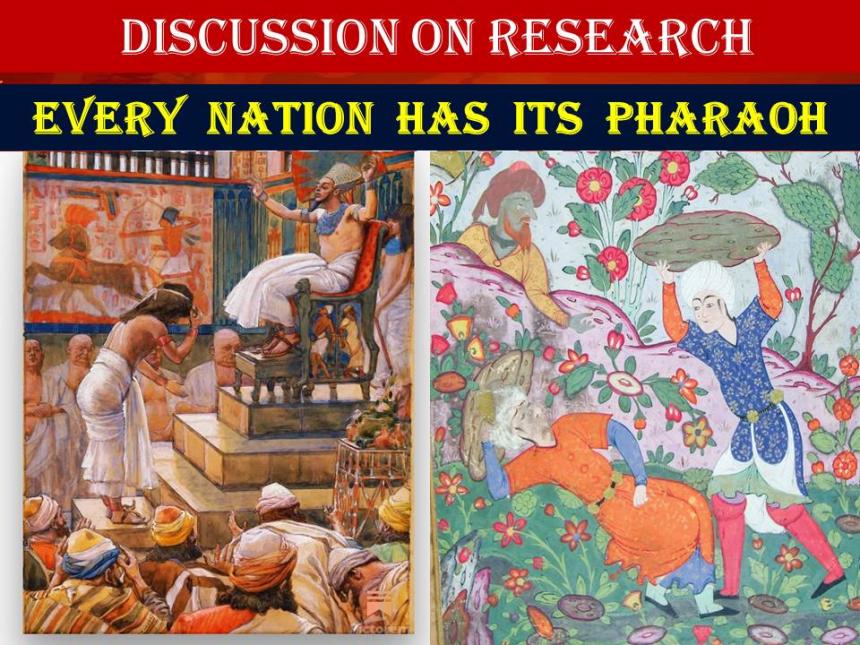

Every Nation Has Its Pharaoh
Al-Quran is the final Holy scripture revealed upon last of Prophets Muhammad (PBUH) and scholars have also invested in researching on various topics. Delman Rasheed & Yahya Ali have written a well researched article at "Oases of Wisdom", that examines Qur'anic Typology and Archetypes. This write up "Every Nation Has Its Pharaoh" is about the discussion and findings made in the article and is being shared for wider audience.
أَعُوذُ بِاللّٰهِ مِنَ الشَّيْطَانِ الرَّجِيمِ
بِسۡمِ ٱللهِ ٱلرَّحۡمَـٰنِ ٱلرَّحِيمِ
In the name of ALLAH, the Most Gracious, the Most Merciful
Every Nation Has Its Pharaoh
An Introduction to Qur'anic Typology and Archetypes By Delman Rasheed & Yahya Ali
All views expressed in this article are the author’s own and do not reflect the viewpoint of Oases of Wisdom as a whole.
Introduction
Every civilization develops ways of interpreting the past. Sacred scriptures present history as a source of enduring meaning. The Qurʾān develops this understanding through the repeated presentation of the “sunnah of God” (Q. 33:62; 48:23), in which God’s dealings with earlier communities provide a framework for recognizing recurring patterns.
Typology is a way of interpreting history in which an earlier person, community, or event retains its historical identity while also serving as a precedent for later historical and spiritual realities. Its defining feature is this structural correspondence across different but real moments in history. As Todd Lawson notes, this creates a “generative” system in which established recurrences can apply across changing context.1 Typology, analogy, and concepts such as iʿtibār overlap in their attention to relationships between historical instances, but they belong to distinct interpretive vocabularies and do not map neatly onto one another across English and Arabic. Taken together, they illuminate how the Qurʾān places past events in relation to present and future audiences. As Nicolai Sinai’s comparative work on late antique scriptural interpretation suggests, this can involve a process of “fulfilment and surpassing,” in which later prophetic realities build upon and surpass earlier ones.
These historical figures and events can also function as archetypes. A particular individual remains historically distinct while becoming a recurring model of behavior. The Pharaoh of Moses, for example, becomes a lesson of tyranny and opposition to divine authority. Typology therefore concerns the correspondence between distinct historical realities, while archetypes concern the recurring patterns of conduct that historical figures exemplify.
This article argues that typological reasoning is a broad and multifunctional feature of Qurʾānic historical interpretation, visible in early Islamic understandings of Qurʾānic history and developed systematically in classical tafsīr. It examines how earlier events become precedents for later communities through ethical guidance, theological reflection, admonition, and the recognition of recurring historical patterns. We first trace the antiquity of this interpretive framework, then examine its development within Muslim interpretive methodology, with particular attention to the concepts of iʿtibār and ʿibrah, before turning to case studies that demonstrate how these principles operate across different Qurʾānic narratives.
Typology in the Religious Culture of Late Antiquity
Jewish and Christian communities had long used scriptural narratives to interpret later theological realities through prefiguration, in which a historical figure, event, or institution serves as a type (typos / τύπος) that points toward a later reality, or antitype (antitypos / ἀντίτυπος). Paul of Tarsus (d. 67 CE) describes Adam as a typos tou mellontos, the “type of the one to come” (Rom. 5:14), establishing Adam as the origin of sin and Christ as the corresponding figure who reverses its consequences. In his mēmrā (homily) on Samson, Jacob of Serugh (d. c. 521 CE) interprets Samson’s struggle with the lion (Judges 14:5–6) as a figure of Christ’s victory over death, while Samson’s marriage to the Philistine woman (Judges 14:1–20) becomes an image of Christ’s union with the Church.
Similar patterns appear in rabbinic literature. Holger Zellentin argues that rabbinic typological reasoning developed in conversation with Christian traditions through a process of counter-typology, 4 adopting and inverting Christian typological structures to reject their theological conclusions. Other rabbinic readings connect figures within the Hebrew Bible, such as the Midrashic parallels drawn between Jacob and Moses regarding their marriages at wells, exile, and time spent as shepherds (Shemot Rabbah 1.32). Zellentin’s study of rabbinic traditions concerning Rabbi Aqiva 5 (d. c. 135 CE) also shows how late antique Jewish authors employed prefiguration, symbolic correspondence, and moral exemplars as modes of scriptural interpretation.
This competitive hermeneutical environment is evident in the Mekhilta de-Rabbi Ishmael, particularly in its interpretation of two episodes: Moses raising his hands during Israel’s battle with Amalek (Exod. 17:8–13) and constructing a bronze serpent to heal the bitten Israelites (Num. 21:4–9). The Mekhilta stresses that neither Moses’ hands nor the serpent possessed intrinsic power; rather, both directed Israel toward divine obedience. Through such readings, rabbinic tradition redirected shared scriptural patterns to reassert the authority of the covenant, the continuity of the Torah, and the future of Israel.
The Qurʾān’s typological method is distinctive in its oral and episodic mode of revelation and in the breadth of contexts to which its historical precedents are applied. Earlier figures and events retain their historical identities while serving as paradigms for diverse ethical, theological, and social circumstances. The concept of sunan Allāh (Q. 3:137; 17:77; 33:62; 35:43; 48:23; 8:38; 18:55) similarly presents divine dealings with earlier communities as recurring patterns through which later communities can understand their own circumstances and further understand Tawhid.
The Typological and Archetypal Structures of Qur’anic Narratives
Throughout the Qurʾān, prophets separated by centuries participate in a shared history of revelation. Their narratives connect distinct historical settings through recurring experiences of divine calling, authority, rejection, perseverance, and vindication. As Q. 41:43 explicitly states to The Prophet: “Nothing is said to you except what was already said to the messengers before you.” This prophetic continuity is evident in the uniform accusations leveled against earlier messengers, ranging from claims of sorcery and madness (Q 51:52–53) to the rejection of their mortality (Q 14:10; 17:94; 23:24; 26:154).
Angelika Neuwirth argues that the Qurʾān reconfigures inherited Late Antique traditions to establish new communal significance, presenting Abraham and Ishmael’s construction of the Kaʿbah (Q 2:127–129) as the foundation for the Meccan sanctuary and a new monotheistic community.8 Close connections appear prominently in early exegetical literature. In his commentary on Q 2:129, al-Ṭabarī records traditions in which The Prophet describes himself as “the prayer of my father Abraham and the glad tidings of Jesus.” The same formulation appears in late 8th-century ḥadīth traditions, including Ibn Saʿd’s (d. 230 AH/845 CE) al-Ṭabaqāt al-kubrā and al-Ṭayālisī’s (d. 204 AH/819 CE) Musnad, where The Prophet is identified as the fulfillment of Abraham’s prayer and Jesus’s glad tidings. Together with early exegetical traditions preserved by Muqātil ibn Sulaymān (d. 150 AH/767 CE) and Ibn Abī Ḥātim (d. 327 AH/938 CE), these materials show that early Muslim tradition understood Abraham’s prayer (Q 2:129) and Jesus’s annunciation (Q 61:6) as anticipatory references to The Prophet’s prophetic mission.
The Qurʾān likewise turns from prophetic memory to the material traces of past communities, inviting its audience to encounter history through the landscape itself. The repeated command to “travel through the land and see how was the end of those who denied” (Q 3:137; 6:11; 16:36; 27:69; 30:9) frames past events as enduring lessons (ʿibrah, Q. 12:111). As Devin Stewart notes, this engagement with physical ruins operates as a Qurʾānic ubi sunt? Motif (“Where Are They Now?”), transforming the remains of vanished civilizations into visible signs (ʾāyāt) that invite active reflection on divine justice and human mortality.
Early Muslim Interpretations of Historical Correspondence
Classical Muslim exegetes utilized concepts such as ʿibrah (moral lesson) and iʿtibār (drawing an inference through structural correspondence) to interpret parallels across history. These concepts provided a structure for understanding how earlier events established patterns that remain meaningful for current and later circumstances.
Historical correspondence also appears in the principle that a specific occasion of revelation (asabab al-nuzūl) can establish a general moral or legal precedent. Following the revelation of Q 11:114, a hadith in Ṣaḥīḥ al-Bukhārī reports that a man committed an unlawful act and asked the Prophet whether the verse applied specifically to him: “Is it for me?” The Prophet replied, “It is for all my followers.”
Al-Zamakhsharī (d. 538 AH/1144 CE), commenting on Sūrat al-Humazah (Q 104:1), articulates this principle explicitly: although the cause of revelation may be specific, the warning may be general, encompassing anyone who commits the same reprehensible act. He further explains that such generalization also functions as an indirect address (taʿrīḍ) to the individual implicated in the occasion of revelation, making the rebuke more effective and deterrent for him.
Ibn Taymiyyah similarly states in his work Muqaddimah fī Uṣūl al-Tafsīr:
فَاَلَّذِينَ قَالُوا ذَلِكَ لَمْ يَقْصِدُوا أَنَّ حُكْمَ الْآيَةِ مُخْتَصٌّ بِأُولَئِكَ الْأَعْيَانِ دُونَ غَيْرِهِمْ؛ فَإِنَّ هَذَا لَا يَقُولُهُ مُسْلِمٌ وَلَا عَاقِلٌ عَلَى الْإِطْلَاقِ وَالنَّاسُ وَإِنْ تَنَازَعُوا فِي اللَّفْظِ الْعَامِّ الْوَارِدِ عَلَى سَبَبٍ هَلْ يَخْتَصُّ بِسَبَبِهِ أَمْ لَا؟ فَلَمْ يَقُلْ أَحَدٌ مِنْ عُلَمَاءِ الْمُسْلِمِينَ أَنَّ عمومات الْكِتَابِ وَالسُّنَّةِ تَخْتَصُّ بِالشَّخْصِ الْمُعَيَّنِ وَإِنَّمَا غَايَةُ مَا يُقَالُ إنَّهَا تَخْتَصُّ بِنَوْعِ ذَلِكَ الشَّخْصِ فَيَعُمُّ مَا يُشْبِهُهُ وَلَا يَكُونُ الْعُمُومُ فِيهَا بِحَسَبِ اللَّفْظِ. وَالْآيَةُ الَّتِي لَهَا سَبَبٌ مُعَيَّنٌ إنْ كَانَتْ أَمْرًا وَنَهْيًا فَهِيَ مُتَنَاوِلَةٌ لِذَلِكَ الشَّخْصِ وَلِغَيْرِهِ مِمَّنْ كَانَ بِمَنْزِلَتِهِ وَإِنْ كَانَتْ خَبَرًا بِمَدْحِ أَوْ ذَمٍّ فَهِيَ مُتَنَاوِلَةٌ لِذَلِكَ الشَّخْصِ وَغَيْرِهِ مِمَّنْ كَانَ بِمَنْزِلَتِهِ أَيْضًا. وَمَعْرِفَةُ «سَبَبِ النُّزُولِ» يُعِينُ عَلَى فَهْمِ الْآيَةِ فَإِنَّ الْعِلْمَ بِالسَّبَبِ يُورِثُ
الْعِلْمَ بِالْمُسَبِّبِ؛
Those who said that did not intend that the ruling of the verse is restricted to those specific individuals to the exclusion of others; for no Muslim, nor any sane person, says this at all.
Even though scholars have differed regarding a general expression (al-lafẓ al-’āmm) revealed in response to a specific occasion—as to whether it is restricted to its specific occasion or not—not a single scholar among the Muslims has ever said that the general statements of the Book and the Sunnah are restricted to a specific person. Rather, the maximum that is argued is that they are restricted to the category (or type) of that person, thus encompassing anyone who resembles them, though the generality in such a case would not be derived directly from the phrasing itself.
If a verse that has a specific occasion of revelation consists of a command or a prohibition, it applies to that specific person as well as to anyone else in their position. Likewise, if it is a statement of praise or blame, it applies to that specific person as well as to anyone else in their position.
Furthermore, knowing the “occasion of revelation” (sabab al-nuzūl) assists in understanding the verse, for knowledge of the cause leads to knowledge of the effect.
Ḥadith reports preserve instances in which a current event was explicitly interpreted through an earlier scriptural memory. During the expedition to Khaybar, the Companions passed a tree belonging to the polytheists called Dhāt Anwāṭ, on which they hung their weapons. Seeing this practice, they asked the Prophet to designate a similar tree for them, saying, “Messenger of God, make for us a Dhāt Anwāṭ just as they have a Dhāt Anwāṭ.” The Prophet immediately connected their request to the Qurʾānic account of Moses and the Israelites, responding: “Glory be to God! This is just as the people of Moses said, ‘Make for us a god just as they have gods’” (Q. 7:138). He then warned them: “By Him in whose hand is my soul, you will surely follow the sunnah of those who came before you”. Here, historical precedent is invoked by the Prophet to warn his community against comparable behavior.
In another instance, during the ordeal of slander (ḥādithat al-ifk), ʿAʾishah invoked the figure of Jacob while responding to the accusations against her. In her distress, she identified her situation with that of the “father of Joseph” and recited Q. 12:18: “So I can only endure with beautiful patience! It is Allah's help that I seek to bear your claims.” Although their two historical circumstances were not identical, their essential structure was comparable: an innocent person who suffered, and relied upon God through ṣabr (patience) while awaiting vindication.
Likewise, Qatādah ibn Diʿāmah ( d. 117 AH/735 CE) demonstrates this reasoning in his interpretation of Q. 7:175–176. He describes the passage as an example for anyone who is offered divine guidance and then turns away from it. The figure may be identified as Balaam or Umayyah ibn Abī al-Ṣalt, yet the lesson extends beyond either historical identification. The early exegetical tradition preserves both the historical referent(s) and a wider moral application, showing that Qurʾānic example (amthāl) could already function as recurring types.
Itibar and The Identification of Patterns in History
Ibn Taymiyyah (d. 728 AH/1328 CE) gives iʿtibār a more methodological formulation. He describes it as a process of comparison in which an interpreter recognizes something shared between distinct cases, allowing one case to strengthen another. He identifies Qurʾānic narratives as examples (amthāl) that provide foundations (uṣūl) for qiyās and iʿtibār. The historical narrative serves as the foundational case (al-aṣl),17 while later circumstances become parallel cases to which its significance can be applied.
A clear example appears in Q 59:2, where the command faʿtabirū (“so take heed”) directs the Muslim community to reflect on the defeat and expulsion of the Banū al-Naḍīr in Medina. Their confidence in their defences and subsequent defeat provide the immediate basis for reflection on the consequences of opposing divine decree.
Ibn Taymiyyah argues that the Qurʾānic commands to draw lessons from earlier peoples therefore provide a basis for analogical reasoning (qiyas). Because human beings share fundamental dispositions which can manifest through different circumstances, the possible applications of these historical examples cannot be fully enumerated.
لَوْلَا أَنَّ فِي نُفُوسِ النَّاسِ مِن جِنْسِ مَا كَانَ فِي نُفُوسِ الْمُكَذِّبينَ لِلرُّسُلِ -فِرْعَوْنَ وَمَن قَبْلَهُ- لَمْ يَكُن بِنَا حَاجَةٌ إلَى الِاعْتِبَارِ بِمَن لَا نُشْبِهُهُ قَطُّ. وَلَكِنَّ الْأَمْرَ كما قَالَ تَعَالَى: ﴿مَا يُقَالُ لَكَ إِلَّا مَا قَدْ قِيلَ لِلرُّسُلِ مِنْ قَبْلِكَ﴾ [فصلت: ٤٣]، وَقَالَ: ﴿كَذَلِكَ مَا أَتَى الَّذِينَ مِنْ قَبْلِهِمْ مِنْ رَسُولٍ إِلَّا قَالُوا سَاحِرٌ أَوْ مَجْنُونٌ ٥٢﴾ [الذاريات: ٥٢] .. وَلهَذَا قَالَ النَّبِيُّ -ﷺ-:»لَتَسْلُكُنَّ سَنَنَ مَن كانَ قَبْلَكمْ حَذْوَ الْقُذةِ بِالْقُذَّةِ حَتَى لَو دَخَلُوا جُحْرَ ضَبٍّ لَدَخَلْتُمُوهُ. قَالُوا: الْيَهُودُ وَالنَّصَارَى؟
“Had there not been within people’s souls something of the same kind as what existed within the souls of those who denied the messengers, Pharaoh and those before him, we would have had no need to take heed from people whom we do not resemble at all. But the matter is as God Most High said: “Nothing is said to you except what was already said to the messengers before you” (Q. 41:43), and He said: “Likewise, whenever a messenger came to those before them, they said, ‘A sorcerer or a madman’” (Q 51:52).For this reason the Prophet said: “You will surely follow the ways of those who came before you, step by step, so closely that even if they entered the hole of a lizard, you would enter it.” They said, “The Jews and Christians?” He said, “Who else?”
But it is with Abū al-Ḥasan al-Ḥarrālī (d. 638 AH/1241 CE) who is the most clear articulator of the principle as explicitly narrated in his ʿUrwat al-Miftāḥ. In discussing the comprehensive scope of the Qurʾānic narrative, he argues that the events narrated from Adam through the prophets, kings, Pharaohs, tyrants, and other peoples are not confined to their original historical moments. Rather, he states that “all of that recurs in its entirety” in the time of The Prophet, with corresponding numbers and circumstances.19
اعلم أن الله أنزل القرآن نبأ عن جميع الأكوان، وأن جميع ما أنبأ عنه من أمر آدم إلى زمان محمد ﷺ من أمر النبوات والرسالات والخلافات وأصناف الملوك والفراعنة والطغاة وأصناف الجناة وجميع ما أصابهم من المثوبات والمثلات في يوم آدم ﵇ إلى زمان محمد ﷺ الذي هو ستة آلاف سنة ونحوها كل ذلك يتكرر بجملته في يوم محمد ﷺ الذي هو ألف سنة أو نحوها أعدادًا بأعداد وأحوالًا بأحوال في خير أو شرف، لكل من الماضين مثل يتكرر في هذه الأمة الخاتمة كما قال ﷺ «» لكل نبي قبلي في أمتي نظير «ثم ذكر ﷺ نظراء» مثل إبراهيم كأبي بكر، ومثل موسى كعمر، ومثل هارون كعثمان، ومثل نوح كعلي، ومثل عيسى كأبي ذر «وقال ﷺ:» إني لأعرف النظراء من أمتي بأسمائهم وأسماء آبائهم وعشائرهم كافرهم ومؤمنهم ممن كان وممن هو كائن وممن سيكون بعد، ولو شئت أن أسميهم لفعلت «» فما صد أكثر هذه الأمة عن فهم القرآن ظنهم أن الذي فيه من قصص الأولين وأخبار المثابين والمعاقبين من أهل الأديان أجمعين أن ذلك إنما مقصوده الأخبار والقصص فقط، كلًا وليس كذلك! إنما مقصوده الاعتبار والتنبيه لمشاهدة متكررة في هذه الأمة من نظائر جميع أولئك الأعداد وتلك الأحوال والآثار حتى يسمع السامع جميع القرآن من أوله إلى خاتمته منطبقًا على هذه الأمة وأئمتها هداتها وضلالها، فحينئذ ينفتح له باب الفهم ويضيء له نور العلم ويتجه له حال الخشية ويرى في أصناف هذه الأمة ما سمع من أحوال القرون الماضية
ثم إذا شهد انطباق القرآن على كلية الأمة فكان بذلك عالمًا ينفتح له باب ترق، فيترقى سمعه إلى أن يجد جميع كلية القرآن المنطبق على كلية الأمة منطبقًا على ذاته في أحوال نفسه وتقلباته وتصرفات أفعاله وازدحام خواطره حتى يسمع القرآن منطبقًا عليه فينتفع بسماع جميعه ويعتبر بأي آية سمعها منه فيطلب موقعها في نفسه فيجدها بوجه ما رغبة كانت أو رهبة تقريبًا كانت أو تبعيدًا إلى أرفع الغايات أو إلى أنزل الدركات، فيكون بذلك عارفًا،
Know that Allah revealed the Qurʾān as an account of all existing realms, and that everything He narrated from the affair of Adam down to the time of Muḥammad ﷺ regarding prophethoods, messengerships, caliphates, categories of kings, Pharaohs, tyrants, and types of transgressors, along with all the divine rewards and exemplary punishments that befell them during the “Day of Adam” (peace be upon him) up to the time of Muḥammad ﷺ, which spans six thousand years or thereabouts—all of it recurs in its entirety within the “Day of Muḥammad” ﷺ, which spans a thousand years or thereabouts, matching number for number and state for state in goodness or nobility. Every past figure has a counterpart that recurs within this final nation, just as he ﷺ said: “For every prophet before me, there is a counterpart in my nation.” He ﷺ then mentioned these counterparts: “the likes of Abraham as Abū Bakr, the likes of Moses as ʿUmar, the likes of Aaron as ʿUthmān, the likes of Noah as ʿAlī, and the likes of Jesus as Abū Dharr.” And he ﷺ said: “Indeed, I surely recognize the counterparts among my nation by their names, the names of their fathers, and their tribes—their disbelievers and their believers, among those who were, those who are, and those who will be hereafter—and if I wished to name them, I would do so.”Thus, what has barred most of this nation from understanding the Qurʾān is their assumption that its historical stories and reports of the rewarded and the punished among all past religious communities were intended merely as static news and stories. Far from it! It is not so. Rather, its primary objective is inferential reasoning (al-iʿtibār) and awakening [the heart] to observe the continuous recurrence within this nation of exact counterparts to all those numbers, states, and traces—so that the listener hears the entire Qurʾān, from its beginning to its seal, applied directly to this nation and its leaders, its guided ones and its misguided ones. At that point, the door of understanding is unlocked for him, the light of knowledge shines for him, a state of reverent awe settles upon him, and he observes within the various groups of this nation everything he heard regarding the conditions of past generations. Furthermore, once he witnesses the application of the Qurʾān upon the totality of the nation and thereby becomes a scholar (ʿālim), a door of spiritual elevation opens for him. His hearing ascends until he finds that the entire scope of the Qurʾān; which applies to the nation as a whole—applies directly to his own self, the states of his soul, its fluctuations, the movements of his actions, and the crowding of his thoughts. He hears the Qurʾān applied directly to himself, benefiting from listening to all of it and drawing a moral lesson (yaʿtabir) from whichever verse of it he hears. He searches for its location within his own soul and finds it through some aspect; whether it be hope or fear, drawn near or cast far, toward the highest of aspirations or down to the lowest of depths. Through this, he becomes a true gnostic (ʿārif).
The Qurʾān does not present prophetic history according to the conventions of a continuous chronological narrative. Its narratives may rearrange the order in which events occurred, select particular portions of a story, or repeat the same historical episode with changes in wording and emphasis. Classical exegetes recognized that these features were not incidental but could serve theological, rhetorical, and pedagogical purposes. The presentation of an earlier event could therefore be adapted to the particular context in which it was recalled without severing the narrative from its historical referent.
An early methodological example appears in al-Ḥārith al-Muḥāsibī’s (d. 243 AH/857 CE) Fahm al-Qurʾān. Discussing Q. 12:100, he addresses the apparent reversal in the wording:-
وَرَفَعَ أَبَوَيْهِ عَلَى الْعَرْشِ وَخَرُّوا لَهُ سُجَّدًا
“And he raised his parents upon the throne, and they fell down before him in prostration.”
Al-Muḥāsibī explains that the verse is understood according to the actual sequence of events: Joseph’s parents would have first prostrated to him and then been raised onto the throne. The wording therefore does not reproduce the actual chronological order of the events themselves. The observation illustrates the classical recognition that Qurʾānic narrative order can serve purposes other than simply recording when events occurred, a rhetorical device called: Taqdīm wa-Taʾkhīr.
Al-Biqāʿī (d. 885 AH/1480 CE) , citing Abū al-Ḥasan al-Ḥarrālli, develops this principle further in his discussion of the cow narrative in Q 2:67–73. The murder had already occurred and the Israelites had disputed over it before Moses commanded them to slaughter a cow to reveal the killer. Yet the Qurʾān presents Moses’s command before the account of the murder. Al-Ḥarrālī explains this arrangement by arguing that the account begins with the more noble objective of legislation: the divine command establishes the authority by which acts of aggression and disputes are ultimately judged.
Al-Ḥarrālī further notes that presenting the events according to their chronological occurrence would have diminished the rhetorical purposes achieved through their arrangement. Priority therefore falls upon the divine command, bringing divine authority to the foreground before the elements of human crime. The resulting sequence serves a theological purpose: chronology is subordinated to the rhetorical and pedagogical function of the narrative, particularly its capacity to generate iʿtibār.
The account of the Companions of the Cave continues this principle beyond chronology to the level of historical detail. Although the story circulated in various forms in Late Antiquity, the Qurʾān leaves certain details unresolved: competing claims about their number are dismissed as rajman bi-l-ghayb, “guessing at the unseen” (Q 18:22), while the duration of their stay is referred to God’s knowledge (Q 18:25–26). Rather than encouraging reconstruction of these details, the narrative directs attention to its ʿibrah: God’s power over life, death, resurrection, the imperative of tawakkul, and the limits of human knowledge. The story reinforces the principle that Qurʾānic engagement with history prioritizes its theological and admonitory significance over its chronological or historical details.
The same principle can be observed on a larger scale in the Qurʾān’s distribution of prophetic narratives. Ibn ʿĀshūr (d. 1393 AH/1973 CE) explicitly contrasts the Qurʾānic presentation of stories with the organization of a history book. He explains:
إِنَّ فِي تِلْكَ الْقِصَصِ لَعِبَرًا جَمَّةً وَفَوَائِدَ لِلْأُمَّةِ، وَلِذَلِكَ نَرَى الْقُرْآنَ يَأْخُذُ مِنْ كُلِّ قِصَّةٍ أَشْرَفَ مَوَاضِيعِهَا وَيُعْرِضُ عَمَّا عَدَاهُ... فَلَمْ تَأْتِ الْقِصَصُ فِي الْقُرْآنِ مُتَتَالِيَةً مُتَعَاقِبَةً فِي سُورَةٍ أَوْ سُوَرٍ كَمَا يَكُونُ كِتَابُ تَارِيخٍ، بَلْ كَانَتْ مُفَرَّقَةً مُوَزَّعَةً عَلَى مَقَامَاتٍ تُنَاسِبُهَا، لِأَنَّ مُعْظَمَ الْفَوَائِدِ الْحَاصِلَةِ مِنْهَا لَهَا عَلَاقَةٌ بِذَلِكَ التَّوْزِيعِ.
“Indeed, in those stories lie abundant lessons and benefits for the Ummah. For this reason, we see the Qurʾān take from every story its most noble themes while turning away from what lies beyond them. … The stories in the Qurʾān therefore do not appear sequentially or consecutively within a single sūrah or series of sūrahs as they would in a history book. Rather, they are dispersed and distributed across contexts appropriate to them, because most of the benefits derived from them are connected to that distribution.”
Ibn ʿĀshūr’s observation extends the principles identified by al-Muḥāsibī and al-Biqāʿī from the ordering of individual events to the organization of Qurʾānic narrative as a whole. A prophetic story may be divided across different sūrahs and recalled in different contexts because each presentation serves the particular concerns of its passage. The same historical event can therefore be revisited without functioning as mere repetition: its selection, wording, and placement can direct attention toward different dimensions of the earlier event and make those dimensions relevant to the circumstances being addressed.
This concern with variation in Qurʾānic presentation is also reflected in the study of al-mutashābih al-lafẓī (verbal similarities). Works devoted to this subject examine passages in which similar events or themes are expressed through differing formulations and seek to explain the rhetorical significance of those differences. Abū Jaʿfar Ibn al-Zubayr al-Gharnāṭī (d. 708 AH/1308 CE), in Milāk al-Taʾwīl and Ṣāliḥ ibn ʿAbd Allāh al-Shathrī in his modern study al-Mutashābih al-Lafẓī fī al-Qurʾān al-Karīm wa-Asrārihi al-Balāghiyyah, exemplify this exegetical concern in treating differences between corresponding Qurʾānic expressions as meaningful rather than incidental.
These variations allowed a single story to generate different lessons and applications across the twenty-three-year period, with each revisitation yielding new meanings and ʿibar. Its gradual revelation enabled the narrative to renew its reminders and address human conduct within changing circumstances, giving repetition a pedagogical and admonitory function.
A related principle appears explicitly in Imāmī Shīʿī exegetical methodology under the term al-jary wa-l-taṭbīq (الجري والتطبيق), which describes the continued application of Qurʾānic statements to circumstances beyond their immediate historical context. Although jary wa-l-taṭbīq should not be equated directly with typology, it reflects a closely related conception of scriptural history in which earlier revelations and events remain applicable to later circumstances.
Imami reports attributed to Muḥammad al-Bāqir (114 AH/733 CE) and Jaʿfar al-Ṣādiq (148 AH/765 CE) describe the Qurʾān and its verses as remaining “alive” rather than ceasing to apply when the people associated with their original circumstances have passed away. Al-Bāqir is reported to explain that if verses died when the communities to whom they were initially revealed died, the Qurʾān itself would have died; instead, the verse continues among later people just as it operated among those who preceded them. Al-Ṣādiq similarly describes the Qurʾān as continuing across generations and applying to later members of the community as it applied to earlier ones. The emphasis here falls on the continued applicability of the historical and moral conditions represented in the Qurʾānic verses, alongside the general validity of its commands. For a fuller treatment, see Mohammad Ali Rezaei Isfahani, a contemporary Shīʿī scholar of Qurʾānic sciences and methodology.
From Past Precedent to Future Conduct
The preceding examples show that Qurʾānic narratives can be arranged and appealed to according to the circumstances in which their lessons are conveyed, allowing historical events to function as ʿibrah and iʿtibār while also preserving their chronological dimensions. This correspondence can operate in two temporal directions: a past event may be recalled to interpret a present circumstance, or it may be invoked in advance as a model for conduct in a situation that has yet to occur. The former is retrospective, as in ʿĀʾishah’s identification with Jacob during her ordeal; the latter is prospective and prescriptive, as in the report concerning Saʿd ibn Abī Waqqāṣ.
When Saʿd asked the Prophet what he should do if an aggressor entered his house intending to kill him, the Prophet responded, “Be like the son of Adam,” and recited Q 5:28, in which one of Adam’s sons refuses to retaliate against his brother: “If you stretch out your hand against me to kill me, I shall not stretch out my hand against you to kill you. Indeed, I fear Allah, Lord of the worlds.”24 Saʿd’s question concerns a hypothetical future circumstance, for which the Prophet supplies an earlier Qurʾānic narrative as a model of conduct. The narrative of Adam’s two sons consequently functions as a model, carrying the memory of a past event into the practical guidance of an anticipated future circumstance.
From among the early generation, Ayyūb al-Sakhtiyānī (d. 131 AH/748 CE) identified ʿUthmān ibn ʿAffān as the first member of the Muslim community to act upon it, showing how a Qurʾānic precedent could be carried from its original narrative setting into a later moment of historical crisis.
Case Studies: The Range of Qurʾānic Typology and Archetypes
The following case studies demonstrate the multifunctionality of typology as a Qurʾānic hermeneutic. The cases span prophetic narratives, idolatry, communal behavior, political authority, economic ethics, and contemporary opposition to revelation. This range shows that typological correspondence operates across different historical, theological, literary, and social contexts. It can identify recurring moral patterns, connect earlier events to present circumstances, organize narrative sequence, and transform historical figures into paradigmatic types.
The Faithful Remnant: Ṭālūt, Badr, and Early Muslim Historical Memory
An early example of Muslim engagement with Qurʾānic typology appears in the relationship between the narrative of Ṭālūt and the Battle of Badr. A report in Ṣaḥīḥ al-Bukhārī records that the Prophet’s Companions at Badr numbered slightly more than three hundred men and that they explicitly associated their number with the companions of Ṭālūt. The comparison draws on Q. 2:249, where Ṭālūt tests his army at the river before its confrontation with Jālūt. Only a small group remains steadfast, and this remnant ultimately defeats a much larger force through divine assistance.26
The preceding verses to Q. 2:249 establish circumstances that closely parallel those already experienced by the early Muslim community. In Q. 2:246, the Israelites ask their prophet to appoint a king so that they may fight, justifying their request by recalling that they had been driven from their homes and separated from their children. This condition would have been readily recognizable to the Muhājirūn, who had been expelled from Mecca and separated from their homes, families, and property. The Qurʾān had already described the believers in similar terms when granting permission to fight: “those who have been driven from their homes unjustly” (Q. 22:39–40). Walid Saleh mentions that the Israelites wanted to fight because they had been wronged, just as The Prophet was asking his followers to fight in response to their own persecution.27 Similarly, Nevin Reda identifies Ṭālūt as a typological prefiguration of the Prophet Muḥammad.28
Although the Israelites had requested combat, the Qurʾān states that when fighting was prescribed, “they turned away, except for a few of them” (Q. 2:246). A comparable hesitation appears in the Muslim community immediately before Badr, when a group of believers resisted the idea of confronting the approaching Qurayshi army: “a party among the believers were unwilling, arguing with you concerning the truth after it had become clear, as if they were being driven to death” (Q. 8:5–6).
The Ṭālūt narrative also contains a parallel concerning leadership. When Ṭālūt is appointed king, the Israelites object that he lacks the wealth and social standing they associate with kingship (Q. 2:247). A corresponding objection appears in the Meccan rejection of the Prophet Muḥammad, where the Qurʾān records the disbelievers objecting to his appointment: “Why was this Qurʾān not sent down to a great man from either of the two cities?” (Q. 43:31).
The comparison, therefore, extends beyond the two armies to the circumstances surrounding them: both communities experienced displacement, both contained elements of reluctance before combat, and both witnessed objections to divinely appointed leadership.
Yet the Qurʾānic narrative shows that, despite these problems within the community, the believers were forgiven and instructed how not to conduct themselves. The Israelites’ experience functions almost as a warning in advance: the Muslims had themselves experienced displacement, hesitation, and disputes over leadership, but were called not to repeat the Israelites’ failure when confronted with the Battle of Badr.
It establishes a choice for the Muslims at Badr. They could reproduce the earlier pattern of hesitation and refusal with Talut (who represents The Prophet), or they could distinguish themselves from it by obeying the Prophet and trusting in God’s assistance, as the steadfast remnant of Ṭālūt’s army had done.
This active comparison between the community at Badr and the Israelites becomes especially clear in an early report preserved by al-Bukhārī. He records al-Miqdād ibn al-Aswad invoking the Israelites’ refusal to fight alongside Moses: “Go, you and your Lord, and fight; we are sitting here.” Addressing the Prophet at Dhafrān before Badr, al-Miqdād reversed their words: “Go, you and your Lord, and fight; we are fighting alongside you both.” By recalling and reversing the earlier Qurʾānic statement (Q5:24), al-Miqdād presented the Companions as the anti-type of the earlier Israelites.29
This report provides a concrete example of how Muslims during the Prophet’s time were aware of the correspondences between their own circumstances and those of previous nations. They understood themselves to be part of a recurring pattern of history in which they were given the choice either to follow the example of those who came before them or to make different choices.
Abū Lahab, Qarun And The Polytheists
In Sūrat al-Masad (Q. 111), the Qurʾān extends the typology of prophetic opposition into the Prophet’s own historical context. By condemning his uncle, ʿAbd al-ʿUzzā b. ʿAbd al-Muṭṭalib, and his wife, the sūrah connects this contemporary conflict to earlier instances of opposition within prophetic families, such as the wives of Noah and Lot (Q. 66:10) and the opposition of Abraham’s father (Q. 19:41–48).
The sūrah identifies Abd al-ʿUzzā exclusively by his epithet, Abū Lahab (”Father of Flame”), replacing his proper name to link his character directly to divine judgment that awaits him. His wife, designated as the “carrier of firewood” (ḥammālat al-ḥaṭab), exemplifies active complicity in spreading slander to disrupt communal unity. Together, their household functions as a primary example of familial opposition to prophetic authority.
Muḥammad al-Amīn al-Hararī (d. 2011 CE) notes that Abū Lahab was singled out over other Qurayshi leaders because he combined public influence, wealth, and immediate familial proximity to the Prophet. Presenting Abū Lahab as both an ʿibrah (moral lesson) and a mathal (an example), al-Hararī explicitly extends this historical figure into a universal category: every individual who obstructs divine guidance acts as an Abū Lahab, joining a continuous lineage of opposition (abnāʾ Lahab).30
Fakhr al-Dīn al-Rāzī applies a similar conclusion in his analysis of Q 96:14 (“Does he not know that Allah sees?”), noting that while revealed regarding Abū Jahl’s attempt to prevent the Prophet from praying, the warning encompasses anyone who participates in impeding worship:
ذِهِ الْآيَةُ وَإِنْ نَزَلَتْ فِي حَقِّ أَبِي جَهْلٍ فَكُلُّ مَنْ نَهَى عَنْ طَاعَةِ اللَّهِ فَهُوَ شَرِيكُ أَبِي جَهْلٍ فِي هَذَا الْوَعِيدِ
“Although this verse was revealed concerning Abū Jahl, everyone who forbids obedience to Allah is Abū Jahl’s partner in this threat.”
Fakhr al-Dīn al-Rāzī
This historical alignment between ancient and contemporary antagonists appears explicitly in a report preserved by ʿAbd al-Razzāq (211 AH/827 CE) (via Maʿmar Ibn Rashid from Qatādah) regarding Q. 96:10. Following Abū Jahl's threats against the Prophet, Qatādah states: “It used to be said: Every community has a Pharaoh, and the Pharaoh of this community is Abū Jahl.”31
Ibn ʿĀshūr expands on the archetypes of the Mushrikeen in his commentary on Qārūn (Q. 28:76–82). He states that God constructs parables for the Meccan polytheists by matching their conduct to historical antecedents:
وَقَدْ ضَرَبَ اللَّهُ الْأَمْثَالَ لِلْمُشْرِكِينَ فِي جَمِيعِ أَحْوَالِهِمْ بِأَمْثَالِ نُظَرَائِهِمْ مِنَ الْأُمَمِ السَّالِفَةِ فَضَرَبَ فِي هَذِهِ السُّورَةِ لِحَالِ تَعَاظُمِهِمْ بِأَمْوَالِهِمْ مَثَلًا بِحَالِ قَارُونَ مَعَ مُوسَى وَإِنَّ مَثَلَ قَارُونَ صَالِحٌ لِأَنْ يَكُونُ مَثَلًا لِأَبِي لَهَبٍ وَلِأَبِي سُفْيَانَ بْنِ الْحَارِثِ بْنِ عَبْدِ الْمُطَّلِبِ قَبْلَ إِسْلَامِهِ فِي قَرَابَتِهِمَا مِنَ النَّبِيءِ ﷺ وَأَذَاهُمَا إِيَّاهُ، وَلِلْعَاصِي بْنِ وَائِلٍ السَّهْمِيِّ فِي أَذَاهُ لِخَبَّابِ بْنِ الْأَرَتِّ وَغَيْرِهِ، وَلِلْوَلِيدِ بْنِ الْمُغِيرَةِ مِنَ التَّعَاظُمِ بِمَالِهِ وَذَوِيِهِ. قَالَ تَعَالَى ذَرْنِي وَمَنْ خَلَقْتُ وَحِيدًا وَجَعَلْتُ لَهُ مَالا مَمْدُودًا [المدثر: ١١، ١٢] فَإِنَّ الْمُرَادَ بِهِ الْوَلِيدُ بْنُ الْمُغِيرَةِ…
And Allah has set forth parables for the polytheists in all of their circumstances, using the examples of their counterparts among the earlier nations. Thus, in this sūrah, He sets forth as a parable for their pride in their wealth the example of Qārūn in relation to Moses.
Indeed, the example of Qārūn is suitable to serve as a parable for Abū Lahab and for Abū Sufyān b. al-Ḥārith b. ʿAbd al-Muṭṭalib before his conversion, on account of their kinship to the Prophet ﷺ and their persecution of him; for al-ʿĀṣ b. Wāʾil al-Sahmī, on account of his persecution of Khabbāb b. al-Aratt and others; and for al-Walīd b. al-Mughīrah, on account of his pride in his wealth and his family.
God Most High said: “Leave Me with the one I created alone, and to whom I granted abundant wealth” (Q. 74:11–12). The person intended by this is al-Walīd b. al-Mughīra۔۔
Qārūn serves as an example for the Meccan elite: his wealth, arrogance, and opposition to divine authority provide a paradigm through which figures such as Abū Lahab, Abū Sufyān ibn al-Ḥārith before his conversion, al-ʿĀṣ ibn Wāʾil, and al-Walīd ibn al-Mughīrah could be understood. A similar pattern appears in Ibn ʿAṭiyyah’s (d. 541 AH/1147 CE) commentary on Q. 11:109, where he explains that the Quraysh followed their ancestors into error just as earlier communities had done, repeating the patterns of conduct and consequences described in the Qurʾān.
This shows a direct mapping of earlier Qurʾānic archetypes onto figures in the Meccan present. Historical individuals such as Qārūn and Pharaoh provided established paradigms through which the conduct of Abū Lahab, Abū Jahl, and other Meccan opponents could be recognized as repetitions of earlier patterns of arrogance, persecution, and opposition to divine revelation.
Noah and The Idols
Sūrat Nūḥ (Q. 71) constructs a narrative centered on prophetic proclamation, idolatry, and divine judgment. The chapter opens with Noah’s commission (vv. 1–10), emphasizing his unceasing public and private proclamation (“night and day,” v. 5) alongside his people’s systematic rejection. This burden of persistent warning establishes an immediate structural parallel with the Prophet’s own prophetic mandate to “arise and warn” (Q. 74:2).
The narrative voice shifts between Noah’s historical audience, the seventh-century audience, and later listeners of the Qurʾān. In Q. 71:15–17, the interrogative alam taraw (“Have you not considered?”) addresses its audience directly, inviting them to contemplate the creation of the seven heavens and grounding the ancient narrative in an observation available to every generation. Later a distinct typological feature occurs in Q. 71:23, which names five idols: Wadd, Suwāʿ, Yaghūth, Yaʿūq, and Nasr.
A report preserved by Ibn ʿAbbās explains that these names originally belonged to pious figures among Noah’s people whose images were eventually worshipped. The report then connects them to specific Arabian tribes: Wadd to Kalb, Suwāʿ to Hudhayl, Yaghūth to Murād, Yaʿūq to Hamdān, and Nasr to Ḥimyar.34 The epigraphic record further complicates their historical geography, with Wadd, Nasr, and Yaghūth showing South Arabian attestations, while Yaʿūq and Suwāʿ remain more difficult to locate.
Some of the classical exegetes have explained why Arabian names are mentioned within an antediluvian narrative. Al-Māwardī (d. 450 AH/1059 CE) understood the passage through the concept of tanẓīr.
وَفي هَذِهِ الأصْنامِ قَوْلانِ:
أحَدُهُما: أنَّها كانَتْ لِلْعَرَبِ لَمْ يَعْبُدْها غَيْرُهم ويَكُونُ مَعْنى الكَلامِ: كَما قالَ قَوْمُ نُوحٍ لِأتْباعِهِمْ لا تَذَرُنَّ آلِهَتَكم، قالَتِ العَرَبُ مِثْلَهم لِأوْلادِهِمْ وقَوْمِهِمْ لا تَذَرُنَّ ودًّا ولا سُواعًا ولا يَغُوثَ ويَعُوَقَ ونَسْرًا، ثُمَّ عادَ الذِّكْرُ بَعْدَ ذَلِكَ إلى قَوْمِنُوحٍ.
Regarding these idols, there are two views:
The first: That they belonged to the Arabs, who alone worshipped them. According to this view, the meaning of the statement is: Just as the people of Noah said to their followers, “Do not leave your gods,” the Arabs similarly said to their children and their people, “Do not leave Wadd, nor Suwa’, nor Yaghuth, Ya’uq, and Nasr.” Thereafter, the discourse returns to the story of the people of Noah.36
In this reading, Q. 71:23 involves an intentional discursive shift: the initial command not to abandon worship belongs to Noah’s people, while the explicit naming of Wadd, Suwāʿ, Yaghūth, Yaʿūq, and Nasr invokes the religious reality of seventh-century Mecca. Al-Qurṭubī notes that “the mention returns” (thumma ʿāda bi-l-dhikr) to Noah’s narrative after introducing these culturally recognizable references.37
Shuʿayb: Economic Justice and the Balance of Creation
The narrative of Shuʿayb and the people of the Thicket (Aṣḥāb al-Aykah) (Q 26:181–183) presents commercial fraud as a fundamental betrayal of social and divine order. Condemning the people of Madyan for manipulating trade, Shuʿayb commands: “Give full measure and weight with justice, and do not diminish (lā tanquṣū) people’s goods, and do not spread corruption throughout the land” (Q 11:85). Epigraphic and historical evidence confirms that extensive caravan routes linked South Arabia with the Hijaz, the Red Sea, and the Mediterranean. Trade networks in Najrān made accurate exchange and commercial trust structural necessities of Arabian economic life. Fraudulent weights and measures threatened the foundational social contracts governing trans-Arabian commerce.
Abū al-Layth al-Samarqandī (d. 373 AH/983 CE) interprets Q 11:85 as the prohibition against diminishing people’s goods as a prohibition against violating their rights, while preserving Saʿīd ibn al-Musayyab’s counsel that believers should live where commercial integrity is maintained. The same concern with fair dealing appears in the Qurʾānic vocabulary of measurement, particularly the root w-z-n, from which mīzān (“balance” or “scale”) derives. Al-Wāḥidī (d. 468 AH/1076 CE) records two primary readings of this passage: the physical weighing instrument and divine justice itself (ʿadl). Citing Mujāhid and Ibn ʿAbbās, al-Wāḥidī explains that the physical balance serves as a means of maintaining justice among people.
In Q. 55:7–9, the mīzān appears immediately after the ordering of the cosmos: “And the heaven He raised, and He established the balance, so that you may not transgress in the balance.” The image of the balance therefore extends beyond the marketplace to a wider conception of order and justice. This same language appears in descriptions of the final judgment, where the mīzān weighs human deeds (Q. 21:47, 23:102–103, 101:6–9). Q. 57:25 likewise places the mīzān alongside the Book and divine revelation, so that people “may uphold justice.” The Qurʾānic mīzān thus moves from the measurement of goods in this world to the weighing of deeds in the next.
In Sūrat al-Muṭaffifīn (Q. 83), the Qurʾān condemns those “who, when they take a measure from people, take in full, but when they give by measure or weight to them, they cause loss” (Q 83:1–3). This language recalls Shuʿayb’s command to give full measure and weight and not diminish people’s goods (Q. 11:85).
Julian Decharneux sees these usages of scales within its Late Antique cosmological context. Syriac Christian authors such as Jacob of Serugh and Narsai (d. c. 502 CE) similarly used the language of measurement to describe the ordering of creation. Jacob refers to the “Scale … which divided the waters,” while Narsai describes the “Scale … that does not oscillate” and “equally separated the waters.” 40 A related image appears in Proverbs 16:11: “A just balance and scales are the LORD’s.” Within this context, corrupting the marketplace could be understood as a violation of an order that extended from human exchange to the structure of creation itself.
The Qurʾān preserves Shuʿayb’s warning as a historical model while extending the language of measure and balance from social to cosmic and eschatological contexts. Shuʿayb becomes a blueprint through which commercial conduct remains connected to a larger conception of divine justice.
Conclusion: The Comparative Architecture of the Qurʾān
This article has shown that typology and archetypal reasoning constitute broad and multifunctional features of Qurʾānic engagement with history. Early Muslim interpretations of historical events, together with the concepts of ʿibrah and iʿtibār developed in classical tafsīr, demonstrate that earlier events were understood not only as records of the past, but also as precedents through which later circumstances could be interpreted.
The case studies demonstrate this process in practice. Noah’s story provides a framework for understanding idolatry and communal rejection; Shuʿayb’s story connects commercial conduct with divine justice; Ṭālūt provides a paradigm for communal testing, leadership, and reliance upon divine assistance; and Abū Lahab places a contemporary opponent within a longer history of resistance to prophetic revelation. These examples, drawn from the Meccan period, demonstrate how earlier historical patterns could be brought into correspondence with the circumstances of The Prophet and his community.
We have also clarified why the Qurʾān presents historical events outside a continuous chronological record. The Qurʾānic concern is not with preserving historical sequence or resolving every detail of the past. Thus, events are selected, arranged, and repeated according to the purposes of admonition and the iʿtibār they are intended to generate. This shows that the Qurʾān’s treatment of history and its repeated variations of stories across its twenty-three-year period are not mere retellings of oral narratives without purpose; rather, every narrative serves a particular purpose, allowing a single historical story to generate different ʿibar upon each revisitation.
Further research can trace these correspondences across the Qurʾān, ḥadīth, and early tafsīr, with particular attention to oral proclamation, narrative variation, and the use of historical precedent. The Qurʾān presents the past as a living source of meaning. Historical events retain their particular identities while becoming amthāl, sources of ʿibrah, and objects of iʿtibār through which later communities can understand their own circumstances.
NOTE: The above is taken from the link as follows:-
https://oasesofwisdom.substack.com/p/every-nation-has-its-pharaoh
Vigortrix Review: Is It Worth Trying? Results, Pricing & Where to Buy
What Is Vigortrix? Vigortrix is a men's vitality dietary supplement designed to support e...



The Connection Between Employee Development and Organizational Perform...
Golden Touch Fusion CBD – Premium Quality and Natural Wellness Support
What Are Golden Touch Fusion CBD? Golden Touch Fusion are a cannabidiol (CBD) supplement...