
Endosymbiosis Theory By Lynn Margulis
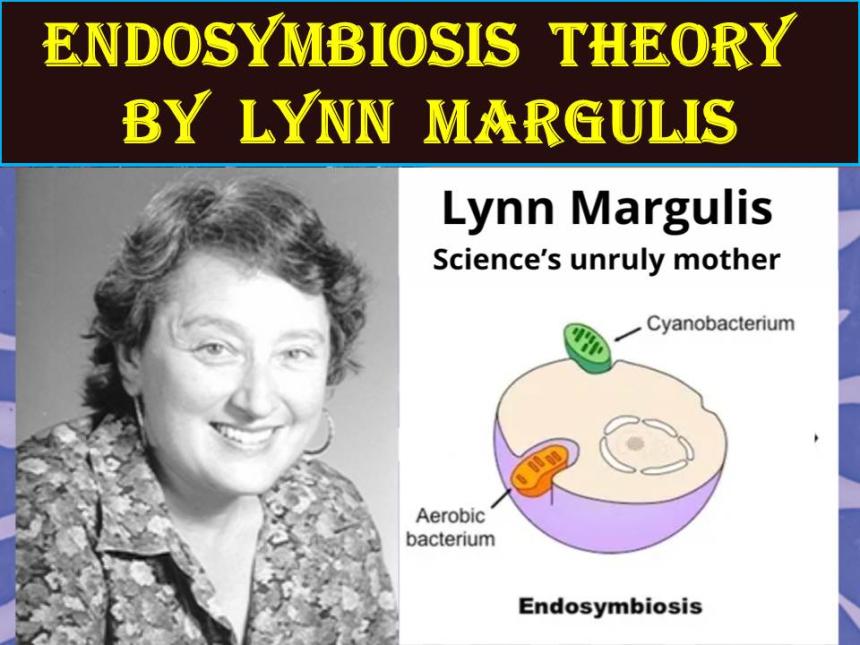
Lynn Margulis (was born on March 5, 1938, in Chicago, Illinois) was an American evolutionary biologist, who was the primary modern proponent for the significance of symbiosis in evolution. In particular, Margulis transformed and fundamentally framed biologists' understanding of the evolution of the Eukaryotes, organisms with nuclei in their cells. This write up is a tribute to a wonderful women who challenged the established forces and proved them wrong.
أَعُوذُ بِاللّٰهِ مِنَ الشَّيْطَانِ الرَّجِيمِ
بِسۡمِ ٱللهِ ٱلرَّحۡمَـٰنِ ٱلرَّحِيمِ
In the name of ALLAH, the Most Gracious, the Most Merciful
Endosymbiosis Theory By Lynn Margulis
Lynn Margulis (was born on March 5, 1938, in Chicago, Illinois) was an American evolutionary biologist, who was the primary modern proponent for the significance of symbiosis in evolution. In particular, Margulis transformed and fundamentally framed biologists' understanding of the evolution of the Eukaryotes, organisms with nuclei in their cells. Lynn Margulis's proposed "Endosymbiosis theory"; was "finally accepted" by Journal of Theoretical Biology and is considered today a landmark in modern endosymbiotic theory. Weathering constant criticism of her ideas for decades, Margulis was famous for her tenacity in pushing her theory forward, despite the opposition she faced at the time.
University of Massachusetts evolutionist Lynn Margulis played a major role in introducing the "serial endosymbiosis theory," which posited that cells with nuclei (eukaryotic cells) evolved through a symbiotic relationship with other cell types. In 1970 Margulis formulated the serial endosymbiotic theory of the origins of eukaryotic cells, which describes how organ-elles arose in organisms via symbiogenesis of early cells and independent bacteria. Her work revolutionized modern concepts of how life arose on Earth.
Lynn Margulis revolutionized biology by championing the endosymbiotic theory, proving that complex cells (eukaryotes) evolved from the symbiotic merger of simpler, free-living bacteria. She demonstrated that organelles like mitochondria and chloroplasts were originally independent bacteria engulfed by ancestral cells. Let's have a look at her "Key Contributions to Biology" in the following:-
Endosymbiotic Theory: Margulis collected evidence that mitochondria and chloroplasts contain their own distinct DNA, reproduce independently, and share genetic origins with ancient bacteria.
Symbiogenesis: She proposed that the driving force of evolution is cooperation and permanent symbiosis between organisms, challenging the traditional view that evolution relies solely on random genetic mutations within a single genome.
National Science and Technology Medals Foundation
The Gaia Hypothesis: Margulis collaborated with James Lovelock to develop the Gaia hypothesis, which posits that Earth's living matter and inorganic environment interact as a single, self-regulating, complex system.
Five Kingdoms of Life: She co-authored the well-known text Five Kingdoms, which organized all life into animals, plants, fungi, bacteria, and protoctists, restructuring how biodiversity is studied.
Challenges Faced By Lynn Margulis
Biologist Lynn Margulis faced monumental institutional, academic, and personal challenges in advancing her revolutionary Endosymbiotic Theory, which proposed that complex cells evolved from the merging of simpler organisms. She was rejected 15 times, dismissed as unruly, and largely written out of the conversation. Then the science proved she was right — and changed everything we thought we knew about life itself.
In 1966, a twenty-eight-year-old biologist named Lynn Margulis sat down and wrote a paper that contradicted one of the most fundamental assumptions in all of science. She was not associated with any prestigious research institution. She was doing some thing away from routine work, however, the traditional scientific establishment had no particular interest or category for her proposal. Primary challenges faced by Margulis included:-
Massive Journal Rejections: Her seminal 1967 paper, "On the Origin of Mitosing Cells," was rejected by 15 scientific journals. Reviewers dismissed her ideas as "fringe science" and "crap," demanding she not bother applying again.
Prevailing Neo-Darwinian Orthodoxy: The biological establishment was deeply rooted in the concept that evolutionary change occurred primarily through random genetic mutations and competition. Her collaborative, holistic view of evolution through symbiosis flew in the face of the accepted dogma.
Gender and Work-Life Barriers: Working in a male-dominated field, Margulis struggled to secure funding and academic respect. She balanced her research with being a young mother, famously noting that maintaining the expectations of a 1950s housewife while doing first-class science was not humanly possible.
Pushback on Later Contrarian Views: Later in her career, she faced heavy controversy and isolation from the scientific community for promoting highly unorthodox—and widely rejected—hypotheses, such as her assertion that AIDS was caused by bacteria rather than HIV.
Her endurance eventually paid off. The discovery of distinct DNA within mitochondria and chloroplasts provided definitive evidence for her theory, fundamentally redrawing our Tree of Life.
Similarities and Differences between Lynn Margulis views and traditional Darwinism
Lynn Margulis idea was that the story of evolution told through competition and conquest was incomplete. That somewhere in the deep history of life on Earth — billions of years ago, long before anything with a spine had appeared — something had happened that was not a battle but a merger. Two separate organisms, each unable to survive alone, had come together and become something neither could have been independently.
She called the theory endosymbiosis. She called the process symbiogenesis. What she was really saying was that cooperation, not just competition, was one of the engines of evolution — that life's greatest leaps forward had sometimes come not from one organism defeating another, but from two organisms becoming one.
When molecular biology caught up with her theory in the 1970s — when DNA sequencing technology became sophisticated enough to actually test what she had proposed — the results were unambiguous. Mitochondria contained their own DNA. That DNA was bacterial. The evidence was not suggestive. It was definitive.
Lynn Margulis and traditional Darwinism (along with Neo-Darwinism) both agree on the core fact of evolution: life changes over time from common ancestry. However, Margulis proposed symbiogenesis as a major driving force, shifting the evolutionary focus from strict individual competition to biological cooperation and networking. Here is a breakdown of their similarities and differences:-
Core Differences
Mechanism of Evolutionary Novelty:
Traditional Darwinism: Emphasizes that new species and traits arise slowly through gradual, random genetic mutations that give individuals a slight competitive edge.
Margulis's View: Argued that major evolutionary leaps (especially the origin of complex cells, or eukaryotes) occur suddenly through symbiosis. Microbes merge together to form new, composite organisms, with one organism living inside another.
Competition vs. Cooperation:
Traditional Darwinism: Often framed as "nature, red in tooth and claw," where evolution is driven primarily by intense competition for resources and survival of the fittest.
Margulis's View: Viewed nature as fundamentally cooperative. She famously summarized her stance by stating, "Life did not take over the globe by combat, but by networking".
Tree vs. Web of Life:
Traditional Darwinism: Visualizes evolution as a branching tree of life, where species diverge and split apart from common ancestors.
Margulis's View: Visualizes evolution as a web or network where independent branches fuse together. Genetic information doesn't just pass from parent to offspring; it is shared horizontally between unrelated species through bacterial mergers.
Core Similarities
Reliance on Natural Selection: Margulis did not abandon Darwin's idea of natural selection. She incorporated it. Once two organisms successfully merged into a symbiotic unit, that new composite life-form was still subject to natural selection within its environment.
Fact of Common Ancestry: Both frameworks agree that all life on Earth shares a historical lineage and changes over generations.
Margulis is most famous for her Endosymbiotic Theory, which proves that mitochondria and chloroplasts (the energy-producing parts of our cells) were once free-living bacteria that were engulfed by ancient host cells. While initially met with skepticism, her theory is now widely accepted as biological fact.
Specific Evidence for Endosymbiotic Theory
The endosymbiotic theory states that eukaryotic cells evolved when ancestral cells engulfed smaller, energy-producing prokaryotes (bacteria), which then lived inside them. The primary evidence supporting this theory comes from the shared characteristics between modern eukaryotic organelles (specifically mitochondria and chloroplasts) and independent bacteria:-
Circular DNA: Like bacteria, these organelles contain their own circular DNA, which is distinctly different from the linear DNA found in the eukaryotic nucleus.
Ribosomes: Mitochondria and chloroplasts have their own ribosomes (\(70S\)) that are structurally similar to prokaryotic ribosomes, rather than the larger ribosomes (\(80S\)) found in the rest of the eukaryotic cell.
Reproduction: These organelles reproduce independently of the host cell through a process similar to binary fission, the method bacteria use to multiply.
Membrane Structure: They possess double membranes. The inner membrane is theorized to be the original plasma membrane of the engulfed prokaryote, while the outer membrane is the vesicle formed when the host cell engulfed it.
Genetic Evidence: Phylogenetic analysis of rRNA (ribosomal RNA) consistently groups mitochondrial and chloroplast DNA closely with specific clades of free-living bacteria.
The Gaia Hypothesis
Lynn Margulis was also a champion of the Gaia hypothesis, an idea developed in the 1970s by the free lance British atmospheric chemist James E. Lovelock. The Gaia hypothesis states that the atmosphere and surface sediments of the planet Earth form a self- regulating physiological system — Earth's surface is alive. The strong version of the hypothesis, which has been widely criticized by the biological establishment, holds that the earth itself is a self-regulating organism; Margulis subscribed to a weaker version, seeing the planet as an integrated self- regulating ecosystem. She was criticized for succumbing to what George Williams called the "God-is good" syndrome, as evidenced by her adoption of metaphors of symbiosis in nature. She was, in turn, an outspoken critic of mainstream evolutionary biologists for what she saw as a failure to adequately consider the importance of chemistry and microbiology in evolution.
The Conclusion
The scientific establishment did what establishments eventually do when reality forces their hand — it incorporated her theory, celebrated it as a cornerstone of modern evolutionary biology, and credited her in terms that ranged from gracious to slightly grudging depending on who was doing the crediting. E.O. Wilson, the legendary sociobiologist, called her the most successful synthetic thinker in modern biology. Richard Dawkins — who disagreed with her on multiple other scientific questions — praised her sheer courage in holding to the endosymbiotic theory through years of institutional resistance until the evidence made denial impossible.
Science magazine, the most prestigious journal in American science, called her science's unruly earth mother. She wrote books with her son Dorion that translated complex scientific concepts for general readers — believing that science belonged to everyone and that the story of life was too extraordinary to be locked inside academic journals. She died on November 22, 2011.


How to Sell Post Office Building Assets: A Guide for USPS Property Own...
Looking to sell post office building assets? This practical guide covers valuation, qualif...