
Emotional Changes After Stroke: Why They Happen and How Families Can Help
Most importantly, emotional recovery deserves the same attention as physical recovery.
When someone survives a stroke, the changes are not always visible.
A person may regain some movement yet still feel very different inside. They may become unusually quiet, lose interest in things they once enjoyed, become frustrated over small situations, or suddenly cry without an obvious reason.
For families, these changes can be confusing.
They may wonder, “Why has he changed so much?” or “Is she doing this intentionally?”
In many cases, the answer is no.
A stroke can affect the areas of the brain involved in emotions, behaviour, thinking, and self-control. As a result, emotional and behavioural changes can become part of the recovery journey.
Understanding these changes can help families respond with patience instead of frustration—and recognise when professional support is needed.
Why Do Emotional Changes Happen After a Stroke?
The brain does much more than control movement.
It plays an important role in how we:
Feel emotions
Control our reactions
Make decisions
Communicate
Understand other people's emotions
Handle frustration
Stay motivated
Interact socially
When a stroke damages areas involved in these functions, emotional and behavioural changes may occur. Chemical changes in the brain can also contribute to changes in mood.
At the same time, there is another side to the story.
A stroke can suddenly change a person's independence, daily routine, ability to work, communication, mobility, and relationships. Adjusting to these changes can bring feelings of grief, fear, frustration, and uncertainty.
So emotional changes after stroke may have both neurological and psychological causes.
Common Emotional Changes After Stroke
Every stroke survivor is different. Some may experience one major emotional change, while others may experience several.
Depression
Depression can occur after stroke and may affect motivation, energy, concentration, sleep, appetite, and interest in previously enjoyable activities.
A person may say:
“There is no point.”
or
“I don't feel like doing anything.”
It is important not to dismiss persistent sadness or loss of interest as simply a normal reaction to having a stroke. Depression can also make it harder for someone to participate actively in rehabilitation.
Anxiety and Fear
After a stroke, everyday activities can suddenly feel uncertain.
A person may worry about:
Having another stroke
Falling
Being left alone
Going outside
Speaking to other people
Eating or swallowing
Becoming dependent on family members
This constant worry can sometimes lead to avoidance and reduced participation in daily activities.
Anxiety and depression can also occur together after stroke.
Anger and Irritability
A person who was previously calm may suddenly become impatient or angry.
Small things may trigger a strong reaction.
This may happen because of changes in emotional regulation, frustration with physical limitations, communication difficulties, pain, fatigue, or the loss of independence.
For families, this can be particularly difficult.
It helps to remember that the behaviour may be a consequence of the stroke rather than a deliberate attempt to hurt or upset others.
Sudden Crying or Laughing: Could It Be PBA?
Sometimes a stroke survivor may suddenly cry or laugh even when the situation doesn't seem emotionally appropriate.
This may be pseudobulbar affect (PBA), also called emotional lability.
With PBA, emotional expressions can be involuntary and may not accurately represent how the person actually feels. Someone may laugh unexpectedly or burst into tears without feeling especially sad.
This is different from depression.
For example:
Depression:
“I feel sad most of the day and don't enjoy the things I used to.”
PBA:
“I suddenly start crying, but I don't actually feel as sad as my crying makes it look.”
Recognising this difference can help families seek the right kind of professional assessment.
Apathy: When Someone Seems to Stop Caring
Another change that can be mistaken for laziness is apathy.
A stroke survivor may:
Stop initiating activities
Spend most of the day sitting or lying down
Show little interest in hobbies
Avoid participating in rehabilitation
Seem emotionally detached
Apathy isn't necessarily the same as depression. A person may not feel intensely sad—they may simply lack the motivation or drive to begin an activity.
Instead of repeatedly saying, “Why aren't you doing anything?”, families can make participation easier by offering simple choices and encouraging manageable activities.
Grief Is Also Part of Recovery
Sometimes emotional changes are a response to loss.
A stroke survivor may be grieving:
Their previous independence
Ability to walk normally
Ability to work
Ability to communicate easily
Favourite activities
Social relationships
Their previous routine
Families can experience their own form of grief too.
The recovery journey may involve periods of sadness, frustration, acceptance, and renewed motivation. These feelings don't necessarily happen in a fixed order, and acceptance does not mean giving up.
How Emotional Changes Can Affect Rehabilitation
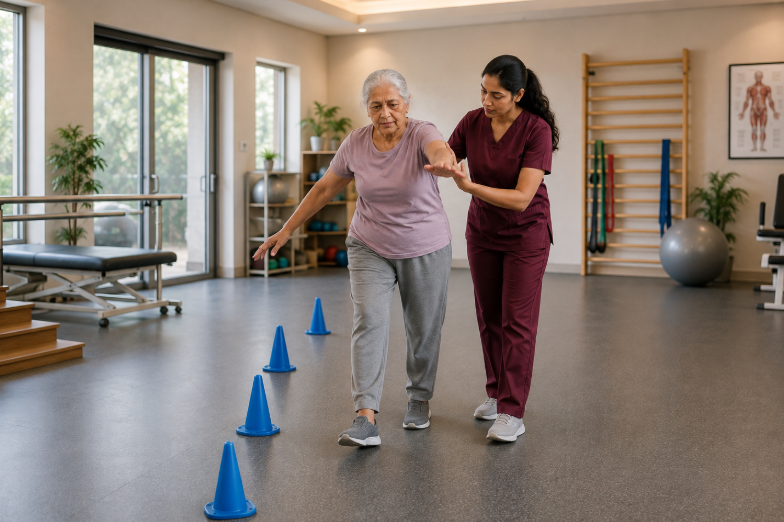
Physical rehabilitation requires effort and for that you need a proper stroke rehabilitation that understands the challenges deeply.
A person may need to practise the same movement repeatedly, work on balance, learn new ways to perform daily activities, or practise communication.
But if someone is depressed, anxious, extremely frustrated, or lacking motivation, participating in therapy can become more difficult.
This creates a cycle:
Emotional distress → less participation → slower functional progress → more frustration
That is why emotional wellbeing should not be treated as something separate from physical rehabilitation.
Supporting mental and emotional health can help a person engage more effectively with the overall recovery process.
How Can Families Help?
Family members don't have to "fix" every emotion.
Often, their role is to provide a safe environment where the person feels understood and supported.
Listen before giving advice
Sometimes a stroke survivor needs to express frustration rather than immediately hear:
“Don't worry, everything will be fine.”
Instead, try:
“I understand that this is difficult. Tell me what is bothering you.”
Being heard can be more helpful than trying to immediately solve the problem.
Don't Take Every Reaction Personally
If the person becomes irritated or emotional, remember that stroke-related changes can affect emotional control and behaviour.
This doesn't mean families should accept harmful behaviour. But understanding the possible neurological contribution can help prevent every disagreement from becoming a personal conflict.
Encourage, Don't Force
Motivation can be difficult after stroke.
Instead of saying:
“You have to exercise.”
try:
“Would you like to do your exercises before or after breakfast?”
Small choices can give the person a sense of control while still encouraging participation.
Celebrate Small Improvements
Recovery may not always happen in dramatic steps.
Today, it might be:
Sitting independently for longer
Taking a few more steps
Completing an exercise
Speaking a little more clearly
Joining the family for a meal
Acknowledging these small achievements can help maintain motivation.
Keep Social Connections Alive
Stroke survivors can become isolated because of mobility problems, communication difficulties, fatigue, or embarrassment about their symptoms.
But social connection can be valuable during recovery.
Family conversations, short visits, hobbies, support groups, or simple outdoor activities—when medically appropriate—can help reduce isolation.
At the same time, avoid overwhelming the person with too much activity or too many visitors.
Communication Matters More Than Ever
If the stroke has affected speech or language, the person may understand much more than they can express.
Families can help by:
Speaking directly to the survivor
Giving them enough time to respond
Avoiding finishing every sentence
Reducing background noise
Using gestures or visual cues when helpful
Asking one question at a time
Communication difficulties can increase frustration and isolation, so creating a patient communication environment is an important part of emotional support.
When Should Families Seek Professional Help?
Emotional changes should be discussed with the rehabilitation or medical team when they are persistent, worsening, or interfering with everyday life.
Professional assessment may be particularly important if the person:
Remains persistently sad or hopeless
Has lost interest in almost everything
Is increasingly anxious or fearful
Refuses rehabilitation repeatedly
Has major changes in sleep or appetite
Becomes unusually aggressive or impulsive
Has frequent unexplained crying or laughing episodes
Becomes socially withdrawn
Expresses feelings of being a burden
Talks about death or self-harm
Any thoughts, statements, or actions involving self-harm or suicide require prompt professional attention. Depression after stroke is treatable, and getting help early matters.
How Rehabilitation Can Support Emotional Recovery
A comprehensive stroke rehabilitation programme doesn't focus only on muscles and movement.
Depending on the person's needs, rehabilitation may involve:
Physical medicine and rehabilitation
Physiotherapy
Occupational therapy
Speech and language therapy
Cognitive rehabilitation
Psychological support
Nursing support
Nutritional guidance
Caregiver education
The aim is to help the person regain function while also adapting to the changes caused by the stroke.
For some survivors, counselling or psychological therapies may be helpful. Cognitive and behavioural approaches can also be considered depending on the individual's needs.
What Families Should Remember
One of the most important things a family can do is separate the person from the stroke.
The person you knew is still there.
They may simply be dealing with changes they never expected.
Instead of asking:
“Why are you behaving like this?”
try asking:
“What has become difficult for you since the stroke?”
That small change in perspective can create more understanding.
Recovery isn't only about improving physical abilities. It is also about rebuilding confidence, adapting to change, finding meaningful routines, and helping the survivor feel like themselves again.
Final Thoughts
Emotional changes after stroke are real, and they can be just as challenging as physical symptoms.
Depression, anxiety, anger, frustration, apathy, grief, personality changes, and sudden emotional outbursts can all occur during recovery.
Families may not be able to remove these challenges, but they can make the journey easier by listening without judgement, encouraging without pressuring, maintaining social connection, recognising warning signs, and involving the rehabilitation team when support is needed.
Most importantly, emotional recovery deserves the same attention as physical recovery.
Because recovering from a stroke isn't just about learning to move again. It's also about learning to live, communicate, connect, and feel confident in life again.
Visit us for more info : https://www.antaraseniorcare.com/care-home/services/stroke-rehabilitation
From Squirrel to Moose: Matching Ten Cartridges to the Animal
From Squirrel to Moose: Matching Ten Cartridges to the Animal