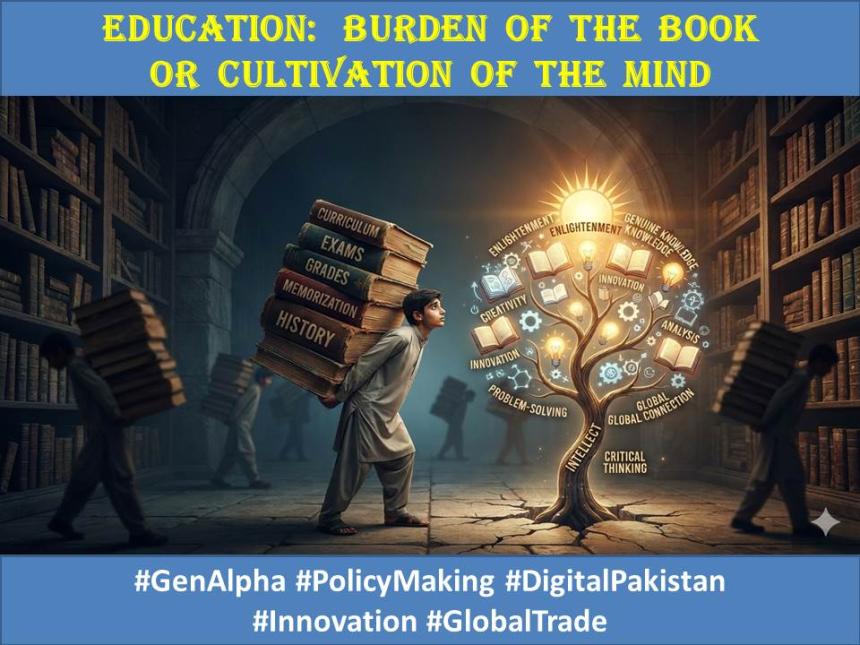

Education: Burden of the Book or Cultivation of the Mind
Information is Free. True Education is Rare. We have spent decades forcing our youth into a blind race for grades, turning books into burdens rather than pathways to consciousness. Despite a stagnant domestic market, our youth are surviving globally by carving out their own digital livelihoods. If we want to save the generations to come (Gen Alpha and beyond), we must dismantle our obsolete educational frameworks today. We must build an economy anchored in free trade and a school system anchored in critical thinking. Read this essay on Education: The Burden of the Book and the Cultivation of the Mind.
أَعُوذُ بِاللّٰهِ مِنَ الشَّيْطَانِ الرَّجِيمِ
بِسۡمِ ٱللهِ ٱلرَّحۡمَـٰنِ ٱلرَّحِيمِ
In the name of ALLAH, the Most Gracious, the Most Merciful
Education: Burden of the Book or Cultivation of the Mind
A human being spends 18 of the most precious years of their life—twelve years in school, four years in a bachelor's program, and then sleepless nights pursuing an MPhil or a PhD—sacrificing them to assignments, research papers, presentations, and examinations. After this long and exhausting journey, when they step into the practical world with a degree in hand, they find themselves standing before a profound question: "What am I supposed to do now?" The moment they step out of the structured bubble of the educational system, the hunt for a decent job becomes life's greatest battle. At this juncture, it is inevitable to ask: is 18 years of long, hard labor not even enough to guarantee a person a fair shot at a dignified career?
To understand the roots of this systemic malfunction, we must look back nearly four and a half decades. In the 1980s, when a flood of youth could be seen arriving at colleges and universities every day, the majority did not seek the acquisition of knowledge or the cultivation of the mind. Instead, they were merely in search of a piece of paper—a degree—that would make them employable.
They walked languidly, loaded with books. It was perhaps for such people that the Holy Qur'an, in Surah Al-Jumu'ah, presented the allegory of a donkey carrying books—bearing the physical weight but entirely devoid of its understanding. This tragedy persists today. The crowd that flooded colleges for a degree 45 years ago has now reached the PhD level, yet the objective remains unchanged: to acquire a "piece of paper" rather than illuminating the intellect.
The foundation of this intellectual bankruptcy lies in the colonial educational system spread by the British Raj. The purpose of this system was never to produce thinkers, researchers, or independent sovereign minds; its sole intent was to manufacture "loyal clerks" to run the machinery of British rule in the Subcontinent. It was a structure where education was reduced to a mere employment license, and the cultivation of reason was cast aside. This clerk-producing system functionalized smoothly only as long as the state possessed public sector vacancies. Today, when those vacancies have vanished and the number of graduates has reached millions, that degree has become nothing more than a worthless receipt.
The time has come to shift our paradigm. We must stop asking society and policymakers, "Why do our graduates not have jobs?" or "Why are they not market-ready?" Instead, we must raise the tougher question: "Why are we failing to generate adequate opportunities for a generation that is becoming educated at such a rapid pace?" When a country lacks funds for Research and Development (R&D), when its economic structure stagnates, and when new industries fail to establish, where else will these brilliant minds fit?
We, as a nation, built no system to support this younger generation. Yet, driven by the sheer force of circumstance and the evolution of the digital era, Generation Z has connected itself to the global landscape. The ultimate irony and blessing of this new digital economy is that earning a livelihood no longer requires a hyper-specialized, conventional academic intellect. Therefore, if we as a state and government cannot offer this generation anything else, let us at least provide them with high-speed internet and the liberty to think freely. Let us create avenues that allow them to link up with global resources. They will discover and carve out their own sustenance.
However, the real test lies with Generation Alpha and the cohorts that follow. For them, we must completely overhaul our entire educational system from its very roots—today, without hesitation, and without wasting another single moment. We must transform the book into a pathway toward true knowledge, rather than a tool for rote memorization. In this digital age, information is no longer something that needs to be taught; children acquire it instinctively. The true purpose of education is not to load the mind with data, but to anchor knowledge to its rightful place: consciousness. We must pull our children out of the blind war for grades and the relentless race for numbers. We must make them truly educated, opening up the vistas of perception, comprehension, and intellect.
Conclusion
The stark reality is that since independence, we have preserved a colonial and subservient educational system. This obsolete structure locked the doors of local innovation and actively catalyzed "brain drain." Yet, credit must be given to this resilient, hard-pressed generation. They have rendered a historic service to the motherland: today, foreign remittances generated by their sheer hard work far exceed our total national exports. The time has come to rectify past transgressions. Education must be implemented in a manner that breeds "educated human beings," not clerks. Concurrently, commerce and economy must be established as the nation's core anchor. Connect our trade and businesses with the global market and simplify the regulatory frameworks. Open the doors to free trade. When intellectual and commercial avenues are liberated, this generation will find its path to prosperity without relying on any crutches.
#GenAlpha #PolicyMaking #DigitalPakistan #Innovation #GlobalTrade




Folding Box Board Paper Price Trend 2026 | Q3 Forecast, Chart, Prices...