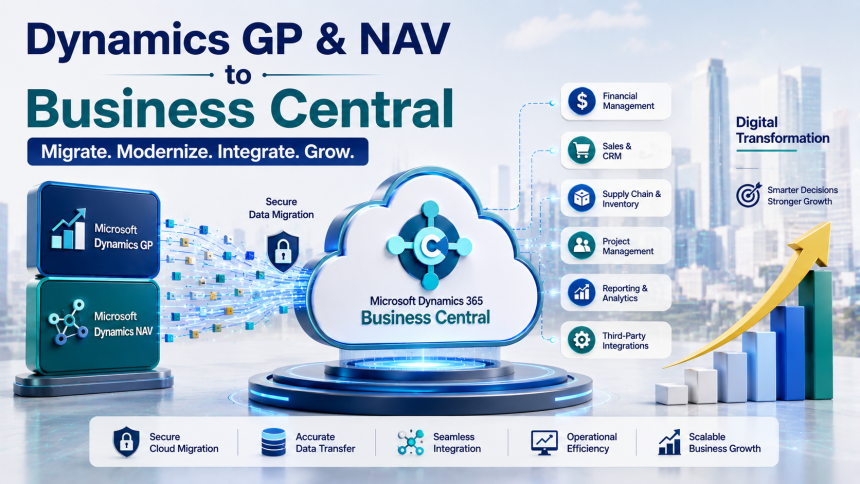

Dynamics GP & NAV to Business Central: A Smarter ERP Migration
Discover how Dynamics GP & NAV to Business Central migration modernizes ERP operations with secure data transfer, integration, automation, and scalable growth.
Introduction
Businesses that have relied on Dynamics GP or Dynamics NAV for years may eventually need a modern ERP environment that can keep pace with changing operations, cloud adoption, automation, and reporting requirements. Microsoft Dynamics 365 Business Central provides a connected platform for managing finance, purchasing, inventory, sales, projects, and other core business activities. However, moving from a mature ERP system to a modern platform requires more than transferring a database. It involves understanding existing processes, deciding what information should move, evaluating custom development, rebuilding integrations, protecting sensitive records, and preparing employees for new workflows. A carefully managed migration can help organizations reduce legacy complexity while establishing a more flexible and scalable foundation for future digital transformation.
Why Businesses Are Reconsidering Legacy ERP Platforms
Dynamics GP and NAV have helped organizations manage essential financial and operational activities, but older implementations can become increasingly difficult to adapt. Over time, businesses often accumulate customized reports, modified workflows, spreadsheets, third-party applications, and manual procedures around their ERP. These dependencies may continue to work, yet they can increase maintenance effort and make future changes more complicated. Moving to Business Central creates an opportunity to reassess these processes instead of simply reproducing them. Organizations can identify which capabilities remain essential, which processes can be simplified, and where automation can eliminate repetitive work. This modernization approach can improve operational visibility while creating a cleaner technology environment that is easier to extend as business requirements evolve.
Creating a Practical Migration Strategy
Assessing the Existing ERP Environment
A successful migration begins with discovery. Before configuration or data transfer starts, the organization should develop a clear understanding of its existing GP or NAV environment. This includes reviewing financial structures, operational modules, customizations, reports, workflows, integrations, user roles, and business-critical processes. Finance, operations, IT, and management teams should participate because each group may have different expectations from the new ERP platform. The migration strategy should define the target environment, project scope, responsibilities, timeline, testing approach, training requirements, and planned cutover. It should also identify dependencies that could affect business continuity. Taking time to understand the existing environment allows teams to make better decisions and prevents unnecessary legacy complexity from being carried into the modern ERP system.
Preparing Data for a Reliable Migration
Data migration is one of the most important parts of an ERP transformation because inaccurate information can affect operations long after go-live. Legacy GP and NAV environments may contain customer records, vendor information, item masters, chart of accounts, dimensions, inventory data, open transactions, and years of historical records. Before moving this information, organizations should determine what is required for ongoing operations and what can be archived. Data cleansing should address duplicates, inactive records, inconsistent formats, missing values, and outdated information. Mapping rules should then connect legacy fields and structures with their Business Central equivalents. After the transfer, important balances and records should be reconciled with the source system. This process helps ensure that employees begin using the new ERP with dependable and meaningful business information.
Modernizing Integrations and Customizations
ERP systems rarely operate as isolated applications. Businesses may rely on connections with CRM platforms, banking systems, payroll applications, e-commerce websites, warehouse solutions, reporting tools, or industry-specific software. These integrations should be reviewed before migration to determine whether they are still necessary and whether their architecture is suitable for the target environment. Legacy customizations also deserve careful assessment. Some modifications may have been created to overcome limitations that no longer exist, while others may still represent important business requirements. Rather than copying every customization, organizations can redesign necessary functionality using supported extensions, APIs, workflow automation, and modern integration methods. This approach can reduce technical debt and create a cleaner Business Central environment that is easier to maintain, update, and connect with future applications.
Protecting Business Data and System Access
Security should be incorporated into every stage of an ERP migration. Financial records, customer information, vendor details, inventory data, and operational information require controlled access during extraction, transformation, testing, and deployment. Organizations should review existing GP or NAV permissions and determine how access should be structured in Business Central. User roles should reflect actual responsibilities, while administrative privileges should remain limited to authorized personnel. Migration files and test environments also need appropriate protection because they can contain sensitive information. Authentication, authorization, audit requirements, data retention, and internal governance policies should be considered before production access is granted. Addressing security early helps reduce unnecessary exposure and gives the organization a stronger foundation for managing business information in the modern ERP environment.
Testing Before the Final Go-Live
Thorough testing helps identify problems before they affect real business operations. The new ERP environment should be tested using realistic scenarios rather than relying only on technical checks. Financial users should validate accounting processes, balances, dimensions, and reporting, while purchasing, sales, inventory, and operations teams should verify their daily workflows. Migrated records should be compared with the legacy environment to identify discrepancies. Integrations should also be tested to confirm that information moves correctly between Business Central and connected applications. User acceptance testing is especially valuable because employees can uncover workflow issues that technical teams may overlook. Problems discovered during testing should be corrected and validated again before production deployment. A disciplined testing process can significantly improve confidence in the migration and reduce avoidable disruption during the transition.
Addressing Common Migration Challenges
ERP modernization can become difficult when organizations underestimate the complexity of their existing systems. Incomplete documentation, inconsistent data, undocumented customizations, outdated integrations, and unclear process ownership can all create unexpected challenges. Another risk is attempting to recreate every legacy feature without considering its current business value. This can result in excessive customization and prevent the organization from benefiting fully from a modern ERP platform. Employee adoption can also be challenging when familiar screens and procedures change. Early communication, practical demonstrations, role-based training, and stakeholder involvement can help users understand the reasons behind the migration. Organizations should also provide post-go-live support because employees often discover questions and improvement opportunities only after they begin working with the new system in real business situations.
Best Practices for a Successful Migration
A successful Dynamics GP & NAV to Business Central project should combine technical accuracy with business process improvement. Teams should establish clear objectives before implementation and document important workflows, data requirements, integrations, reporting needs, and ownership responsibilities. Legacy data should be cleaned before migration, while customizations should be assessed individually instead of being transferred automatically. Testing should involve real users and realistic transactions, and integration validation should cover both normal and exception scenarios. Training should begin before go-live so employees have sufficient time to understand new workflows. For organizations with complex structures, a phased migration can provide additional control. After deployment, ongoing monitoring and user feedback can help identify opportunities to improve automation, reporting, configuration, and operational efficiency.
Business Benefits of Business Central Migration
A well-planned migration can provide benefits that extend beyond replacing an older ERP platform. Business Central can create a more connected environment for financial management, purchasing, sales, inventory, projects, and operational activities. Cloud accessibility can support flexible working while reducing dependence on traditional infrastructure management. Connections with Microsoft's broader business technology ecosystem can support collaboration, reporting, automation, and analytics. Organizations can also reduce manual data entry when previously disconnected processes become integrated. A modern ERP architecture can make it easier to introduce new applications and capabilities as business requirements change. By simplifying outdated workflows and improving information visibility, businesses can support faster decision-making, increase productivity, and establish a scalable platform that is better prepared for continued expansion.
Conclusion
Moving from Dynamics GP or NAV to Business Central is an opportunity to modernize the entire way an organization manages its ERP environment. The strongest results come from treating the transition as a business transformation rather than a simple technical upgrade. Careful planning, clean data, modern integrations, strong security, comprehensive testing, and effective user preparation all contribute to a smoother migration. Businesses should also use the project to remove unnecessary customizations and improve processes that no longer support current objectives. With a structured approach, Business Central can provide a connected and adaptable foundation for finance, operations, automation, reporting, and growth. By preparing thoughtfully and focusing on long-term business value, organizations can move beyond legacy ERP limitations and build a modern environment ready for evolving market and operational demands.

Merchant Bar Price Trend Q2 2026 | Global Price Trends, Forecast, Char...



Can You Rewire A House Without Removing The Walls During Rewiring A Ho...

Hot Rolled Coil Price Trend Q2 2026 | Global Price Trends, Forecast, C...