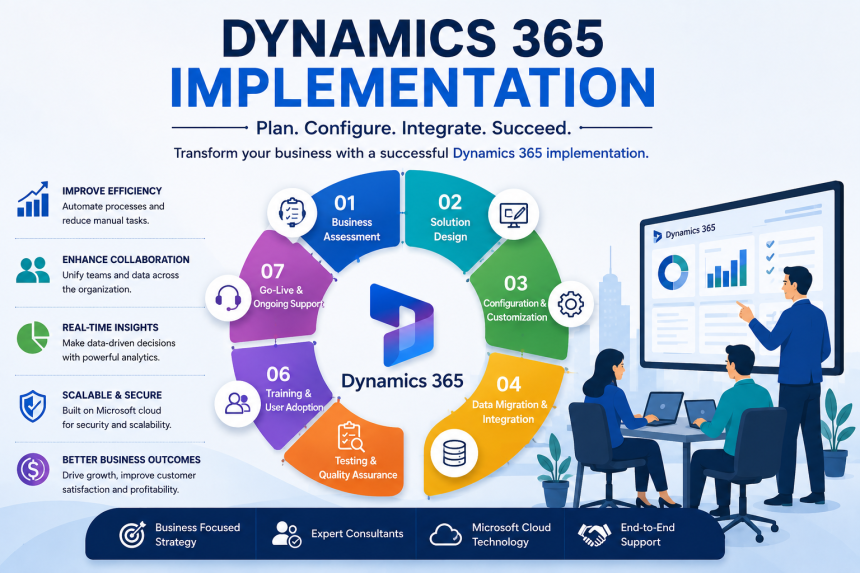

Dynamics 365 Implementation: Drive Operational Efficiency
Explore a complete Dynamics 365 Implementation guide covering planning, deployment, customization, migration, and best practices for business growth.
Introduction
In an increasingly digital business landscape, organizations are under constant pressure to improve operational efficiency, enhance customer experiences, and respond quickly to market changes. Legacy software and disconnected systems often create data silos, manual processes, and communication gaps that slow business growth. To remain competitive, companies need an integrated platform that connects departments, automates workflows, and delivers actionable insights.
Microsoft Dynamics 365 is one of the most powerful business solutions available today, combining Customer Relationship Management (CRM) and Enterprise Resource Planning (ERP) into a unified cloud platform. It enables organizations to manage sales, finance, customer service, supply chain, and operations from a single source of truth.
However, implementing Dynamics 365 is more than a software deployment. It is a business transformation initiative that requires strategic planning, stakeholder collaboration, and continuous optimization. This guide explores the implementation process, benefits, best practices, and common challenges to help businesses achieve long-term success.
What is Microsoft Dynamics 365?
Microsoft Dynamics 365 is a suite of intelligent business applications designed to improve organizational productivity and operational performance. The platform integrates multiple business functions, allowing departments to share accurate information, collaborate efficiently, and automate repetitive tasks.
Whether an organization needs customer relationship management, financial management, project operations, field service, or supply chain management, Dynamics 365 offers scalable applications that can be implemented according to business needs.
Another major advantage is seamless integration with Microsoft products such as Microsoft Teams, Microsoft 365, Azure, Power BI, and Power Platform. These integrations create a connected digital workplace where employees can work more efficiently while accessing real-time business data.
Why Businesses Choose Dynamics 365
Organizations invest in Dynamics 365 because it supports digital transformation while improving daily business operations.
Key benefits include:
- Centralized business information
- Improved collaboration across departments
- Automated business processes
- Better customer engagement
- Real-time dashboards and reporting
- AI-powered insights
- Secure cloud infrastructure
- Scalable business applications
- Faster decision-making
- Lower operational costs
These capabilities allow businesses to respond quickly to changing market conditions while increasing productivity.
Planning Before Implementation
Every successful Dynamics 365 project begins with careful planning. Businesses should first identify operational challenges, define business objectives, and evaluate existing software systems.
Business Process Assessment
Understanding current workflows helps identify inefficiencies and opportunities for automation.
Requirement Analysis
Project stakeholders should define reporting requirements, security permissions, integration needs, compliance requirements, and future scalability expectations.
Project Roadmap
Creating a structured implementation roadmap with milestones, timelines, resource allocation, and risk management improves project execution while minimizing delays.
Proper planning significantly increases implementation success.
Essential Stages of Dynamics 365 Deployment
A structured deployment process helps organizations transition smoothly from legacy systems to Microsoft Dynamics 365.
Discovery and Solution Design
Consultants begin by understanding organizational goals, operational processes, and technical requirements. Workshops with business users help define workflows, reporting structures, automation opportunities, and integration requirements.
The solution architecture developed during this stage becomes the foundation for implementation.
Configuration and Customization
After completing the planning phase, consultants configure Dynamics 365 based on business requirements. Standard capabilities are activated while custom workflows, approval processes, dashboards, business rules, reports, and forms are developed to improve operational efficiency.
A successful Dynamics 365 Implementation ensures every department works from a connected platform that supports collaboration, automation, and informed decision-making. Instead of forcing organizations to change successful business practices, the implementation should enhance existing processes while eliminating unnecessary manual work.
The platform can also integrate with accounting software, ERP applications, eCommerce platforms, payroll systems, third-party business tools, and Microsoft applications to create a unified business ecosystem. Proper customization allows businesses to maintain flexibility while supporting future expansion without unnecessary complexity.
Data Migration and Integration
Business data is one of the most valuable organizational assets. During implementation, customer records, financial transactions, product information, vendor details, inventory data, and historical sales records are migrated to the new platform.
Before migration begins, businesses should clean their existing databases by removing duplicate records and correcting outdated information.
Integration with existing software ensures seamless communication between business applications while eliminating duplicate data entry.
Testing and Quality Assurance
Testing ensures the configured solution performs correctly before deployment.
Typical testing includes:
- Functional testing
- Integration testing
- Security testing
- Workflow validation
- User Acceptance Testing (UAT)
- Performance testing
Identifying and resolving issues before go-live minimizes business disruption.
Training and User Adoption
Technology delivers value only when employees confidently use the system.
Organizations should provide role-based training that covers daily business activities, dashboards, workflow automation, reporting, and mobile access.
Effective change management encourages user adoption and helps employees transition smoothly to the new platform.
Go-Live and Continuous Improvement
Deployment marks the beginning rather than the end of the implementation journey.
Organizations should continuously monitor:
- System performance
- User engagement
- Business workflows
- Integration health
- Reporting accuracy
- Security compliance
Regular updates and optimization ensure the system continues supporting evolving business requirements.
Common Implementation Challenges
Businesses may encounter several challenges during implementation if planning is insufficient. Some common issues include:
Poor Data Quality
Duplicate and inaccurate records affect reporting and operational efficiency.
Employee Resistance
Users may hesitate to adopt new technology without adequate training.
Over-Customization
Excessive customization can complicate future upgrades and increase maintenance costs.
Undefined Business Objectives
Projects lacking measurable goals often struggle to demonstrate return on investment.
Partnering with experienced Dynamics 365 consultants helps organizations avoid these challenges.
Best Practices for a Successful Implementation
Businesses can maximize implementation success by following proven strategies:
- Define clear business objectives.
- Engage stakeholders throughout the project.
- Clean business data before migration.
- Customize only where necessary.
- Conduct comprehensive testing.
- Train users continuously.
- Monitor system performance after deployment.
- Review and improve business processes regularly.
These practices improve implementation outcomes while supporting long-term business growth.
Business Value of Dynamics 365
Organizations implementing Dynamics 365 often experience measurable improvements across multiple business functions.
Some long-term benefits include:
- Increased operational efficiency
- Better customer experiences
- Faster reporting and analytics
- Improved employee productivity
- Automated business processes
- Enhanced collaboration
- Real-time business visibility
- Stronger regulatory compliance
- Greater scalability for future expansion
These advantages help businesses remain competitive in rapidly changing markets.
Conclusion
Microsoft Dynamics 365 provides organizations with a powerful platform for managing operations, strengthening customer relationships, and driving digital transformation. However, the true value of the platform depends on careful planning, structured implementation, employee engagement, and continuous optimization.
A successful Dynamics 365 implementation creates a connected business environment where information flows seamlessly, processes become more efficient, and leaders gain the insights needed for strategic decision-making. By investing in the right implementation approach, businesses can build a scalable digital foundation that supports innovation, improves operational performance, and enables sustainable long-term growth.





Global Market Insights: How Potty Training Tools and Step Stools Are R...

Heating Oil Safety Tips Every New Hartford CT Homeowner Needs
heating oil New Hartford CT,
