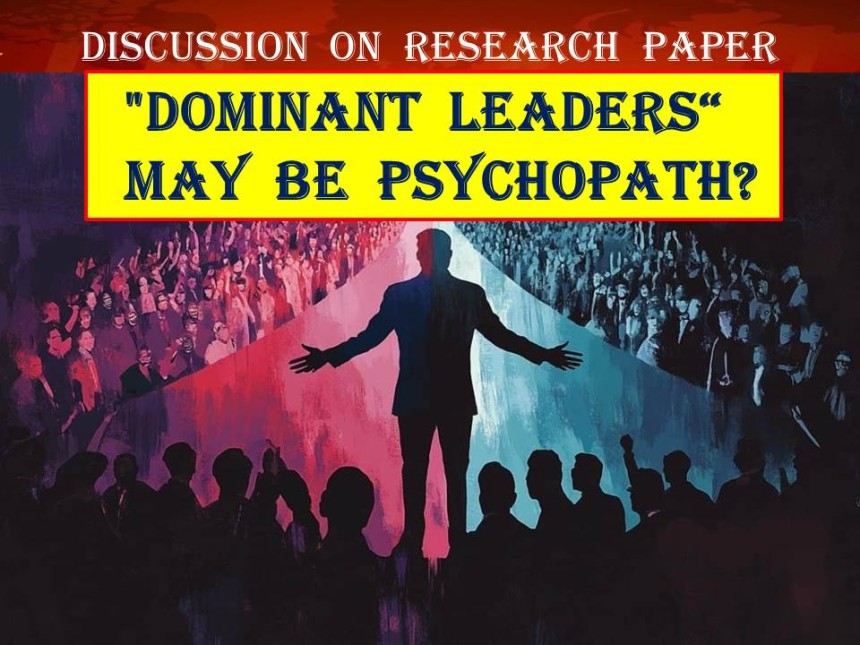

"Dominant Leaders" May be Psychopath?
A fascinating 2021 paper that completely reframes why psychopaths rise to leadership. The paper proposes a specific, intrinsic motivation; "The Need for Domination". A psychopath is someone with a severe personality disorder. A dominant leader is a decisive, results-oriented, and confident individual who seeks control, autonomy, and quick action. This write up has been arranged for discussion purpose as it involves or lives in a big way.
بِسۡمِ ٱللهِ ٱلرَّحۡمَـٰنِ ٱلرَّحِيمِ
In the name of ALLAH, the Most Gracious, the Most Merciful
"Dominant Leaders" May be Psychopath?
What if You are told that the "successful" psychopath in your office isn't actually motivated by money, fame, or success?
A fascinating 2021 paper that completely reframes why psychopaths rise to leadership. The truth is much darker. Here is the psychology of the "Need for Domination":-
First, let's look at the numbers. Research estimates that psychopaths are for times (4x) more likely to be found in high-profile leadership positions than in the general population. But why? And how do they get there without getting caught?
We usually picture psychopaths as impulsive criminals (the "prison profile"). But the paper by Palmen, Kolthoff, & Derksen identifies a different breed: The "Controlled Primary Psychopath."
https://www.sciencedirect.com/science/article/pii/S135917892100104X
These people have the same lack of empathy, but they have one superpower: High Self-Control. This self-control acts as a "moderator." It allows them to suppress the impulsive, antisocial behavior that usually lands psychopaths in jail. Instead of punching someone, they use "functional impulsivity" and charm to climb the corporate ladder. But here is where it gets weird.
We assume these leaders want what we want: Money. Prestige. Achievement. The researchers argue: No.
While Narcissists crave "Achievement" (to be admired) and "Affiliation" (to be loved), Psychopaths score LOW on both. They don't care if the company succeeds. So what drives them?
The paper proposes a specific, intrinsic motivation: The Need for Domination. For the psychopathic leader, power isn't a means to an end. Power is the end. They are biologically wired by the "Dominance Behavioral System" to seek control over others.
This distinction is crucial. A Narcissist might work 80 hours a week because they want the glory of a successful product. A Psychopath doesn't care about the product. They care about the hierarchy. They want to be the one pulling the strings.
The study highlights a chilling detail about their view on resources (money/perks). Psychopaths prefer "relative" success over "absolute" success. They would rather have less total money, as long as they still have more than you. It’s not about comfort; it’s about superiority.
This explains why "successful" psychopathic leaders are actually terrible for business. Because they lack the "Need for Achievement," they rarely work for the collective good. They are parasitic. They use the organization's assets solely to increase their dominance over employees.
The paper warns that this specific profile—High Dominance + Low Affiliation + Low Achievement—is a recipe for disaster. It leads to:
Fraud; Toxic cultures; Employee burnout. They are "successful" at getting the job, but destructive once they have it.
The Takeaway:
When you see a leader who is charming but creates chaos, ask yourself; Are they trying to build something? Or are they just trying to own you? If they seem to value control more than profit or people, you might be looking at a Controlled Primary Psychopath.
If you want to dive deeper, check out the paper: "The need for domination in psychopathic leadership" (Palmen et al., 2021).
The above taken from this thread on X.com
Assessment and Analysis on "Dominant Leaders" with Psychopathy
"Social Dominance" is considered a well-established trait within "Psychopathy", particularly associated with specific subtypes and personality facets. It is a key component of the interpersonal dimension of the disorder and is linked to a desire for power and control over others. "Psychopathy" is a personality disorder represented by a combination of charm, egocentricity, impulsivity, manipulation skills, and anti-sociality hidden behind a façade of normalcy. It is interesting to study psychopathy in the workplace, with a specific focus on psychopathic individuals in leadership positions in business and politics; because it deals with life of common man in various façade.
Social dominance orientation (SDO) is a powerful motivational factor where individuals prefer group-based hierarchy and inequality, driving them to seek positions of power, support hierarchy-enhancing ideologies (like racism or nationalism), and compete for resources, viewing the world as a zero-sum game. It motivates career choices in prestigious, high-status roles, influences support for policies upholding group dominance, and contrasts with empathy, leading to less concern for equality and more support for dominant group interests.
A psychopath is someone with a severe personality disorder, characterized by a profound lack of empathy, remorse, and conscience, leading to manipulative, callous, and often antisocial behavior, though it's not an official diagnosis but related to Antisocial Personality Disorder (ASPD). They use charm to exploit others, have shallow emotions, struggle with impulse control, and disregard rules, sometimes appearing normal but lacking deep emotional bonds or guilt for causing harm. There are seven key characteristics of a psychopath; Lack of empathy; Impulsive behavior; Antisocial behavior; Surface-level charm; Narcissism; Cold-hearted, unemotional traits; Lack of guilt.
"Social Dominance" may be a leadership trait, but it's complex: Sociable dominance (assertive, confident) links to task leadership, while aggressive dominance (controlling, power-seeking) can be detrimental, often seen as controlling rather than empowering; effective leaders balance dominance with qualities like vision, empathy, and ethical focus, differentiating true leadership from mere control.
A dominant leadership style is characterized by being decisive, direct, assertive, and results-oriented, with leaders taking charge, setting clear directions, and focusing on control and achieving goals quickly, often through a commanding presence, though it risks creating a fear-based culture or hindering collaboration if not balanced with empathy and awareness. These leaders thrive in dynamic situations, value power, and push for high achievement but can be perceived as intimidating or inflexible.
A dominant leader is a decisive, results-oriented, and confident individual who seeks control, autonomy, and quick action, often characterized by a strong, sometimes intimidating presence, prioritizing tasks and goals over interpersonal details, and excelling at taking charge but potentially struggling with collaboration, flexibility, and employee empathy, leading to faster decisions but also potential conflict or toxic environments.
A leader with a naturally dominant personality can employ a democratic leadership style in specific contexts, but a political system based on a single "dominant leader" is generally considered a form of semi-authoritarianism that undermines true democracy. Psychopathic individuals may be drawn to leadership roles because these positions allow them to fulfill their need for domination and control over others. The dominant leaders with psychopathic traits may rise to top of the ladder in a business or political set up but they will not be able to add value to the organization in long term basis.
Dominant leaders can attract followers, but the nature of this attraction varies significantly by context and leadership style. This form of leadership often relies on coercion or a perceived ability to protect the group, but it can also reduce follower trust and lead to long-term opposition. A dominant psychopathic leader can attract followers, often by leveraging specific traits that people commonly associate with strong leadership, such as superficial charm, charisma, confidence, and a willingness to make bold, tough decisions.
Conclusion
Leaders are a compulsion for the progress and development of human society. Before the rise of democracy, as the form of most preferred governance model, the "most successful" model of leadership in kingship era generally combined a balance of power, pragmatism, strong moral character, and a focus on the long-term welfare of the kingdom and its people. Purely autocratic or purely weak models often led to instability or collapse through out the history.
The rise of "dominant leaders" during democratic era (in all fields of life; but especially in business and politics as the paper above) is a subject of ongoing debate and political psychology research; it's not an established fact; but early signs are very troubling and intriguing. Research suggests that preferences for dominant or strong leaders tend to increase during times of perceived threat or crisis, such as; economic uncertainty, internal disorder or intergroup conflict, and a perceived lack of control among the populace.
The above paper suggests that "dominant leaders" lack in empathy, but they have one superpower: High Self-Control. The self-control allows them to suppress the impulsive, antisocial behavior. They use "functional impulsivity" and charm to climb the ladder.
This kind of leaders are driven by "intrinsic motivation"-the "Need for Domination" to seek control over others. This distinction is crucial. A Narcissist might work 80 hours a week because they want the glory of a successful product. A Psychopath doesn't care about the product.
The paper continues to reflect that "dominant leaders" seek authority; to be the one pulling the strings. Psychopaths prefer "relative" success over "absolute" success. The "psychopathic leaders" seek superiority and are actually terrible, because they rarely work for the collective good. Such parasitic individuals use the organization's assets solely to increase their dominance. The paper warns that this specific profile—High Dominance + Low Affiliation + Low Achievement—is a recipe for disaster. It leads to; Fraud, Toxic cultures and Employee burnout. The "dominant leaders" are "successful" at getting the job, but destructive once they have it.
What European Manufacturers Need From an Indian Event Partner
European manufacturers expanding in India bring high standards with them. They expect prec...


NBSK Pulp Price Trend Q2 2026 | Global Price Trends, Forecast, Chart,...

BCTMP Price Trend Q2 2026 | Global Price Trends, Forecast, Chart, Pric...