
Direct to Device (D2D) Market Growth to Drive USD 6.9 Billion Opportunity by 2032
Annual demand in the Direct to Device (D2D) Market is expected to rise from USD 1.2 billion in 2026 to USD 6.9 billion by 2032. The market stood at USD 0.9 billion in 2025, while the 2026 value represents year-on-year growth of 33.2%.
Market Overview and Growth Outlook
Annual demand in the Direct to Device (D2D) Market is expected to rise from USD 1.2 billion in 2026 to USD 6.9 billion by 2032. The market stood at USD 0.9 billion in 2025, while the 2026 value represents year-on-year growth of 33.2%. The forecast reflects accelerating adoption of satellite links for standard connected devices.
“The Direct to Device (D2D) Market is expected to grow at a CAGR of 32.6% during 2026-2032.” Over the same period, cumulative sales opportunities are projected at USD 23.3 billion. This trajectory is being shaped by demand for emergency connectivity, resilient communications, remote digital access, industrial IoT, and satellite integration with 5G non-terrestrial networks.
D2D technology enables smartphones, tablets, wearables, and IoT modules to communicate directly with satellites. Users do not need dedicated satellite hardware or terrestrial cellular infrastructure. The technology provides messaging, voice, data, and emergency communication across locations where terrestrial networks are unavailable, constrained, or temporarily disrupted.
The commercial logic behind Direct to Device (D2D) Market growth rests on closing persistent communication gaps. Satellite-to-device networks extend connectivity to remote assets, industrial facilities, transportation systems, maritime operations, rural communities, and emergency environments while retaining compatibility with conventional consumer and commercial devices.
Request a free sample report:
https://www.stratviewresearch.com/Request-Sample/direct-to-device-market#form
Market Segmentation Analysis
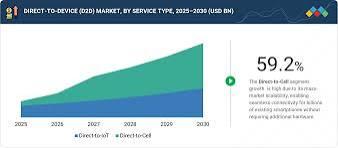
Service Type is divided into Direct-to-IoT, Direct-to-Cell, and Direct-to-Broadband. Direct-to-IoT is projected to be the dominant segment during the forecast period. Its growth is linked to low-power connected devices and uninterrupted connectivity requirements across asset tracking, environmental monitoring, predictive maintenance, smart agriculture, logistics, energy, maritime, mining, and remote industrial operations.
Customer Type comprises Consumer, Enterprise Network, and Government & Defense. Enterprise Network is expected to hold the largest market share. Enterprises increasingly rely on digitally connected infrastructure, automated monitoring systems, smart sensors, and equipment positioned across remote locations. D2D connectivity supports continuous operational visibility where terrestrial cellular service cannot provide dependable coverage.
Frequency Type consists of L-band, S-band, Ku-band, Ka-band, and Others. L-band is anticipated to dominate the market during the forecast period. The segment participates in a connectivity ecosystem serving messaging, data, emergency communication, industrial IoT, transportation, maritime connectivity, and monitoring applications distributed across areas with limited infrastructure.
Orbit Type includes LEO, MEO, and GEO. LEO is expected to have the largest market share during the forecast period. LEO constellation expansion supports broader direct-to-device coverage and commercial service deployment, enabling satellite operators and network providers to deliver connectivity directly to conventional devices without relying exclusively on terrestrial towers.
Latency Class includes L1, L2 and L3. L3 is projected to dominate the market. Latency is a significant consideration for connected infrastructure, industrial automation, smart grids, and autonomous mobility. Consistent network performance can be difficult to achieve in remote regions where satellite links may experience signal delay and service variability.
Regional Market Insights
North America is expected to be the dominant and fastest-growing region over the forecast period. The region combines advanced telecommunications infrastructure with an established satellite communications ecosystem. Demand is reinforced by emergency communication requirements, investment in network resilience, constellation development, commercial satellite-to-device deployment, and the need to extend coverage to underserved areas.
Emerging Trends Shaping the Direct to Device (D2D) Market
The market is evolving from specialized satellite communications toward direct connectivity for ordinary consumer and commercial devices. This transition expands the potential user base because smartphones, tablets, wearables, and IoT modules can access satellite services without specialized terminals. It also creates new service opportunities for mobile operators, satellite companies, enterprises, and public communication agencies.
5G NTN integration is becoming an important architectural direction. Combining satellite systems with cellular standards allows service providers to extend existing network ecosystems beyond terrestrial infrastructure. The result is a more unified communication model covering connected devices across remote, rural, maritime, aviation, and disaster-affected areas.
Connected industrial infrastructure is widening the role of D2D networks. Remote monitoring, automated equipment, smart sensors, and real-time asset tracking require consistent communication over large operating territories. This trend supports Direct-to-IoT adoption and reinforces demand from telecommunications, transportation & logistics, energy & utilities, agriculture, mining, maritime, aviation, government & defense, and industrial manufacturing.
Key Growth Drivers of the Market
Industrial IoT deployment: Connected equipment and sensors require uninterrupted data transmission, creating demand beyond the reach of terrestrial cellular infrastructure.
Emergency network resilience: Satellite-enabled links maintain messaging during disasters and outages, supporting public alerts and continuity of critical communication.
Remote asset visibility: Logistics, agriculture, energy, maritime, and mining organizations need reliable tracking and monitoring across geographically dispersed operations.
LEO constellation expansion: Additional satellite infrastructure increases coverage availability and supports commercialization of space-based mobile communication services.
5G NTN adoption: Standardized integration makes satellite connectivity accessible through conventional devices and strengthens cooperation between satellite and mobile ecosystems.
Competitive Landscape
Top Companies in the Market
Iridium Communications Inc.
Globalstar
Viasat
SpaceX
ORBCOMM
Conclusion and Strategic Outlook
The Direct to Device (D2D) Market is expected to reach USD 6.9 billion by 2032 from USD 1.2 billion in 2026, reflecting a CAGR of 32.6%. Its expansion is supported by a clear requirement for seamless communication across remote environments, growing IoT deployments, emergency resilience, rural digital access, and integration with cellular network standards.
Direct-to-IoT and Enterprise Network are projected to lead the service and customer categories, while L-band, LEO, and L3 remain the dominant frequency, orbit, and latency segments. Future industry performance will depend on constellation deployment, launch capacity, capital availability, regulatory coordination, and the ability to deliver dependable network performance.
FAQs – Direct to Device (D2D) Market
1. What is the Direct to Device (D2D) Market forecast through 2032?
The Direct to Device (D2D) Market is forecast to reach USD 6.9 billion by 2032. The market is expected to increase from USD 1.2 billion in 2026.
2. How quickly is the market expected to grow?
The market is projected to expand at a CAGR of 32.6% during 2026-2032. Annual demand in 2032 is expected to be nearly six times the 2026 level.
3. Which factors support market growth?
Emergency communication, connected IoT devices, remote asset monitoring, rural coverage, satellite-enabled services, and 5G NTN integration support demand. These factors extend connectivity beyond terrestrial network limitations.
4. Where is regional demand strongest?
North America is expected to remain the dominant and fastest-growing region. Its satellite ecosystem and telecommunications infrastructure support continued market development.
5. Is the Direct to Device (D2D) Market an uncomplicated investment opportunity?
No. The growth outlook is substantial, but latency, network variability, constellation costs, launch delays, and regulatory coordination create execution risks that market participants must manage.
Eight Mistakes Buyers Make With Mainstream Rifle Ammunition
Eight Mistakes Buyers Make With Mainstream Rifle Ammunition

Twist Rate, Barrel Length and Bullet: Setting Up a Rifle for the Load
A bullet only flies true if the barrel spins it fast enough. Here is how twist rate, bulle...