
CRM Integration vs Consolidation Migration: Complete Guide
CRM data integration connects systems, while full CRM consolidation migration unifies all customer data into one platform for better efficiency and management.
Introduction
Customer relationship management (CRM) systems are at the heart of modern business operations. They help organizations manage customer interactions, track sales opportunities, streamline marketing efforts, and improve customer service experiences. As businesses expand and adopt multiple technologies, managing customer data efficiently becomes increasingly challenging.
Many organizations operate several software platforms across different departments. Sales teams may use one application, marketing teams another, and customer support departments yet another. While these tools provide valuable functionality, disconnected systems often lead to fragmented customer information, duplicate records, and inefficient workflows.
To address these challenges, businesses often consider CRM integration or CRM migration strategies. However, understanding the differences between these approaches is essential for selecting the right solution. Each method offers unique benefits depending on an organization's goals, existing infrastructure, and long-term business strategy.
Why Businesses Need Better CRM Connectivity
Organizations generate vast amounts of customer data through websites, email campaigns, sales interactions, customer support tickets, social media engagement, and e-commerce transactions. When this information is spread across multiple systems, it becomes difficult to create a complete picture of customer relationships.
Disconnected data environments can create several operational challenges:
Inconsistent Customer Information
Different departments may access outdated or conflicting customer records, leading to communication issues and poor customer experiences.
Reduced Productivity
Employees often spend valuable time manually updating records or switching between systems to find information.
Limited Business Insights
Fragmented data makes it difficult to generate accurate reports and identify customer behavior patterns.
Increased Operational Costs
Managing multiple disconnected systems often requires additional resources and ongoing maintenance.
These challenges highlight the importance of creating a connected technology ecosystem that supports business growth and operational efficiency.
Understanding CRM Data Integration
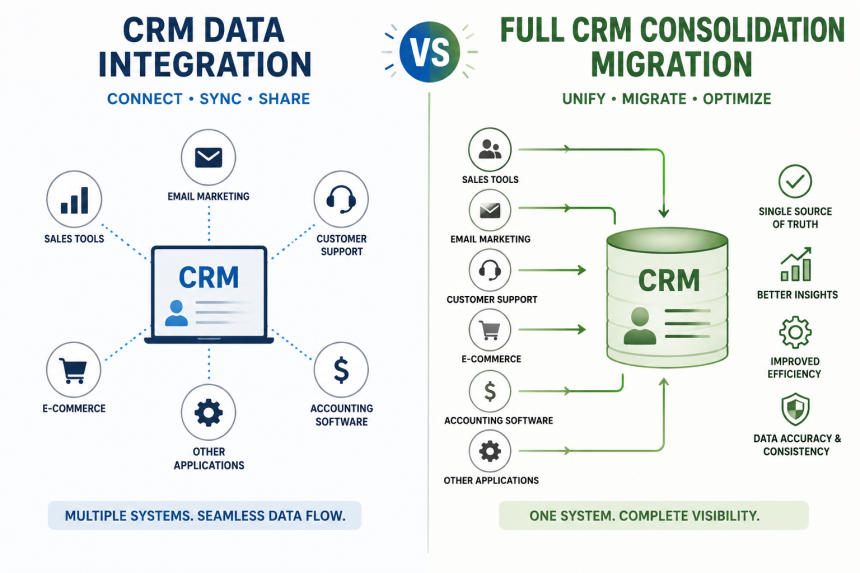
CRM data integration focuses on connecting multiple systems so they can exchange information automatically. Rather than replacing existing applications, integration allows organizations to maintain their current platforms while ensuring data flows seamlessly between them.
For example, a CRM system can be integrated with marketing automation software, accounting platforms, customer support tools, and e-commerce applications. This enables customer information to remain synchronized across departments.
Key benefits of CRM data integration include:
Improved Data Accessibility
Employees can access up-to-date information without manually transferring data between systems.
Enhanced Collaboration
Departments can work with consistent customer information, improving communication and coordination.
Faster Implementation
Integration projects are often less disruptive than full-scale migration initiatives.
Lower Initial Costs
Businesses can continue using existing software investments while improving connectivity.
CRM integration is often ideal for organizations that want to improve operational efficiency without replacing their entire technology infrastructure.
CRM Data Integration vs Full CRM Consolidation Migration
As businesses evaluate modernization strategies, one common consideration is CRM Data Integration vs Full CRM Consolidation Migration. While both approaches aim to improve data management and operational efficiency, they serve different business needs.
CRM data integration focuses on connecting existing platforms and enabling information sharing between systems. The goal is to preserve current applications while creating a unified flow of customer data. This approach works well for organizations that rely on specialized software tools and do not want to replace them entirely.
In contrast, full CRM consolidation migration involves moving data, processes, workflows, and users from multiple systems into a single CRM platform. Rather than maintaining separate applications, businesses consolidate operations into one centralized environment.
A full consolidation strategy can simplify technology management, improve reporting accuracy, and reduce software complexity. However, it typically requires more planning, investment, and organizational change than a standard integration project.
The decision between integration and consolidation depends on factors such as business objectives, system complexity, budget considerations, and long-term growth plans.
Benefits of Full CRM Consolidation Migration
For organizations seeking greater simplicity and consistency, full CRM consolidation offers several advantages.
Centralized Customer Information
All customer records are stored in one system, creating a single source of truth across the organization.
Simplified Reporting
Businesses can generate comprehensive reports without combining information from multiple platforms.
Reduced Software Maintenance
Managing a single CRM system often lowers administrative overhead and support requirements.
Improved User Experience
Employees work within one platform rather than navigating multiple applications.
Stronger Data Governance
Centralized environments make it easier to maintain data quality, security, and compliance standards.
While consolidation can deliver significant benefits, organizations must carefully plan migration projects to ensure successful outcomes.
Factors to Consider Before Choosing an Approach
Selecting between integration and consolidation requires a thorough evaluation of business requirements and existing technology infrastructure.
Business Goals
Organizations should determine whether they want to improve connectivity between systems or simplify operations through platform consolidation.
Current Technology Landscape
The number of existing applications and their integration capabilities can influence the best approach.
Budget and Resources
Integration projects may require lower initial investment, while consolidation initiatives often deliver greater long-term efficiencies.
Scalability Requirements
Businesses should consider how future growth will impact system performance and operational needs.
User Adoption
Changes to business processes and technology environments should be carefully managed to support employee adoption.
Best Practices for CRM Transformation Projects
Regardless of the chosen approach, successful CRM projects require careful planning and execution.
Conduct a Comprehensive Assessment
Evaluate current systems, workflows, and business objectives before making strategic decisions.
Prioritize Data Quality
Clean and validate customer records to ensure accuracy throughout the project.
Establish Clear Success Metrics
Define measurable outcomes related to productivity, customer satisfaction, and operational efficiency.
Perform Thorough Testing
Testing helps identify integration issues, migration errors, and workflow challenges before deployment.
Provide Employee Training
Well-trained users are more likely to adopt new systems and maximize their value.
Conclusion
Choosing between CRM data integration and full CRM consolidation migration is an important decision that can significantly impact business performance. Both approaches offer valuable benefits, but the right choice depends on an organization's goals, resources, and technology strategy.
CRM integration enables businesses to connect existing systems and improve data flow without major disruption. Full CRM consolidation migration, on the other hand, creates a centralized environment that simplifies operations and enhances visibility across the organization.
By carefully evaluating business requirements and following proven implementation practices, organizations can select the approach that best supports long-term growth, operational efficiency, and customer relationship success. A well-executed CRM strategy provides the foundation for better decision-making, stronger customer engagement, and sustainable business growth.
Hospital Curtain Track Suppliers in India & Operation Theatre Technici...

Golden Touch Fusion CBD: How They Work, Expected Results, and Where to...
Introduction Golden Touch Fusion CBD Gummies are marketed as a cannabidiol (CBD) suppleme...
Oil and Grease Paper Price Trend Q2 2026 | Price Trends, Forecast, Cha...

Cotton Yarn Price Trend Q2 2026 | Price Trends, Forecast, Chart, Price...