Context Engineering for LLMs & Enterprise AI Agents
Learn how context engineering for LLMs helps build reliable AI agents at scale with memory, retrieval, orchestration, and governance.
AI pilots perform perfectly in controlled demonstrations. They execute tasks and follow protocols as designed. Once deployed into real workflows, however, these same systems often start to fray. Decisions become inconsistent, and policies are misapplied. The issue is rarely the model's capability. Instead, it stems from the unmanaged information ecosystem surrounding it. This gap is what context engineering for LLMs addresses and why enterprises invest in scalable MCP server development to build reliable AI infrastructure. It is the essential discipline for moving from impressive prototypes to robust, production-grade AI infrastructure. It builds the reliable memory and attention systems that enterprise operations require. Without this layer, even the most powerful AI will quietly break under real-world pressure, preventing teams from delivering reliable AI agents at scale. Why Prompt Engineering Fails in Production AI? Context engineering vs prompt engineering in enterprise AI agents A perfectly crafted prompt can feel like a master key in a demonstration. In a live enterprise environment, that same prompt often stops working. The issue is one of scope. Prompt engineering optimizes a single interaction, but production AI must survive relentless system pressure. This local optimization breaks under the weight of real workflows, which is why context engineering vs prompt engineering becomes a real concern in enterprise systems. Workflow Degradation at Scale A prompt is static, but business processes are dynamic and expansive. As workflows grow in complexity, the initial instructions are diluted. They must compete with user requests, historical data, and new outputs. The clarity of the original design dissipates, leading to unpredictable behavior and reduced AI agent reliability. Single-String Architecture Prompts exist within one continuous stream of text. Enterprise systems, however, are multifaceted. They require separate threads for policy, memory, and operations within a scalable AI agent architecture. Forcing everything into a single string creates a fundamental mismatch. It conflates memory, instruction, and output until the model cannot distinguish its core task. Instruction Burial & Memory Loss Key directives get lost in the expanding context. Critical details from earlier in a conversation become inaccessible without proper LLM memory management and dynamic context management. The model then experiences task interference, applying logic from one domain to another. This manifests as inconsistency, not mere hallucination. It is a structural failure. Consequently, businesses face tangible risks. Inconsistency leads to compliance gaps and erodes trust. Policy drift introduces operational chaos. Relying solely on prompt engineering is building on unstable ground. It cannot support the weight of a full-scale system. Read More: https://mobisoftinfotech.com/resources/blog/ai-development/context-engineering-for-llms-enterprise-ai-agents
AI pilots perform perfectly in controlled demonstrations. They execute tasks and follow protocols as designed. Once deployed into real workflows, however, these same systems often start to fray. Decisions become inconsistent, and policies are misapplied. The issue is rarely the model's capability. Instead, it stems from the unmanaged information ecosystem surrounding it.
This gap is what context engineering for LLMs addresses and why enterprises invest in scalable MCP server development to build reliable AI infrastructure. It is the essential discipline for moving from impressive prototypes to robust, production-grade AI infrastructure. It builds the reliable memory and attention systems that enterprise operations require. Without this layer, even the most powerful AI will quietly break under real-world pressure, preventing teams from delivering reliable AI agents at scale.
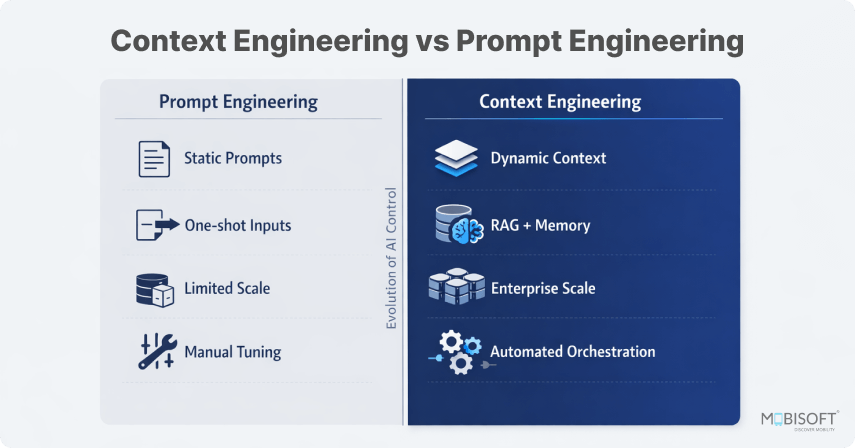
A perfectly crafted prompt can feel like a master key in a demonstration. In a live enterprise environment, that same prompt often stops working. The issue is one of scope. Prompt engineering optimizes a single interaction, but production AI must survive relentless system pressure. This local optimization breaks under the weight of real workflows, which is why context engineering vs prompt engineering becomes a real concern in enterprise systems.
Workflow Degradation at ScaleA prompt is static, but business processes are dynamic and expansive. As workflows grow in complexity, the initial instructions are diluted. They must compete with user requests, historical data, and new outputs. The clarity of the original design dissipates, leading to unpredictable behavior and reduced AI agent reliability.
Single-String ArchitecturePrompts exist within one continuous stream of text. Enterprise systems, however, are multifaceted. They require separate threads for policy, memory, and operations within a scalable AI agent architecture. Forcing everything into a single string creates a fundamental mismatch. It conflates memory, instruction, and output until the model cannot distinguish its core task.
Instruction Burial & Memory LossKey directives get lost in the expanding context. Critical details from earlier in a conversation become inaccessible without proper LLM memory management and dynamic context management. The model then experiences task interference, applying logic from one domain to another. This manifests as inconsistency, not mere hallucination. It is a structural failure.
Consequently, businesses face tangible risks. Inconsistency leads to compliance gaps and erodes trust. Policy drift introduces operational chaos. Relying solely on prompt engineering is building on unstable ground. It cannot support the weight of a full-scale system.