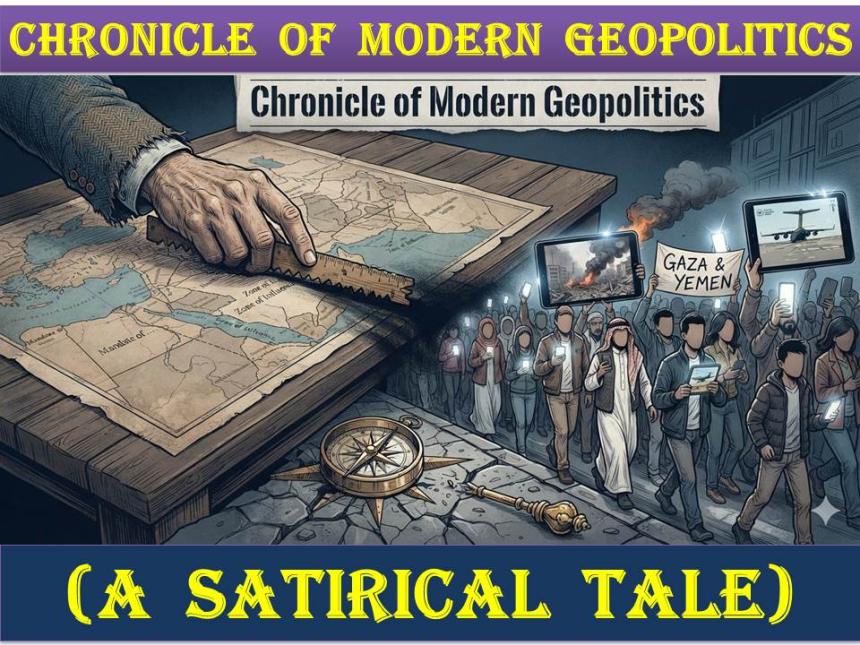

Chronicle of Modern Geopolitics
The year is 2026, and the map of the world is no longer colored by oil fields or ideological purity, but by broadband subscription tiers. The Chronicle of Modern Geopolitics reads less like a solemn textbook and more like a high-stakes global comedy where the borders are imaginary, but the ego clashes are real. Here this write up is a satirical tale dispatched from the front lines of modern statecraft.
أَعُوذُ بِاللّٰهِ مِنَ الشَّيْطَانِ الرَّجِيمِ
بِسۡمِ ٱللهِ ٱلرَّحۡمَـٰنِ ٱلرَّحِيمِ
اللہ کے نام سے شروع جو بڑا مہربان نہایت رحم کرنے والا ہے
In the name of ALLAH, the Most Gracious, the Most Merciful
Chronicle of Modern Geopolitics
(A Satirical Tale)
The Drawing Room of Destiny (London, 1920s)
The air in the smoke-filled Westminster office smelled of expensive tobacco, aged scotch, and supreme colonial confidence. On a massive oak table lay a freshly unrolled map of the Middle East, its ink barely dry.
Sir Reginald, a diplomat whose closest encounter with the desert was a sandbox in Brighton, held a long wooden ruler. Next to him stood Monsieur Dupont, nervously adjusting his monocle.
"Right then," Sir Reginald muttered, dragging his pencil in a sharp, jagged line right through three ancient trade routes and two ethnic communities. "We’ll call this bit Iraq. Has a nice, snappy ring to it."
"And what of this desert buffer zone here?" Dupont asked, pointing a manicured finger. "The tribes there have coexisted for centuries under their own treaties."
"Nonsense, Dupont! What they need is a European-style border," Reginald chuckled, drawing a perfectly straight horizontal line that separated a water source from the people who drank from it. "There. A masterpiece of geographic engineering. We shall give them crowns, flags, and a permanent sense of administrative confusion. It keeps them busy, you see."
"And right here in the center?" Dupont whispered, looking at the crossroads of the continents.
Reginald tapped the map with his pencil, leaving a dark, heavy graphite smudge. "Ah, the pièce de résistance. A permanent geopolitical fulcrum. We will place a brand-new state right in the middle of everyone else. It will guarantee that no one in this region will ever be able to agree on anything for the next hundred years. Divide and rule, my dear chap. Divide and rule."
Outside the window, the London rain poured, completely deafening the distant, future echoes of artillery that this very room had just set into motion.
The Streets of Fire (1967 & 1973)
The air in the streets of Cairo, Damascus, and Amman was thick with dust, exhaust fumes, and the crushing weight of historical shock. It was 1967, and then 1973. The radios in every coffee shop blared martial music, but the news filtering through the static was grim. The maps were being redrawn again—this time not by British pencils, but by American-made armor and Israeli jets.
Outside the state ministries, the streets morphed into a human sea. Millions of boots, sandals, and bare feet marched over asphalt that radiated the brutal summer heat.
"Death to America! Death to Israel!" the crowd roared, a singular, deafening chant that shook the wooden window frames of nearby apartments. Banners painted in hurried, dripping red ink demanded total mobilization. "Open the borders! Give us weapons! We will march to Jerusalem!"
An old man, his hands calloused from decades of tilling soil that his family no longer owned, stood on top of an overturned crate. He waved a faded flag, his voice hoarse from hours of shouting. "They took our lands in broad daylight! This is fascism! Where are our armies? Where are our leaders?"
A few blocks away, behind the heavily fortified, sandbagged walls of a presidential palace, a young military officer—who would later grow up to become the Minister of Sovereign Eloquence—peered out through the heavy velvet curtains. He watched the sea of angry faces, his heart hammering against his ribs.
"Sir," a nervous lieutenant whispered behind him, holding a stack of intelligence briefings detailing the total destruction of their air force on the runways. "The people are demanding a counter-offensive. They want us to cut the oil to the West immediately. They are ready to tear down the palace if we don't act."
The young officer turned around, slowly smoothing down his olive-drab uniform. He looked at the chaos in the streets, then looked at a secure, direct telephone line connected straight to a Western embassy. A realization washed over his face—a blueprint for his entire future career.
"Let them shout," the officer said quietly, a cynical smile forming on his lips. "In fact, give them bigger microphones. Let them burn the flags. It keeps their eyes on the skies instead of on our bank accounts. We will give them the grandest, most furious speeches history has ever heard."
"And the actual war, sir?" the lieutenant asked.
"The war is a logistical nightmare," the officer replied, walking over to a mirror to practice his best stern, revolutionary scowl. "But the rhetoric of war? That is political gold. We will tell them we are planning a total offensive. We will tell them we are launching a barrage of righteous fury. And while they are busy chanting in the dirt, we will quietly negotiate our security guarantees with Washington. Go out there and tell the state radio to play the national anthem on a loop."
The Great Condemnation (Middle Eastern Ministry, Present Day)
The television screen in the grand briefing room showed live, harrowing footage of smoke rising over flattened city blocks, hospitals overwhelmed, and civilian infrastructure reduced to dust.
At the podium stood His Excellency, the Minister of Sovereign Eloquence, wearing a flawlessly pressed traditional robe and a heavy gold watch that caught the glare of a dozen television cameras. He adjusted his microphone, his face contorted into an expression of practiced, theatrical rage.
"The setting up of this fascist entity in our sacred geography is an insult to history!" the Minister boomed, slamming his fist onto the mahogany podium. "We condemn it in the strongest possible terms! We launch all possible offensive! We are launching a diplomatic barrage of deep, deep concern! Our people will never accept it... we will fight!"
The cameras flashed aggressively. Journalists scribbled down the fiery words.
Behind the podium, tucked safely inside the Minister’s flowing sleeve, his custom smartphone vibrated. A subtle notification popped up from a private wealth management app based in Lower Manhattan: “Wire transfer of $50,000,000 to New York Holding Corp confirmed. Portfolio risk: Low.”
The Minister cleared his throat, maintaining his furious glare for the lenses, and leaned closer to the microphones. "Yes! We will fight with the absolute fury of a thousand press releases! Our diplomatic desks are fully mobilized! Our ink shall flow like rivers of righteousness!"
A young, weary reporter in the front row raised his hand, his voice raspy. "Your Excellency... when you say 'we will fight' and 'launch all possible offensive,' does that mean cutting off the gas pipelines, freezing the enemy's corporate assets in our capitals, or sending actual military aid to the borders?"
The Minister blinked, his furious expression instantly smoothing out into the blank, pleasant smile of a luxury hotel receptionist.
"Ah, let us not get bogged down in crude, physical logistics," the Minister chuckled smoothly, adjusting his cuffs. "When I say 'all possible offensive,' I mean we are currently fiercely debating the font size of our next joint communique. We are looking for an adjective that is even stronger than 'unacceptable.' We are considering 'highly inappropriate' or perhaps 'deeply unhelpful.' It is a battlefield of syntax, my young friend, and our diplomats are on the absolute front lines."
He then looked directly into the main broadcast camera, restoring his mask of righteous indignation for the millions watching at home. "But make no mistake—our rhetorical resolve is unbreakable! We will continue to shout from this air-conditioned room until the echoes of our condemnation are heard across the globe!"
He swept his robes dramatically and stepped away from the podium, heading straight for the private elevator that led to the underground hangar where his private jet sat fueled and waiting for the flight to Nevada.
The Divine Intervention (The Talk Show)
The studio lights of The Righteous Path Broadcast were blindingly bright, reflecting off the polished glass desk. The backdrop featured a dramatic, CGI loop of a stormy sky over the Middle East, complete with artificial lightning.
The TV host, wearing a somber expression and a perfectly tailored suit, leaned into the camera. "Tonight, as our brothers continue to endure broad-day robbery and fascism, we ask the ultimate question: Why has victory eluded us for decades? Joining us is the highly revered, globally broadcasted religious scholar, Maulana Al-Asfa."
The camera panned to Maulana Al-Asfa. He possessed a majestic, snow-white beard, wore an immaculate silk robe, and held a set of heavy, amber prayer beads. He looked deeply into the lens, his voice trembling with a mix of theatrical sorrow and absolute authority.
"My dear viewers," the Maulana began, slamming his hand onto the glass desk, making the studio microphones pop. "The truth is bitter! ALLAH is angry with us! Israel is invincible because we have lost our way!"
The host gasped softly, nodding for the cameras. "Explain this to our broken public, Maulana."
"We look at the enemy's advanced fighter jets, their impenetrable air defenses, and their global financial backing," the Maulana thundered, his eyes widening. "And we ask, how? I tell you, it is a divine decree! We are being punished for our collective sins! The streets are filled with music, the youth are distracted, and our devotion is weak! Until every single citizen fasts, prays, and accepts their fate with patience, the enemy will remain untouchable! Israel is invincible because it is a test of our faith! We must condemn them, yes, but we must look inward and accept this divine wrath!"
In millions of households, ordinary citizens sat in the dark—their electricity cut off, their cities in ruins—staring at the screen. Many wept, nodding along, suddenly feeling the crushing weight of spiritual guilt for a geopolitical tragedy they had no power to stop.
The Bavaria Summit
The grand conference room of a five-star resort in Bavaria was airtight, soundproof, and perfectly air-conditioned, safely insulated from the realities of the Middle East.
Around a massive mahogany table sat the military chiefs of staff from Israel, Saudi Arabia, the UAE, Bahrain, Kuwait, Qatar, Jordan, and Egypt, all arranged neatly alongside the Commander of U.S. Central Command (CENTCOM).
The CENTCOM Commander cleared his throat, adjusting his glasses. "Gentlemen, thank you for coming. I know the region is currently... energetic. But let us focus on what truly unites us: PowerPoint presentations and regional stability."
General Eyal Zamir, the Israeli Chief of Staff, stood up and clicked a remote. A high-definition slide appeared on the screen, showing a beautifully rendered, completely flat, 3D grid map where Gaza and South Lebanon used to be.
"As you can see," General Zamir announced with clinical enthusiasm, "our multi-front operations have successfully maximized kinetic restructuring. We have achieved a 100% reduction in standing architecture. It is streamlined. Minimalist. Very modern."
The representative from Egypt leaned forward, adjusting his heavily decorated uniform. "Yes, yes, excellent architectural critique, General. But what about the humanitarian PR? Our state television is running out of synonyms for 'deep concern.' We’ve used 'gravely worried' four times this week alone."
"Don't worry," the Qatari official chimed in, typing furiously on a gold-plated tablet. "We are currently drafting a strongly worded press release that condemns the structural damage while simultaneously funding a luxury beachfront hotel project for the 2035 reconstruction phase. Balance is key."
"Speaking of balance," the U.S. Commander interrupted, sliding a thick, classified folder across the table toward the Saudi delegation. "Riyadh, we have a fresh delivery for you. Straight from Tel Aviv’s finest servers, courtesy of Washington’s express courier service."
The Saudi general opened the folder. Inside was a piece of paper containing real-time satellite imagery of a small, dusty pickup truck in northern Yemen.
"Ah, marvelous," the Saudi general sighed, rubbing his temples. "This intelligence is vital. You see, we accidentally broke the ceasefire deal last month, and the Yemenis had the audacity to retaliate. It was deeply unsettling for our regional stability narrative. We spent three years perfecting that lecture."
The U.S. Commander smiled subtly, tapping a pencil against his notes. "Well, gentlemen, you must remember that colonial power does not operate only through armies, military bases, and economic control. It also seeks to control how people understand their own reality. Now the U.S. Army has established a new psychological operations company with a focused battalion whose official mission includes influencing the reasoning, motives, and behavior of targeted audiences. It’s all about guiding the public's perception of what 'stability' actually looks like."
The Emirati general nodded approvingly, taking a slow sip of his espresso. "Fascinating. This is precisely why I have argued for years that sovereignty must include sovereignty over information, communications, education, and narrative. We cannot let the street control the plot. The battlefield is not only land and resources. The mind is a battlefield too. If they think we are passive, they get restless. If they think it is an unyielding framework of divine peace, they stay calm."
"Exactly," the Saudi general agreed. "It is incredibly rude of them to interrupt our peace-building rhetoric with actual, unscripted resistance. It ruins the aesthetic of the Abraham Accords."
The Egyptian official looked at the Saudi general. "By the way, did you enjoy the Cairo summit with MBS? We had a wonderful security discussion. The catering was exquisite."
"Oh, the Cairo talks were splendid," the Saudi general replied. "The Americans proposed a brand-new regional mechanism to protect us from Yemen. It’s a wonderful system where everyone agrees to look the other way while we coordinate our air defense systems, but we all pretend we don't know each other when the cameras turn on."
"A classic strategy," the Jordanian representative noted, nodding approvingly. "We’ve been intercepting things quietly for months while publicly demanding justice. It’s exhausting work, but someone has to maintain the illusion of geopolitics."
General Zamir clicked to the final slide of his presentation. It was a giant, colorful pie chart labeled: “Regional Security, Stability, and Peace Framework.” The entire chart was empty, except for a tiny sliver labeled “Actual Peace,” which was crossed out with a red marker.
"In conclusion," Zamir said, smiling warmly at the table. "While the ground level is, uh, bleeding, our upper-level corporate synergy has never been stronger. To regional stability!"
The generals, commanders, and chiefs raised their crystal glasses of sparkling water, clinking them together in perfect unison. Outside the window, the peaceful German forest rustled in the wind, completely oblivious to the indictments of history being signed inside.
The Velvet Sanctuary (Las Vegas, 2:00 AM)
Six hours later, the Minister’s private jet touched down on the tarmac of Harry Reid International Airport. The blinding neon lights of the Las Vegas Strip reflected off the concrete, a universe away from the smoke and rubble of the Mediterranean coast.
Inside the high-stakes VIP lounge of an ultra-exclusive casino, the bass rattled the crystal chandeliers. The Minister had traded his traditional robes for a bespoke Italian silk suit. He sat on a plush velvet couch, a vintage bottle of Chateau Margaux chilling in a silver bucket beside him.
Sitting at the same blackjack table, wearing a Hawaiian shirt and dark sunglasses, was the CENTCOM Commander, casually stacking $10,000 chips. Next to them was Maulana Al-Asfa, his majestic white beard looking stark against a sharp black tuxedo as he tossed a $25,000 chip to a glamorous cocktail waitress.
"I caught your speech on the news feed before I left Germany," the Commander said, not looking up as the dealer slid him an Ace. "Powerful stuff, Minister. 'A fascist entity in our sacred geography.' Real poetic."
The Minister waved a dismissive hand, taking a hit from the dealer and landing a perfect 21. "Please, General, it’s just show business. The street needs its theater. If I don't shout about 'sacred geography' at least twice a month, they start looking too closely at the state budget or wondering why their electricity only works four hours a day."
"Smart," the Commander nodded, signaling the dealer to stay. "And the 'we will fight' part? My bosses in Washington were a little worried you might accidentally trip and cut off the oil pipelines."
The Minister burst out laughing, nearly spilling his wine. "Fight? With what? Our armies are exclusively trained for military parades and suppressing local protests! Do you know how much it costs to fuel a fighter jet? If we actually fought, I’d have to liquidate my real estate portfolio in Manhattan. No, no. The plan remains exactly as we agreed."
He turned to the Maulana. "And your broadcast, Maulana? 'ALLAH is angry.' Absolute genius."
The Maulana chuckled, taking a slow sip of his vintage red wine. "Thank you, Minister. If you tell the people the enemy is invincible because of geopolitics, they blame the government. But if you tell them the enemy is invincible because ALLAH is angry at them, they just go home and pray in silence. It keeps the streets perfectly quiet."
"And it keeps the cash flowing straight to our offshore accounts," the Minister laughed. "We will scream, we will cry, and we will curse the day that British diplomat drew those lines on the map. But tomorrow morning, our sovereign wealth funds will quietly purchase another billion dollars in U.S. treasury bonds. Just make sure your defense contractors keep sending us those shiny new anti-missile systems. We need them to protect our oil fields from the people who are actually fighting."
The Commander smiled, clinking his glass against the Minister’s. "To the fine art of theatrical warfare."
The Abraham Accord Galas
Months later, the ballroom of a luxury hotel in Dubai was bathed in a soft, ethereal blue light. Floating holographic olive branches drifted across the ceiling, while a gentle, ambient soundtrack of a lute mixed with a harp played softly in the background.
On the main stage, a massive banner read: "The Abraham Accords: Honoring the Father, Uniting the Sons."
The TV host stood at a podium made of transparent plexiglass. He smiled warmly, his voice dripping with enlightened optimism.
"For centuries, darkness and division ruled our sacred geography," the host announced, gesturing to the crowd of corporate executives, defense lobbyists, and regional diplomats. "But today, we step into the light. We invoke the holy name of Abraham—the father of us all! We are here to eradicate the old enmities, to cast aside the fundamentalists, the terrorists, and the Islamists who have kept us trapped in the past. Enlighten and peace must prevail! We are all brothers now!"
The crowd erupted into polite, rhythmic applause.
Sitting in the front row, wearing a bespoke suit with a small, stylized olive-branch pin on his lapel, was the Minister. Right next to him sat a prominent Israeli tech venture capitalist and the CENTCOM Commander.
"Beautiful words," the Minister whispered, leaning over to the Israeli investor. "Truly, a new dawn of brotherhood. Now, about that new cybersecurity contract... your firm's facial-recognition software is exactly what we need to monitor the... uh... fundamentalists in our public squares."
"Ah, yes, the 'enlightened stability' package," the investor smiled warmly, clinking his glass against the Minister's. "We are happy to provide it. True brotherhood means sharing the best surveillance tech. Peace cannot prevail if people are allowed to protest our mutual investments."
Behind them, Maulana Al-Asfa nodded approvingly to a group of international reporters.
"This is the true spirit of faith," the Maulana preached into a nearby microphone. "We must purge the radicals who demand justice through conflict. Real peace is spiritual. Real peace means accepting the financial structures of the world. Anyone who disrupts this holy unity is a terrorist against the family of Abraham."
The Broken Shield
The holographic olive branches at the Dubai gala continued to float lazily under the ceiling, but the music suddenly cut out. A sharp, piercing static echoed through the speakers, instantly silencing the room of corporate dignitaries, tech investors, and diplomats.
On the giant digital screens behind the stage, the pre-programmed corporate loop of "Abrahamic Unity" vanished. In its place, raw, unedited live feeds and highly classified satellite imagery flickered into view, broadcasting a reality that no press release could sanitize.
The regional map had finally fractured completely under the weight of the 2026 Iran War. The fiery rhetoric from air-conditioned podiums had been replaced by the stark, smoking reality of a region fundamentally changed by active conflict.
The digital screens laid bare what the regional streets had suspected for decades: US military bases across Kuwait, Bahrain, Qatar, the UAE, Saudi Arabia, Iraq, Oman, and Jordan had sustained widespread, severe damage from waves of Iranian precision missile and drone strikes.
The screen zoomed in on NSA Bahrain—the proud headquarters of the US Fifth Fleet—rendered entirely unusable by direct hits. Another slide showed the smoldering remains of a multi-million dollar radar aircraft at Prince Sultan Air Base in Saudi Arabia, its tail severed from a burned fuselage, blinding the region's air defense coordination. At Camp Buehring in Kuwait, the major staging area for US armor, structures were flattened.
The network of regional bases had shifted from static diplomatic outposts into active launchpads and targets. Because Iran and its allies targeted the infrastructure protecting Israel, the entire network of foreign bases was drawn into the fire. The illusion of a "peaceful regional mechanism" was entirely shattered as precision missiles bypassed multi-billion dollar air defense systems, proving that the bases were never there to protect the local populations, but to anchor a century-old status quo.
The Algorithmic Intifada
As the screens continued to flash images of the smoking military installations, the broadcast shifted to show the wider regional reality.
The View from Gaza
The feed showed Gaza. Two million people crammed into a landscape of pulverized concrete and dust, their lives, property, and basic human rights entirely erased from the ledger of global diplomacy. The camera panned over endless rows of tents pitched in the rubble of what used to be schools and neighborhoods.
A local journalist, his voice cracking with exhaustion, spoke directly into the lens: "They are signing accords in air-conditioned ballrooms, speaking of enlightenment and brotherhood. But here, two million human beings have been stripped of everything. Our property is gone, our children have no futures, and our basic right to exist is treated as a geopolitical footnote. Where is the 'peace' for us?"
The View from Yemen
The screen flickered to life, showing the rugged mountains and ports of Yemen. Smoke billowed from coastal infrastructure following the latest round of heavy airstrikes. For years, the country had been told to accept its place at the bottom of the regional hierarchy, but the blockade on Gaza had triggered a fierce, unyielding retaliation from Ansarullah.
A local Yemeni dockworker, standing near a damaged crane, looked into the camera. "They lectured us for years about 'regional stability' while they broke ceasefire deals and dropped bombs on our markets. Now, when we stand up to stop the starvation of Gaza, they label us terrorists. They built foreign military bases all around us, not to bring peace, but to protect the trade routes of the very system that bleeds our brothers."
The Awakening
In the front row of the gala, the Minister stared at the screens, his face turning an ash-gray color that matched his bespoke suit. The Israeli tech investor quickly closed his laptop, and the CENTCOM Commander was already on his secure phone, frantically barking orders to redirect ammunition stockpiles.
Maulana Al-Asfa nervously clutched his amber prayer beads, looking around the room as the wealthy attendees began making a frantic rush for the exits.
"Minister," the Maulana whispered, his voice trembling. "The public is seeing this live. The narrative is completely out of our hands. 'ALLAH is angry' isn't going to cover this up anymore. They see the destruction of the bases, they see Gaza bleeding, and they see us sitting here."
For decades, the plan had been foolproof: control the television channels, dictate the official narrative through centralized newsrooms like Sky News Arabia, and drown out political dissent with grand announcements of luxury mega-projects. But a structural shift had taken place. The common man no longer looked to the state-sanctioned screen to find out what was true.
It was a digital revolution. Armed with VPNs, encrypted messaging apps like Signal and Telegram, and decentralized media links, a young, tech-savvy population was bypassing the state firewalls entirely.
On smartphones across the region—in coffee shops, cramped university dorms, and the dust-blanketed streets of marginalized towns—millions of ordinary citizens watched the double-speak layout side-by-side in real time. They saw the corporate press releases juxtaposed against the viral video clips of Western military cargo planes landing at local Gulf bases.
The juxtaposition was devastating. The "bad manners" of the elite—the lavish galas, the offshore New York bank accounts, the casino high-stakes tables—were no longer secrets whispered in dark alleys. They were high-definition, viral content. By turning pompous official statements into comedic memes, the public stripped these regimes of their manufactured authority. They were using decentralized finance to crowdfund direct mutual aid, sending e-sims to Gaza, and uniting a borderless transnational identity that rejected the post-colonial maps entirely.
The Minister didn't answer the Maulana. He looked at his smartphone, which was flashing with frantic notifications from his private banks in Lower Manhattan and Zurich. The market was crashing, the oil corridors were closed, and the geography drawn by colonial rulers a century ago was finally collapsing under the weight of its own contradictions.
He stood up, adjusting his silk tie one last time, his voice hollow.
"Call the private hangar," the Minister muttered, turning his back on the screens showing the reality of Gaza and Yemen. "Tell them to prep the jet for Las Vegas. The artificial blue sky inside the casino is the only place left where our version of the world still makes sense."
Outside the ballroom, across the mountains of Yemen, the ruins of Gaza, and the smoldering military installations of the Gulf, the real world burned—utterly indifferent to the empty rhetoric of the men who had spent a century pretending to rule it. The common man was rising, the spell of dynastic power was broken, and time was finally zeroing in on the elite.
Epilogue: The Tarmac and the Torrent
The artificial blue sky of the Las Vegas casino vanished from the Minister’s thoughts as the sound of shattering glass finally echoed through the palace district. The illusion of absolute control, maintained for a century by the stroke of British pencils and Western security guarantees, had evaporated into the night air.
The Flight of the Elite
At the private terminal of the royal airfield, the orderly world of diplomacy had dissolved into pure panic. The runway was packed with sleek, multi-million dollar corporate jets, their engines whining at full thrust. Wealthy dignitaries, royal advisors, and media executives scrambled across the tarmac, trading their traditional authority for generic Western passports and designer travel bags.
The Minister of Sovereign Eloquence stood at the base of his Gulfstream's air-stair, his tailored Italian suit creased, his phone continuously dropping signal as local cell towers went dark. A final notification blinked on his screen before the network vanished completely: “New York Bank Account Access restricted pending emergency regulatory freeze.”
Behind him, Maulana Al-Asfa clutched his silk robes, his snow-white beard trembling as he looked toward the horizon. "Minister! The flight paths over the Mediterranean are closed! The towers aren't answering!"
"Get on the plane!" the Minister shouted over the roar of the engines, his voice entirely stripped of its theatrical boom. "We fly west over the Atlantic! If New York is frozen, we go straight to London or Zurich! The artificial sanctuaries must still be standing!"
As the heavy cabin doors sealed shut and the jets roared down the runway, ascending into the dark sky, the rulers looked out the windows. Below them, the vast, illuminated palaces and sprawling mega-projects they had built to show off their pomp looked tiny, fragile, and completely surrounded by an ocean of moving lights.
The Torrent in the Streets
Down on the ground, the post-colonial maps meant absolutely nothing. The digital networks that had spent years exposing the double-speak and bad manners of the elite had finally transformed into a physical torrent. In Riyadh, Cairo, Amman, and Manama, the streets were alive with a human sea that no cybercrime law or facial-recognition software could contain.
Millions of ordinary citizens—the common men and women who had endured decades of perpetual displacement, economic blockades, and empty press releases—marched in perfect, terrifying unison. They didn't carry the flags of the dynastic regimes; they carried banners of solidarity with Gaza and Yemen, alongside the decentralized digital symbols of their new transnational movement.
An old man, the very same one who had chanted in the dust of the 1973 streets, stood before the gates of an abandoned ministry building. He looked up at the empty podium where the Minister used to deliver his barrages of "deep concern."
"The era of theatrical stability is over," the old man said, his voice carrying over the crowd. "They spent a hundred years lecturing us about peace while they watched our brothers bleed. They ran away with their wealth, but they left behind the land. And the land belongs to the people."
The crowd surged forward, their footsteps shaking the asphalt, reclaiming the public squares that had been denied to them for generations. The empty rhetoric of the air-conditioned ballrooms was gone, completely drowned out by the thunder of a continent rising to draw its own borders at last.


Le Cialis générique est-il moins cher que le médicament original ?
Le Cialis original contient du tadalafil, un principe actif utilisé pour traiter les troub...



Surgical Simulator Market Growth: Immersive Technologies Reshape Surgi...

How does a Weight Loss Clinic help improve weight awareness?
A weight loss clinic in Abu Dhabi helps individuals improve weight awareness through perso...