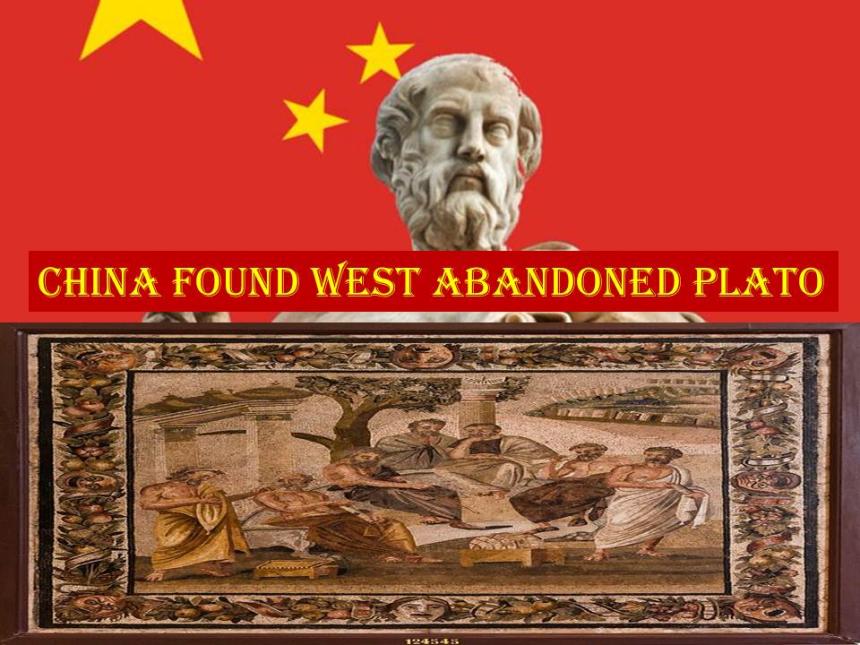

China Found West Abandoned Plato
Plato (427–347 B.C.) is arguably the foundational philosopher of Western civilization. Western ideology and civilization have undoubtedly been influenced by Greek philosophy, and at the helm of these influencers stands Plato. The West is quietly abandoning the books that built its civilization. China, a bed rock of "Confucius Philosophy" has taken up Plato's thoughts for research in their universities. This write up is an opinion in this regards and is being shared for wider audiences' discussion.
بِسۡمِ ٱللهِ ٱلرَّحۡمَـٰنِ ٱلرَّحِيمِ
In the name of ALLAH, the Most Gracious, the Most Merciful
China Found West Abandoned Plato
Plato (c. 427–347 B.C.) is arguably the foundational philosopher of Western civilization, shaping 2,400 years of thought regarding ethics, politics, metaphysics, and education. His work, particularly The Republic and the establishment of his Academy, introduced core concepts like Platonic ideals, the, theory of forms, and the intersection of faith and reason, which heavily influenced Christian theology (Religion of most of the West).
Plato's Academy is considered Western World (Europe's and America's) first university. His emphasis on rational inquiry over popular opinion (doxa) set the standard for Western intellectual thought. In The Republic, Plato explored justice and the "ideal city," introducing concepts of a, philosopher-king and, specialized, hierarchical, governance. Plato's ideas have been used to both idealize, just societies and, critique democracy in the whole of western civilization.
Early Christian theologians, most notably St. Augustine, utilized Platonic thought to reconcile faith with reason, bringing Platonic ideals into Western theology. Plato’s influence extends from the Renaissance, where his works were revived, to modern discussions on ethics, psychology, and even, totalitarian, political structures. His dialogues, such as the, Allegory of the Cave, remain central to understanding the Western pursuit of knowledge and truth.
Western ideology and civilization have undoubtedly been influenced by Greek philosophy, and at the helm of these influencers stands Plato. Throughout the entire course of Western civilization, Plato's influence as a thinker and writer has been greater than that of any other historic figure. Along with Socrates and Aristotle, he laid the foundations of Western culture by providing a brilliant and penetrating account of man's moral and political character. However, the West seems to be abandoning the foundation of its very civilization namely "Plato" and China, a bed rock of Confucius Philosophy has taken up Plato's thoughts for research in their universities.
The idea that Western civilization has "abandoned" Plato is a subject of intense philosophical and historical debate, rather than a settled fact. While Plato is undeniably a cornerstone of Western thought, the degree to which his ideals—such as absolute truth, the Theory of Forms, and the, philosopher-king—are followed, or even valued, has fluctuated dramatically throughout history.
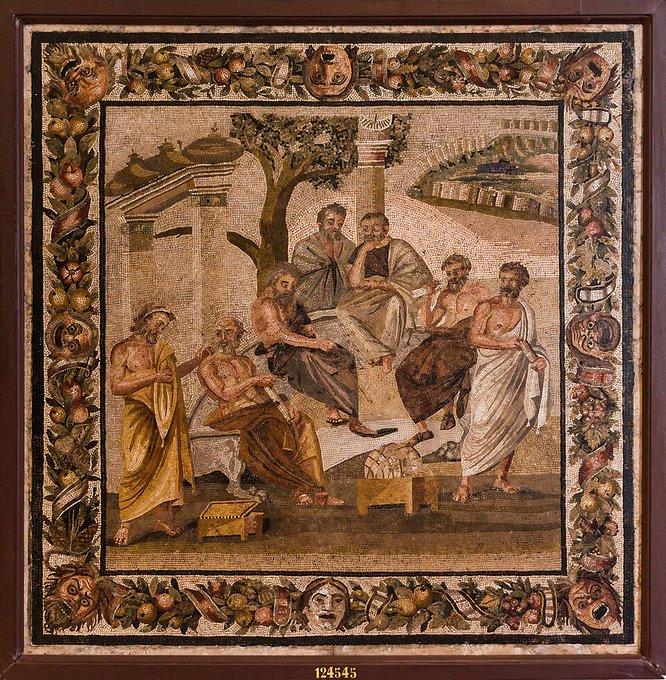
Plato's Academy mosaic in the villa of T. Siminius Stephanus in Pompeii, around 100 BC to 100 CE
Here in the following is an opinion in this regards shared on X.com and is being shared for wider audiences' discussion:-
The West is quietly abandoning the books that built its civilization. China is studying them to understand how power actually works.
Something strange is happening in the world of ideas. Across the Western world, universities are quietly shrinking or closing classics departments. Ancient Greek texts that once formed the backbone of education are increasingly treated as relics tied to elitism or imperialism. Meanwhile in China, Plato, Aristotle, and Thucydides are being translated, debated, and studied with renewed intensity.
One civilization is losing interest in the intellectual tradition that shaped it. Another is studying that tradition to understand how power actually works.
The contrast became unmistakable in November 2024. On the same day Americans were voting in their presidential election, the Cambridge classicist Tim Whitmarsh arrived in Beijing expecting to attend an academic gathering. What he encountered instead felt more like a geopolitical summit. Hundreds of diplomats, scholars, and officials filled the massive Yanqi Lake convention center while a letter from Xi Jinping was read aloud.
Xi’s message framed ancient Greece and China as two civilizations standing at opposite ends of Eurasia that had shaped the course of humanity. The letter encouraged deeper cultural exchange between them and announced the creation of a Chinese School of Classical Studies in Athens.
The symbolism was hard to miss. China was not simply studying the Western classics. It was claiming a place in the civilizational conversation those texts created. For many Western observers the moment felt surreal. Plato’s works once defined elite education across Europe and America. Generations of students learned about politics, ethics, and human nature through those dialogues.
Today many universities debate whether those same works still belong in the curriculum at all. China, meanwhile, is building new institutes devoted to them. But the real story is not simply that China is reading Plato. It is what Chinese readers find in him.
No work captures the tension more clearly than Plato’s Republic. In that dialogue, Plato asks a deceptively simple question. What would a perfectly just society look like?
His answer begins with a theory of the human soul. Plato argues that every person contains three competing elements. There is reason, which seeks truth and understanding. There is spirit, which produces courage and pride. And there is appetite, which drives desire for food, wealth, pleasure, and comfort. Justice exists when reason governs the other two.
From this psychological model Plato constructs a political one. A just state, he suggests, mirrors the structure of the soul. Those dominated by reason become philosopher-rulers. Those guided by spirit become guardians and soldiers. Those driven primarily by appetite become producers, merchants, and craftsmen. The result is a hierarchical society where each group performs the role suited to its nature.
To modern readers raised on democratic ideals, this structure often feels unsettling. Plato’s ideal city is not built on equality or mass participation. It is governed by a small group of highly educated rulers who understand what is truly good for the state.
Yet the most controversial idea appears when Plato confronts a practical problem. How can such a society remain stable? His answer is what later readers called the Noble Lie.
Plato proposes that citizens should be taught a founding story about their origins. They should believe that all people were born from the earth itself, making them siblings of the same land. But the gods mixed different metals into their souls. Those with gold in their souls are destined to rule. Those with silver must defend the city. Those with iron or bronze must labor and produce.
This story would encourage unity while persuading citizens that social hierarchy reflects natural differences rather than political manipulation. To many modern Western readers, the idea feels disturbing.
Critics argued that Plato’s vision resembles the ideological logic of totalitarian regimes. A state built on myth, hierarchy, and controlled breeding seemed uncomfortably close to modern authoritarian experiments.
Other scholars tried to soften the passage by arguing that Plato meant something closer to a symbolic national myth rather than deliberate deception. Still others suggested that Plato was exposing the dangers of political ideology rather than endorsing it. The result is a long Western debate about what to do with the Noble Lie. Condemn it, reinterpret it, or rescue Plato from his own argument.
In China, however, the reaction is unfolding differently. Many Chinese readers approach the passage not primarily as a moral scandal but as a political observation. Human beings differ widely in judgment, ability, and discipline. Not everyone can rule wisely. Most societies depend on narratives that encourage cohesion and obedience to social roles.
Seen from that perspective, Plato’s argument can appear less shocking and more pragmatic. Some Chinese commentators describe the Noble Lie as a recognition that social stability requires shared beliefs strong enough to bind millions of people together. Others treat it as an allegory for meritocracy. If individuals truly differ in ability, then the best rulers should be those most capable of governing.
The debate often extends further.
Some writers argue that modern democracy contains its own version of the Noble Lie. The belief that political equality automatically produces wise decisions may itself function as a unifying national myth. Plato’s critique of democracy, shaped by his experience of Athens during the Peloponnesian War and the execution of Socrates, can therefore appear surprisingly contemporary.
This difference in interpretation reflects deeper cultural instincts. Western political thought since the Enlightenment has emphasized individual freedom, skepticism toward authority, and the moral danger of concentrated power. Plato’s hierarchical state therefore raises alarms.
Chinese political culture developed under very different historical conditions. For centuries, governance drew heavily on the teachings of Confucius, whose philosophy emphasized social roles, hierarchy, and harmony within an ordered community. In that tradition the state often resembles an extended family in which authority flows from wisdom and responsibility rather than popular vote.
When readers from these two traditions encounter Plato’s Republic, they naturally notice different things. Western readers often focus on the danger of manipulation and authoritarian rule. Chinese readers often focus on the problem of maintaining order in large societies where individuals possess unequal abilities.
Both interpretations reveal something about the societies reading the text.
Yet the broader irony remains. The works of Plato and Aristotle once formed the intellectual spine of Western education. They shaped the language of politics, ethics, and philosophy for centuries. Today many Western institutions hesitate to defend them.
Meanwhile in China, new institutes translate these texts, compare them with classical Chinese philosophy, and introduce them to students who approach them without the same cultural fatigue.
Civilizations reveal their priorities through what they preserve. Some treat ancient books as embarrassing remnants of a less enlightened past. Others treat them as laboratories of human experience, filled with uncomfortable insights about ambition, power, and the limits of equality.
Plato understood something many modern societies prefer not to confront. Politics rarely runs on truth alone. It runs on stories, symbols, hierarchies, and shared beliefs strong enough to hold a civilization together.
Twenty-four centuries later, his ideas are still traveling the world. The strange twist of history is that they may now be studied most carefully in places far from the civilization that first produced them.

Pourquoi les Joueurs Choisissent Neowordpress
Pourquoi les Joueurs Choisissent Neowordpress