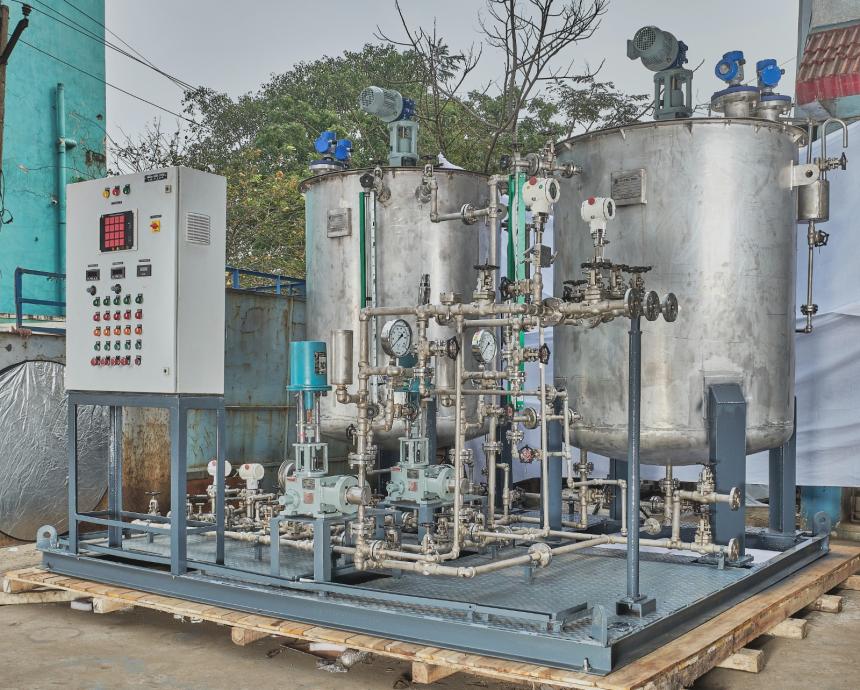

Chemical Dosing Pump System: How the Pump and System Work Together
It's tempting to think of a chemical dosing pump as the whole solution, but the pump is only one part of a larger chemical dosing pump system. Tank sizing, piping design, injection point placement, and control logic all have to work together with the pump for the dosing to actually be accurate and reliable in the field. A high-quality pump installed into a poorly designed system will still underperform.
Why "System" Matters More Than "Pump" Alone
A dosing pump is rated for a certain flow range and accuracy under specific suction and discharge conditions. Change the surrounding system — a longer suction line, an undersized tank, a poorly placed injection point — and that same pump can deliver noticeably different real-world performance. This is why chemical dosing pump system design treats the pump, tank, piping, and controls as one engineered unit rather than separate purchases.
Core Elements of a Complete System
The chemical storage tank needs to be sized for expected consumption and refill frequency, with material compatible with the specific chemical being stored. The dosing pump itself — typically diaphragm, plunger, or peristaltic — is selected based on flow rate, accuracy, and chemical compatibility. Suction and discharge piping, including foot valves, strainers, and back-pressure valves, determines how consistently the pump can actually draw and deliver fluid. Instrumentation and controls, ranging from a simple manual stroke setting to a fully automated PLC-integrated loop, determine how well the system adapts to changing process conditions.
Standalone Pump vs. Fully Engineered System
For simple, low-risk applications, a standalone pump with basic tank and piping is often sufficient. For processes involving multiple chemicals, tighter accuracy requirements, or integration with plant-wide control systems, a fully engineered chemical dosing pump system — designed, pre-piped, and tested as a unit — reduces both installation risk and the chance of mismatched components working against each other.
Common System-Level Design Mistakes
A pump sized correctly on paper can still underperform if the suction line is too long, if the tank lacks adequate agitation for a settling chemical, or if the injection point is placed in a low-flow section of the process line where mixing is poor. These are system design issues, not pump issues, and they're often the actual root cause when a "correctly specified" pump doesn't deliver expected results in the field.
Automation and Feedback Integration
Many chemical dosing pump system now include sensor feedback — pH, ORP, flow, or conductivity — tied to a controller that adjusts pump output in real time. This turns a fixed-rate dosing pump into a responsive system capable of tracking process variability, which matters most in applications with fluctuating flow or chemical demand.
What to Specify When Requesting a System
Provide your chemical type and concentration, required dosing rate and accuracy, discharge pressure conditions, available installation space, and whether automated control is needed. Specifying these at the system level — rather than asking for "a dosing pump" in isolation — leads to a package that's actually engineered to perform as a whole.
Anala Pumps, operated by S.J. Industries, designs and manufactures complete chemical dosing pump system — pump, tank, piping, and controls engineered together — for water treatment, chemical processing, and industrial applications. ISO-certified with 25+ years of manufacturing and export experience from Chennai, India. Details at analapumps.com/product/dosing-system, or contact [email protected] / +91 98403 50439.
Hospital Curtain Track Suppliers in India & Operation Theatre Technici...

Golden Touch Fusion CBD: How They Work, Expected Results, and Where to...
Introduction Golden Touch Fusion CBD Gummies are marketed as a cannabidiol (CBD) suppleme...
Oil and Grease Paper Price Trend Q2 2026 | Price Trends, Forecast, Cha...

Cotton Yarn Price Trend Q2 2026 | Price Trends, Forecast, Chart, Price...