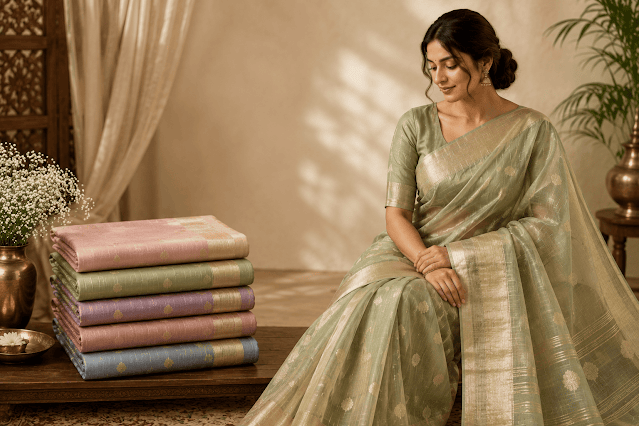

Chanderi Cotton Saree: When Everyday Comfort Meets Heritage Weaving
Explore the Chanderi cotton saree's heritage, weave, and price — plus how it differs from Chanderi silk saree and where to buy it online safely.
A Chanderi cotton saree is a lightweight, sheer handwoven saree from Chanderi town in Madhya Pradesh's Ashoknagar district, made from fine cotton yarn (sometimes blended with silk in the border and pallu) using a nearly 700-year-old weaving tradition. It carries a Geographical Indication (GI) tag and is prized for a rare combination most sarees can't offer: the breathability of pure cotton with the delicate drape and subtle sheen usually associated with silk.
That combination is exactly why this saree keeps coming up in searches from two very different kinds of buyers — people looking for something comfortable enough to wear all day, and people looking for something elegant enough for a festive occasion. The Chanderi cotton saree tries to sit in both categories at once, and understanding how it does that will help you pick the right variant, avoid overpaying for a powerloom copy, and know what you're actually getting when you buy Chanderi saree online.
Where Does the Chanderi Cotton Saree Come From?The Chanderi weaving tradition originated in Chanderi, a historic town in Madhya Pradesh that sat on a major trade route connecting central India to Gujarat and northern markets as early as the 13th century. Weavers from the Ansari and Koshthi communities have maintained the craft for generations, originally supplying fine cotton muslins to royal courts including Gwalior, Indore, and Baroda. According to the Ministry of Tourism's Incredible India portal, Chanderi's identity as a textile hub grew alongside its role as a trade and cultural crossroads, with the town's forts and temple architecture later inspiring many of the motifs woven into its fabric.
What Makes Chanderi Cotton Different from Chanderi Silk Saree?The core difference is fibre content: a Chanderi cotton saree is woven almost entirely from fine cotton yarn, while a Chanderi silk sareeuses silk in the warp, weft, or both, giving it a glossier finish and a heavier drape. A third, more common variant — Chanderi silk-cotton — blends cotton warp with silk weft to balance comfort and sheen. Here's how the three compare:
FeatureChanderi CottonChanderi Silk-CottonChanderi SilkFibrePure cotton yarnCotton warp + silk weftSilk warp and weftTextureCrisp, breathable, matte-sheerSoft sheen, semi-transparentGlossy, lustrousWeightLightestMediumHeaviestBest ForDaily wear, office, summerFestive wear, giftingWeddings, formal eventsTypical Price Range₹800 – ₹3,500₹2,500 – ₹8,000₹5,000 – ₹20,000+If you're comparing a Chanderi cotton saree against a Chanderi silk saree for a specific occasion, the simplest rule is: choose cotton for comfort and everyday elegance, and silk when you need more richness and formality.
Why Is Chanderi Cotton Saree Considered Ideal for Everyday and Summer Wear?Chanderi cotton saree is well suited to daily and summer wear because the yarn is spun fine enough to create a sheer, lightweight fabric that allows airflow while still holding its shape and slight stiffness through the day. Unlike heavier cotton weaves, Chanderi doesn't cling to the body, and unlike synthetic sheer fabrics, it doesn't trap heat. This is also why it works well layered under a blouse for office wear or worn plain for a warm-weather family function — it looks put-together without requiring heavy styling.
What Are the Traditional Motifs on a Chanderi Cotton Saree?Chanderi sarees are recognised by a set of traditional motifs, most commonly woven using an extra-weft technique on the border and pallu rather than printed on:
- Ashrafi booti — small coin-shaped motifs scattered across the body
- Nalferma — motifs resembling betel leaves
- Mor (peacock) booti — peacock-shaped motifs on the border or pallu
- Bundelkhand-inspired geometric patterns drawn from local temple and fort architecture
These motifs are typically woven in gold or silver zari thread, which is what gives even a plain cotton Chanderi saree its characteristic shimmer at the border.
How Is a Chanderi Cotton Saree Woven?Weaving a Chanderi cotton saree is a multi-stage handloom process that typically takes a skilled weaver anywhere from 2 to 6 days depending on the complexity of the border and pallu work.
- Fine cotton yarn is prepared and starched to give the fabric its characteristic crispness.
- The warp is set on a traditional pit loom, often fitted with a dobby or jacquard attachment for patterned borders.
- The weft is woven through, with extra zari threads inserted by hand for booti motifs.
- The border and pallu are woven with denser thread count than the body for contrast and durability.
- The finished fabric is calendered (pressed) to enhance its natural sheen.
Because motifs are woven rather than printed, a genuine Chanderi saree shows the same design clearly on both the front and back of the fabric — a detail worth checking before you buy.
Chanderi vs Other Lightweight Handloom CottonsBuyers researching Chanderi often end up comparing it with other sheer, lightweight Indian handloom cottons. Here's a quick reference:
FeatureChanderiKota DoriaMaheshwariOriginAshoknagar, Madhya PradeshKota, RajasthanMaheshwar, Madhya PradeshSignature LookSheer with woven zari bootiSquare check (khat) patternStripes, checks, coin bordersFibreCotton or cotton-silkCotton-silk (alternating)Cotton or cotton-silkTypical Price Range₹800 – ₹20,000+₹1,000 – ₹6,000₹1,200 – ₹7,000GI TagYesYesYesHow Can You Identify a Genuine Handwoven Chanderi Cotton Saree?Before buying, check for these markers of authenticity:
- Same motif visible on both sides of the fabric — a sign the design is woven, not printed.
- Sheer, slightly stiff texture rather than a soft, limp drape (which usually indicates a blended synthetic imitation).
- Hand-feel test: genuine Chanderi has a light starch-like crispness when new, which softens gradually after a few washes.
- Fine, even weave density in the body, with a visibly denser, more detailed border and pallu.
- GI tag label or weaver-cooperative certification, where the seller provides one.
A genuine handwoven Chanderi cotton saree typically starts around ₹800–₹1,200 for simple, minimal-zari designs and can go up to ₹3,000–₹3,500 for pieces with denser booti work and wider borders. Prices rise sharply once silk is introduced — Chanderi silk-cotton sarees generally range from ₹2,500 to ₹8,000, while pure Chanderi silk sarees with heavy zari work can cross ₹15,000–₹20,000. Three factors mostly explain price differences within the cotton category itself: yarn fineness, the amount of hand-woven zari work on the border and pallu, and whether the piece is handloom or powerloom-made.
How Should You Buy a Chanderi Saree Online?To buy Chanderi saree online with confidence, check the product listing for three specific details: the exact fibre composition (pure cotton, silk-cotton, or pure silk), whether the motifs are described as woven or printed, and the seller's return policy in case the fabric doesn't match what's shown in photos. Zoom into close-up images if available — a woven booti will show slight thread texture, while a printed one will look perfectly flat.
Ethnic wear platforms such as Indeloom list handloom sarees online, including Chanderi cotton and Chanderi silk-cotton variants, and generally include fabric details on the product page — it's worth reading these carefully and cross-checking them against the authenticity markers above regardless of which platform you buy from. A few extra tips:
- Compare listed prices against the typical ranges above — an unusually low price on a "pure handloom Chanderi" listing is worth questioning.
- Ask the seller directly whether the motifs are extra-weft (woven) or printed.
- Prefer listings that mention GI-tag sourcing or a named weaver cooperative when authenticity matters most to you.
- Check fabric-care instructions before buying if you plan to wear the saree frequently, since real Chanderi needs gentler care than synthetic sheer fabrics.
Chanderi cotton sarees should ideally be dry-cleaned or hand-washed in cold water with a mild detergent, dried in shade rather than direct sunlight, and stored folded in a breathable cotton cloth rather than plastic to prevent the zari from tarnishing. Because the fabric is fine and can snag easily, it's best to avoid rough fastenings or jewellery that could catch on the weave while wearing it.
Frequently Asked QuestionsIs Chanderi cotton saree suitable for daily wear? Yes. Its lightweight, breathable weave makes it comfortable for daily and office wear, especially in warm climates, though frequent wear will require gentler washing to preserve the zari border.
What is the difference between Chanderi cotton and Chanderi silk saree? Chanderi cotton is woven purely from cotton yarn for a light, breathable feel, while Chanderi silk saree uses silk in the warp and weft for a glossier, heavier drape suited to formal occasions.
Does Chanderi cotton saree have a GI tag? Yes, Chanderi sarees, including the cotton variant, are protected under a Geographical Indication tag confirming their origin in Chanderi, Madhya Pradesh.
How can I tell if a Chanderi saree is handwoven or machine-made? Check if the motif is visible identically on both sides of the fabric — genuine handwoven Chanderi shows the design on the reverse side too, while printed or powerloom copies typically don't.
Final ThoughtsThe appeal of the Chanderi cotton saree isn't just its light weight — it's that it manages to feel dressed-up and everyday-comfortable at the same time, a balance that comes directly from centuries of refinement in yarn count and weaving technique. Whether you're choosing between a Chanderi cotton saree and a Chanderi silk saree for an occasion, or trying to buy Chanderi saree online without ending up with a printed imitation, knowing the fibre, the motif technique, and the realistic price bands puts you in a much stronger position to choose well — and to support the weaving communities in Ashoknagar who keep this craft alive.
NPK Price Trend Q3 2026 | Global Price Trends, Forecast, Chart, Prices...


Building a Healthier Future Through Professional Rehabilitation Servic...




Phosphate Rock Price Trend Q3 2026 | Global Price Trends, Forecast, Ch...