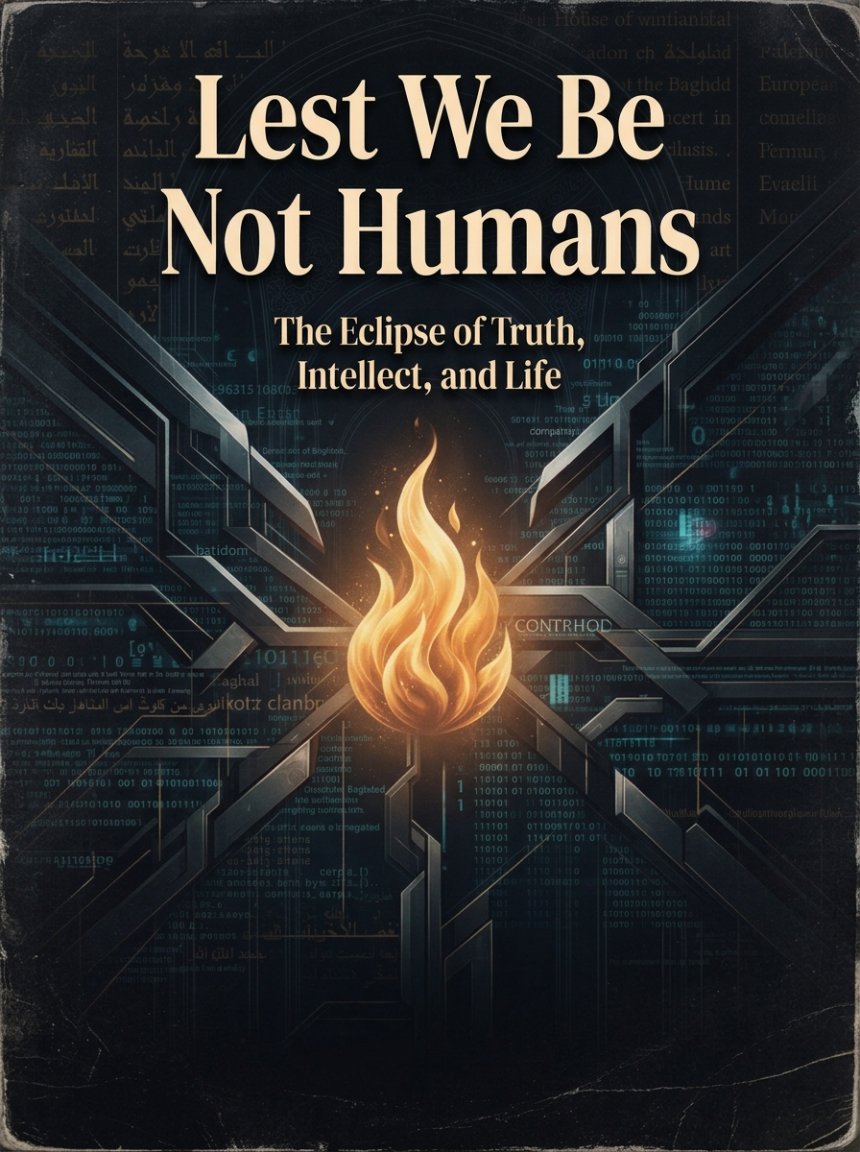

Can Truth Be Shadowed Forever?
The ever sailing times, the history, the human consciousness, and the nature consistently demonstrate that light ultimately pierces the dark. Similarly, time and time again it has been sanctified that the truth cannot be shadowed forever. The innate human pursuit of clarity and understanding continually pushes past illusions and manufactured lies. This write up "Can Truth Be Shadowed Forever?" is an opinion about the truth and lies manufactured during last few hundred years.
أَعُوذُ بِاللّٰهِ مِنَ الشَّيْطَانِ الرَّجِيمِ
بِسۡمِ ٱللهِ ٱلرَّحۡمَـٰنِ ٱلرَّحِيمِ
In the name of ALLAH, the Most Gracious, the Most Merciful
Can Truth Be Shadowed Forever?
The ever sailing times, the history, the human consciousness, and the nature consistently demonstrate that light ultimately pierces the dark. Similarly, time and time again it has been sanctified that the truth cannot be shadowed forever. Like the sun and the moon, fundamental realities possess an inherent persistence that eventually breaks through deception, secrecy, or misunderstanding.
Deception requires continuous energy to maintain, whereas truth is an objective anchor that remains stable without maintenance. Time acts as a catalyst that unravels inconsistencies, bringing hidden details or suppressed facts to the surface. The innate human pursuit of clarity and understanding continually pushes past illusions and manufactured lies.
Plato illustrated that while we often perceive mere shadows of reality, the mind strives to turn toward the true light outside the cave. In Jungian psychology, ignored or repressed personal truths act as a hidden shadow self that eventually demands conscious recognition and integration.
Islam is a divine religion, based upon the Holy Quran revealed upon Holy Prophet (PBUH) from the Ultimate Truth ALLAH. Muslims believe that it is based on the final revelations of God (Allah) to the Prophet Muhammad through the angel Gabriel, recorded in the Quran.
The core beliefs include the "Oneness of God", which is belief in one supreme, unique, and indivisible God named ALLAH; "the Holy Quran"; the literal word of God revealed to Prophet Muhammad (PBUH). Moreover, "Finality of Prophethood" in Muhammad (PBUH) as the final messenger sent to humanity; and "Angels" as unseen beings like Gabriel (AS) who carry out God's commands. One more basic belief is acceptance of "Previous Scriptures" as earlier holy books like the Torah, Psalms, and Gospel in their original forms and belief in "Day of Judgment" i.e life after death, accountability, heaven, and hell. The last of the beliefs is "Divine Decree" meaning by that everything happens according to God's ultimate plan and knowledge.
Islam is widely described by its followers and scholars as a complete code of life. This means it provides comprehensive guidance for every aspect of human existence, rather than just personal worship. The Islam as a religion directs personal worship, prayers, fasting, and connection with God and mandates honesty, humility, charity, and justice in daily behavior; and moreover, prescribes daily routines for cleanliness, diet, and physical health.
Most importantly, Islam as a religion provides for "Social System" which regulates family dynamics, marriage, divorce, and community rights; and provides for "Economic Framework" which outlines fair trade, property rights, charity, and bans exploitation. Most importantly, it also provides "Legal and Political" guidelines which sets principles for governance, justice, and human rights.
Islam introduced several foundational governance and legal concepts that mirror principles found in modern political, legal, and administrative systems. While modern democratic and legal structures evolved from diverse historical sources, early Islamic governance introduced specific advancements in human rights, constitutional law, and institutional accountability.
The Greatest Minds of West Knew the Truth- Islam
Many prominent Western thinkers, historians, and literary figures throughout history have studied Islam and the Prophet Muhammad, (PBUH) expressing deep appreciation for their profound impact on human civilization, law, and morality. Western historians note that Muslim scholars like Ibn al-Haytham (Alhazen) and Al-Razi introduced critical empirical and scientific inquiry methods that directly shaped the "European Renaissance". Medieval European scholars such as Adelard of Bath and Leonardo Fibonacci traveled to Islamic centers of learning to translate Arabic texts in mathematics, astronomy, and medicine, laying the foundation for modern Western science.
Edward Gibbon (1737–1794): The renowned English historian praised the early simplicity and good sense of Prophet Muhammad (PBUH), noting how he avoided the pomp of royalty.
Thomas Carlyle (1795–1881): The Scottish philosopher strongly defended the Prophet Muhammad (PBUH) in his lectures (On Heroes, Hero-Worship, and the Heroic in History), rejecting false accusations against Islam and calling Muhammad (PBUH) a sincere, great soul.
Irish Statesman Edmund Burke
Edmund Burke (1729–1797) was an 18th-century British Irish Statesman and philosopher, widely regarded as the founder of modern conservatism. On May 28, 1794, Edmund Burke participated in the ongoing, multi-year parliamentary trial and impeachment of Warren Hastings, the former Governor-General of Bengal. Warren Hastings served as the first Governor-General of Bengal from 1773 to 1785. That session formed part of the historic prosecution led by Burke to hold Hastings accountable for corruption, tyranny, and abuse of power in India. Burke accused Hastings of high crimes and misdemeanors, charging him with financial extortion, illegal acceptance of gifts, and oppressive governance over local Indian rulers and populations.
Burke famously argued that political authority must always be bound by eternal principles of justice and law, rejecting Hastings' defense that Asian governance justified arbitrary despotism. Though Hastings was ultimately acquitted on nearly all charges due to shifting political tides and procedural exhaustion, Burke's powerful speeches remain landmark texts on human rights, imperial misconduct, and constitutional ethics.
Edmund Burke, United Kingdom's Irish State man; a connoisseur of Sharia Law said in one of his speech, during the impeachment of Warren Hastings; “Mr. Hastings caused to be published, and I am obliged to him for it, a book called ‘The Hedaya’… Will you believe, my Lords, that a people [supposedly] having no laws, no rights, no property, no honor, would be at the trouble of having so many writers on jurisprudence?"
"And yet there are, I am sure, at least a thousand eminent Mahometan writers upon law, who have written far more voluminous works than are known in the Common Law of England, and I verily believe more voluminous than the writings of the Civilians themselves".
"That this should be done by a people who have no property is so perfectly ridiculous as scarcely to require refutation; but I shall endeavor to refute it, and without troubling you a great deal".
"First, then, I am to tell you that the Mahometans are a people amongst whom the science of jurisprudence is much studied and cultivated; that they distinguish it into the law of the Koran and its authorized commentaries,--into the Fetwah, which is the judicial judgments and reports of adjudged cases,--into the Canon, which is the regulations made by the emperor for the sovereign authority in the government of their dominions,--and, lastly, into the Rawaj-ul-Mulk, or custom and usage, the common law of the country, which prevails independent of any of the former.” — Speeches in the Impeachment of Warren Hastings, May 28, 1794.
Thomas Jefferson Founding Father & 3rd President of USA
Thomas Jefferson (April 13, 1743 – July 4, 1826) was a Founding Father and the third president of the United States from 1801 to 1809. Historical Facts on Jefferson and the Quran indicates that Jefferson bought a 1734 two-volume English translation of the Quran by George Sale in 1765 while a young law student in Williamsburg, Virginia. He collected books broadly and studied comparative law and religion, wanting to understand diverse legal codes and global legal structures. The book stayed in his personal library as a reference on law and world philosophy.
SNEAKO and Itachi on how Thomas Jefferson walked with a Quran and REJECTED Christianity. This was the same for many of the American Founding Fathers, as they did not believe in the Trinity at all. "They were mainly deists. They rejected the Trinity.
Thomas Jefferson was not a Muslim. He owned a copy of the Qur'an because he was deeply interested in law, comparative religion, and the question of religious liberty, as John Locke heavily influenced him. Jefferson was particularly influenced by John Locke's "A Letter Concerning Toleration" of (1689), where Locke argued; "Neither Pagan, nor Mahometan, nor Jew ought to be excluded from the civil rights of the Commonwealth because of his religion".
He along with other liberal tolerationist writers of England picked from Islamic law. Jefferson adopted this principle in his own defense of religious freedom, during the debate of Virginia Statute for Religious Freedom, where they wanted to exclude Jews, Catholics and Muslims from ever becoming president. His ownership of the Qur'an reflects his commitment to extending civil rights to people of different faiths, including Muslims, not evidence that he was himself a Muslim.
If you've read about Jefferson, you would know he explicitly envisioned a republic where even Muslims, Jews, and people of other religions could enjoy equal civil rights despite the widespread prejudice of his time.
The Foundation of Western Civilization
People in West underestimate, how well-read historical figures were, and how favorably classic Islamic law (Sharia) was viewed by early legal thinkers and classical liberals. Historical figures often possessed vast, cross-cultural literacy, and classical Islamic law (Sharia) historically garnered respect from various early Western legal minds and Enlightenment-era thinkers who admired its systematic equity, commercial flexibility, and distinct separation between scholarly authority and state power.
Enlightenment and founding-era thinkers routinely mastered multiple languages, ancient philosophy, and comparative legal frameworks. Early modern European and American jurists studied non-Western jurisprudence out of practical administrative necessity and philosophical curiosity. Scholars maintained deep familiarity with diverse legal traditions beyond their immediate local or religious boundaries.
Classical jurists operated independently of the ruler, which early modern liberals saw as a valuable check on absolute monarchical power. Classical Islamic jurisprudence featured robust contract, property, and trust (waqf) law that predated and influenced similar Western commercial mechanisms. Early comparative legal observers noted procedural protections, systematic equity, and rationalist legal reasoning (ijtihad) within classical legal schools.
How Western Civilization Developed Blindness to Islam?
Jonathan Lyons is the author of "The House of Wisdom: How the Arabs Transformed Western Civilization" (Bloomsbury Press 2009). He served as editor and foreign correspondent for Reuters for more than twenty years and has a doctorate in sociology from Monash University. He is an independent scholar whose work explores the social bases of knowledge. He has written an essay titled "Islamic Science and the West: A Case of Collective Amnesia" and following is taken from the same essay:-
"After some initial research, it became apparent that scattered literary influences seeping across the borders of Muslim al-Andalus into the borderlands of Christian Spain and France were merely symptoms of a much broader and more significant knowledge transfer from Muslim societies to European ones—a bequest that was as pervasive as it was largely ignored in mainstream historiography."
"Six years later, I completed The House of Wisdom: How the Arabs Transformed Western Civilization (the working title did not survive the marketing department). The book interweaves the enormous intellectual and practical achievements of the medieval Islamic world with accounts of the restless Europeans who went in search of Muslim learning—learning that helped lay the foundation for the Renaissance and, ultimately, for the West’s global supremacy."
https://renovatio.zaytuna.edu/article/islamic-science-and-the-west-a-case-of-collective-amnesia
The Colonial Power Thrusted "Empirical Blindness"
When the British East India Company took control of territories from late Mughal and regional Muslim rulers in the 18th and 19th centuries, India was ruled through "Islamic Based Laws" and traditional Hindu customs. The Fatawa-e-Alamgiri was a massive 17th-century legal compendium commissioned by Mughal Emperor Aurangzeb. It standardized Hanafi Islamic jurisprudence to guide judges (qazis) across the empire, functioning as the primary penal and civil framework for Muslim rulers before the East India Company centralized control.
East India Company did not immediately replace all local laws. Instead, it initially maintained a modified version of Islamic criminal and personal law (adapted into what scholars call Anglo-Muhammadan law) alongside traditional Hindu customs, gradually superseding them with English-derived codified codes over time.
The Company used modified Islamic criminal jurisprudence (the Fatawa-e-Alamgiri and Mughal penal structures) in its lower courts for decades, though supervised by British judges. The Governor-General of Bengal Warren Hastings' Plan of 1772 decreed that matters of inheritance, marriage, caste, and religious usages/institutions would apply Islamic law for Muslims and Hindu law for Hindus ("Personal and Family Law"). British judges relied heavily on native legal advisors—muftis and qadis for Islamic law, and pandits for Hindu law—to interpret the texts.
When the British East India Company took control of the India from Muslim rulers, Warren Hastings the Governor-General who was appointed to take charge, explicitly complained that the existing Sharia penal system was too lenient, his exact words were “The sharia was founded on the most lenient principles and on an abhorrence of bloodshed.” So, to enforce colonial control, the British systematically dismantled these protections, replacing them with harsher statutory laws that restricted the population's liberties.
The Company and subsequent Crown administration slowly removed native legal officers and replaced pluralistic or localized interpretations with rigid, centralized codes.Then the "Indian Penal Code (1860)" was enacted after the 1857 uprising; which replaced Islamic and traditional criminal law with a uniform system based largely on English criminal law. By 1864, official Islamic and Hindu law officer posts within the formal British court structure were largely abolished, paving the way for standard Anglo-colonial statutory law across British India.
When European colonial powers entered various Muslim lands during the 18th and 19th centuries, they documented a highly organized, widespread, and deeply entrenched indigenous system of education. In many cases, literacy rates and school availability in these regions matched or even exceeded those found in contemporary Europe. When the British Empire finally left the Indian subcontinent in 1947, they left behind a devastating reversal of educational standards, transforming a region that historically featured widespread, community-funded literacy into one of the most illiterate populations on earth.
Yes, the dismantling of indigenous education systems by colonial powers perfectly illustrates the creation of "Orientalism" as defined by Palestinian-American scholar Edward Said. In his foundational 1978 book, Orientalism, Said argued that Western colonial powers did not just rule by military force; they constructed a systematic, biased body of knowledge about the East (the "Orient") to justify their imperial domination.By intentionally weaponizing education, language, and administration, colonial authorities transformed their observations into a rigid, patronizing narrative.
Edward Said utilized the concept of discourse to show that knowledge is never neutral—it is tied directly to power. When French and British colonialists arrived and found highly literate populations, acknowledging this reality would undermine their imperial justification: the "civilizing mission". To resolve this paradox, colonial administrators, scholars, and linguists actively reclassified indigenous education as "backward," "stagnant," or "purely religious". Resultantly; they created a monopoly on defining what "true education" was, establishing the West as rational and progressive, and the East as irrational and uneducated.
Edward Said described how the West manufactures "The Other"—a distorted caricature of Eastern people used as a counter-balance to define Western superiority. By replacing local languages (like Arabic, Persian, or Sanskrit) with English or French as the sole media for civil and legal power, colonial policies instantly rendered the traditionally educated native populace illiterate overnight. Resultantly; native history, science, and governance were pushed out of the classroom. Local populations were forced to look at themselves through a Eurocentric lens, internalizing the idea that their own heritage was inferior.
The Modern Construct of Islam and Muslims in West
The modern construct of Islam and Muslims in the West is a complex social, political, and media-driven narrative. It often frames Islam as a static, monolithic "other" or a cultural threat to liberal secular values, heavily shaped by colonial histories, geopolitical conflicts, and post-9/11 security policies. However, it has been cleverly designed and orchestrated by "brilliant minds" in USA's deep state and CIA. Read the books ("Cloak & Gown": Scholars in the Secret War, 1939–1961 by Robin W. Winks & "The Intelligence Intellectuals": Social Scientists and the Making of the CIA by Peter C. Grace).
Before 1990, terrorism by Muslim extremists was almost nonexistent on U.S. soil, while Jewish & Christian groups frequently carried out terror attacks across the United States. In 1986 during the famous Cold War and "Afghan Jihad" against United Soviet Socialist Russia (USSR) Afghan schoolchildren were given U.S.-funded textbooks that taught arithmetic with rifles, bullets, grenades, and other imagery of war. The books were produced through the University of Nebraska at Omaha with USAID funding during the anti-Soviet war. And it wasn’t just math.
https://x.com/KashifMD/status/2086896819494068278?s=20
“J is for Jihad.” The curriculum reportedly paired letters and sounds with the language of militant resistance:
J — Jihad
K — Kalashnikov
M — Mujahid
R — Rocket
SH — Shaheed (martyr)
T — Tank
More importantly, this wasn’t one controversial alphabet page. Jihad, martyrdom, fighting, enemies, and military concepts were woven into ordinary literacy lessons—handwriting practice, vocabulary, sentence construction, grammar drills, and fill-in-the-blank exercises. That is how ideology becomes ordinary: not through one sermon, but through repetition in childhood education. Why would the U.S. indoctrinate elementary-school kids and glorify armed jihad? Years later, the United States would spend enormous resources fighting the very culture of militant jihad it had once helped cultivate as a Cold War weapon.
This was a well articulated American design (Wars. Occupation. Foreign troops. Dictatorships. State collapse. Mass civilian deaths) that failed miserably; Read the article for details in the following link:-
“Muslim values are incompatible with Western Values.”
The statement that Muslim values are incompatible with Western values is a subject of ongoing debate among sociologists, political scientists, and theologians, with views divided between those who emphasize fundamental philosophical differences and those who highlight shared principles and successful integration.
The Muslim values may be briefly described through the lens of Quran as follows:-
• Surrender your ego to God [2:112]
• Feed orphans & the poor [2:177]
• Give mandatory charity [2:43]
• Honor parents & family [17:23]
• Care for your neighbors [4:36]
• Speak the truth & avoid falsehood [22:30]
• Keep your promises [17:34]
• Do not cheat or defraud [83:1–3]
• Control your anger & forgive others [3:134]
• Be humble, not arrogant [31:18–19]
• Speak gently, even to those you oppose [20:44]
• Lower your voice; avoid harshness [31:19]
• Be patient in adversity [2:153]
• Protect the vulnerable [4:75]
• Judge people fairly—even against yourself [4:135; 5:8]
• Do not let hatred make you unjust [5:8]
• Do not mock or insult others [49:11]
• Avoid suspicion, backbiting & gossip [49:12]
• Make peace between people [49:10]
• Consult others in your affairs [42:38]
• Repay evil with what is better [41:34]
• Be kind & just to those who believe differently [60:8]
• Respect freedom of conscience [2:256]
• Avoid alcohol & gambling [5:90]
The Conclusion
The core values of modern Western civilization are primarily rooted in the Enlightenment, the Scientific Revolution, and the evolution of liberal democracies. The core Islamic Values are listed above and if someone says Islam is a religion of "Absolutely terrifying stuff; he must immediately consult a physician and a psychiatrist. Sooner or later the world will be reaching the "Truth" and Islam is the religion as enshrined in Quran and the "Life and Sayings" of Holy Prophet Muhammad (PBUH) and the "Ultimate Truth" is ALLAH; the One and Only Sustainer and Benefactor of humankind.
The Truth cannot be shadowed forever. As an old proverb notes, three things cannot be long hidden: the sun, the moon, and the truth. While deception and darkness may obscure reality for a time, objective facts and underlying realities tend to resurface through shifting circumstances, changing evidence, or the passage of time.
The "digital technology" has given us an incredibly powerful toolkit to unearth and expose falsehoods. When modern investigators, journalists, and scientists want to debunk a lie, they rely on digital footprints that are virtually impossible to completely erase. Publicly available digital platforms allow the global community to crowd-source fact-checking in real time.

What a Grain Is, and Why 50, 55, 62, 130 and 168 Keep Showing Up on th...
A grain is 1/7000 of a pound. Choosing a bullet weight is mostly a matter of what your bar...


Furadeira de Impacto: Como Escolher, Utilizar e Aproveitar Seus Benefí...
Furadeira de Impacto: Como Escolher, Utilizar e Aproveitar Seus Benefícios