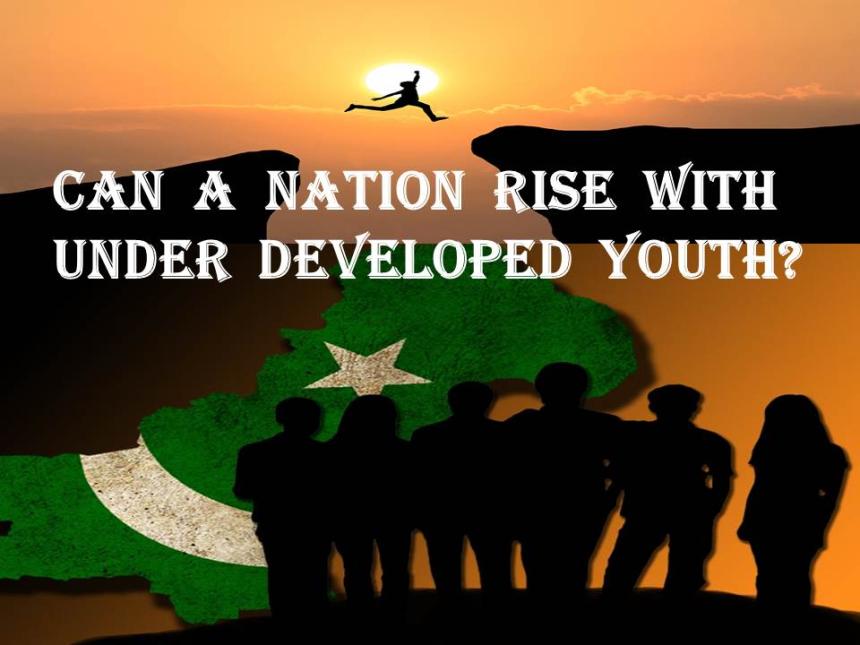

Can a Nation Rise with Under Developed Youth?
"Youth are the future of a nation"; and this age-old mantra rings especially true for countries where the vast majority of the population is under 30. This demographic factor represents a monumental driving force for development, innovation, and civic change. This write up is based upon an opinion piece from a senior citizen of Pakistan who had spent time at appropriate "observation post".
أَعُوذُ بِاللّٰهِ مِنَ الشَّيْطَانِ الرَّجِيمِ
بِسۡمِ ٱللهِ ٱلرَّحۡمَـٰنِ ٱلرَّحِيمِ
اللہ کے نام سے شروع جو بڑا مہربان نہایت رحم کرنے والا ہے
In the name of ALLAH, the Most Gracious, the Most Merciful
Can a Nation Rise with Under Developed Youth?
The world population of youth, within the ages of 10-24, amounts to1.9 billion in a world population of 8.3 billion people, as per current UNFPA state of world population early 2026. Close to 90 percent of the world's youth population (nearly 1.3 billion people aged 15-24) live in developing and less-developed countries. The vast majority of these young people live in regions like Sub-Saharan Africa and South Asia. Pakistan is one of such countries. This demographic concentration presents a major challenge for those country’s and global development. If the right investment in health, education, and social development are made, this massive demographic element can propel global socioeconomic development through a "demographic dividend".
As the mantra goes "youth are the future of a nation"; and this age-old mantra rings especially true in Pakistan, where the vast majority of the population is under 30. This demographic factor represents a monumental driving force for development, innovation, and civic change. However, the youth as the future of a nation, must particularly be passionate, informed, and active citizens who can bring innovation and positive change by engaging in politics, creating jobs through entrepreneurship, championing social and environmental causes, and embracing their national responsibility.
The effect (rise and fall of the nation) of the significantly large population of youth depends on the manner in which the state treats and plans growth of her youth, which could either become a liability, consuming more resources than contributing or rise as problem solvers and change agents of the future. It must be understood that these young will live longer into the future than their elders; they are more likely to face the impacts of accelerating challenges (AI, Climate Change and other accompanying risks) to human well-being all alone, because they will not be replaced as fast by their kids and they have done.
It is matter of fact that yesterday's teen agers rise to take helm of national affairs tomorrow; because youth are the leaders of tomorrow and any nation that has not educated, trained and developed them properly will pay heavily. It is, therefore, important to ensure provision of proper education and skill development to all the youth in the entire segment of society, so that they may participate effectively in nation-building. A key factor shall be the involvement of youth in community services, disaster management, environmental conservation, and social development (civic engagement) activities. Such opportunities are must to foster the sense of responsibility and ownership and to culture leadership traits long before that are placed in performing roles.
No Nation Can Rise Higher Than the Condition of Its Children
In the following an opinion titled "No Nation Can Rise Higher Than the Condition of Its Children" is shared, as written by Air Cdre Pervez Akhtar Khan (Retd). The purpose is to understand the condition of youth some four decades away as candidly expressed in the article. Please read intently to follow conclusion.
In 1985, I was posted to the ISSB as a Deputy President — one of the first fighter pilots to serve there. The Air Force believed that my years as an Instructor Pilot might help improve the selection of future General Duty Pilots. At the time, nearly half the selected candidates were eventually suspended from flying training.
What appeared to be a technical problem slowly revealed itself to be something much deeper.
ISSB in those days was not merely a selection board. It was almost a sociological cross-section of Pakistan itself. Young men arrived there from every imaginable background — elite schools, cadet colleges, government schools, remote villages, madrassahs, and what we colloquially called Tatians — children from poor schools where students often sat on floor rugs.
Before taking over duties, we underwent a three-month training programme in applied psychology. For a fighter pilot, this was a completely new world. I immersed myself in the works of Sigmund Freud, Carl Jung, B. F. Skinner and later Abraham Maslow. The professional psychologists at ISSB were immensely helpful.
But the real education came not from books, but from the boys themselves.
Sometimes during interviews, I would drift away from formal questioning.
I would ask a candidate: “When was the last time you ate meat?”
Most would instinctively reply: “Last night, Sir.”
“No,” I would clarify gently. “I mean at home.”
The answers stayed with me for decades.
“Last Bakra Eid, Sir.”
“At a cousin’s wedding.”
“Some months ago.”
These were not beggars. These were young men aspiring to become officers.
That was perhaps the first time the true meaning of national health struck me with full force.
Not hospitals. Not insurance schemes. Not medical equipment.
Nutrition.
I began wondering: How many children in Pakistan grow up undernourished? How many brains never fully develop? How many children are physically or cognitively stunted long before adulthood? And then we ask them to “reach for the sky.”
Over time, another pattern also emerged.
Many candidates had memorised textbooks impressively, yet struggled with independent thought. They could reproduce passages flawlessly but froze when asked simple open-ended questions requiring analysis, imagination, or critical reasoning.
Slowly, I realised we were confusing literacy with education.
An education system built excessively around rote learning may produce degrees, but rarely produces curiosity. And when rigid learning combines with excessive religiosity — not spirituality, but intellectual rigidity masquerading as virtue — questioning itself begins to feel dangerous.
Yet our own civilisational history tells the opposite story. Muslim civilisation once led the world in astronomy, medicine, mathematics, navigation, and philosophy precisely because it encouraged inquiry.
Today, far too often, we produce memory instead of imagination.
And populations deprived of critical thinking become vulnerable.
They become easy prey for ambitious politicians, demagogues, sectarian entrepreneurs, conspiracy merchants, and manipulative power structures. A society unable to question eventually becomes easy to mobilise through fear and slogans.
Poor nutritional nourishment weakens the body. Poor intellectual nourishment weakens the mind.
Together, they slowly produce what we in the Subcontinent often call a "ghulami zehniyat" — a slave mentality.
That, to me, is the real tragedy of the Subcontinent.
Not lack of intelligence. Not lack of talent.
But the wastage of human potential on a civilisational scale.
Since 1985, Pakistan has added nearly 150 million more people to its population. Nearly a quarter of a billion Pakistanis have been born during this period. Yet tens of millions entered life already disadvantaged — underfed, under-schooled, intellectually undernourished, and psychologically conditioned more for obedience than inquiry.
Just pause and reflect on the scale of that.
This is not merely an economic issue. It is not merely a governance issue. It is not even merely a social issue.
It is a civilisational event unfolding in slow motion.
Because when millions of children fail to reach their physical or intellectual potential generation after generation, the loss compounds historically. Lost scientists. Lost thinkers. Lost inventors. Lost teachers. Lost philosophers. Lost citizens capable of independent reasoning.
An invisible graveyard of unrealised human possibility.
Civilisations do not decline only when armies invade them. Sometimes they decline quietly — when the nourishment of the body and mind collapses together over decades.
The tragedy of the Subcontinent often feels larger than economics or politics alone.
We are home to some of the oldest civilisations on earth, extraordinary reservoirs of intelligence, resilience, and creativity — and yet we continue wasting human potential on a staggering scale.
One sees similar contradictions across much of the Subcontinent itself. Great technical achievements coexist beside malnourished children. Ambitious rhetoric about becoming global powers coexists with classrooms where curiosity still struggles for space.
That is why countries like Japan affect thoughtful observers so deeply. They remind us that civilisation is not merely skyscrapers, missiles, or stock markets.
It is behaviour. It is trust. It is dignity. It is how a society treats a child standing quietly in a classroom.
The true competition of the 21st century may not ultimately be about territory, GDP, or military strength alone.
It may simply be: Which societies are best able to nourish the human mind and body together?
Because no nation can rise higher than the condition of its children.
***NOTE: The above is self explanatory and requires no further addition.***
The Conclusion
The condition of country's youth in mid 1980s is well expressed and incidentally teen agers of those days are at the top of leadership ladder these days (yesterdays youth are leaders today). The history will announce its verdict about the educational growth, skill and social development afforded to them and consequently the outcome produced by them for national progress, prosperity and problem solving.
It is nevertheless compulsion to emphasize equipping today’s young minds with modern social, technical, and scientific knowledge to build a robust and competitive work force and leadership. Digital literacy and critical thinking are added factors for our youngsters; so that they may effectively tackle 21st-century global challenges; by ensuring provision of platforms to participate in decision and policy making. Leaders from thinkers like Erasmus to Quaid-e-Azam Muhammad Ali Jinnah have long emphasized that a nation's prosperity is directly tied to how it trains and supports its younger generations.


Buy Verified Payoneer Accounts - US, UK, CA, NA, AUS .( PVA)
Payoneer Verification Guide: How to Create and Verify Your Account Safely in 2026 Intr...

How to Buy Verified Payoneer Accounts in Make Best Offer
Payoneer Verification Guide: How to Create and Verify Your Account Safely in 2026 Intr...
Buy Verified Payoneer Account : r/Reviews the Best Verified Accounts
Payoneer Verification Guide: How to Create and Verify Your Account Safely in 2026 Intr...
The 1 Top Sites To Buy a Verified Payoneer Accounts the Relied...
Payoneer Verification Guide: How to Create and Verify Your Account Safely in 2026 Intr...