
Business Intelligence Reporting: Actionable Insights for Growth
Business Intelligence Reporting transforms raw data into actionable insights through dashboards and reports, helping businesses make smarter decisions faster.
Introduction
In today's highly competitive business environment, organizations generate massive amounts of data from various sources, including sales transactions, customer interactions, marketing campaigns, financial operations, and supply chain activities. However, collecting data alone is not enough. Businesses must be able to analyze, interpret, and utilize this information effectively to make informed decisions and maintain a competitive advantage.
This is where business intelligence reporting plays a crucial role. By converting raw data into meaningful reports and visual insights, organizations can identify trends, monitor performance, and make strategic decisions with confidence. Business intelligence reporting empowers businesses to move beyond guesswork and rely on accurate, data-driven information for growth and success.
The Importance of Data-Driven Decision Making
Modern businesses operate in an environment where decisions need to be made quickly and accurately. Traditional reporting methods often involve manually gathering data from multiple systems, which can be time-consuming and prone to errors. As a result, leaders may struggle to access reliable information when they need it most.
Business intelligence reporting eliminates these challenges by centralizing data from different sources and presenting it in a clear and understandable format. Whether a company wants to evaluate sales performance, track customer behavior, analyze operational efficiency, or forecast future trends, business intelligence tools provide the necessary visibility to support better decision-making.
Organizations that embrace data-driven strategies are often more agile, responsive, and capable of adapting to changing market conditions. They can identify opportunities faster, address issues proactively, and optimize resources more effectively.
Key Components of Business Intelligence Reporting
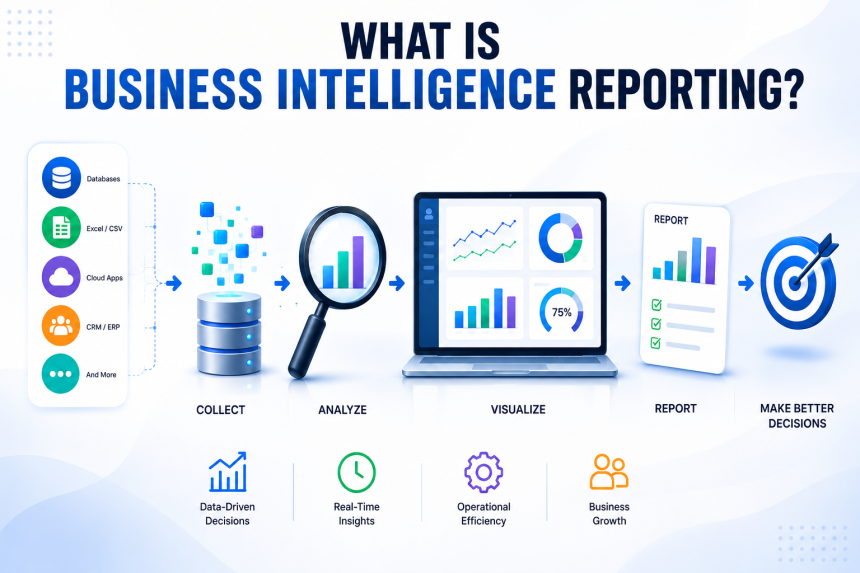
Business intelligence reporting consists of several interconnected processes that work together to transform raw data into valuable business insights.
Data Collection and Integration
The first step involves gathering data from various sources such as CRM systems, ERP platforms, databases, spreadsheets, cloud applications, and third-party tools. This data is then integrated into a centralized repository where it can be analyzed consistently.
Data Analysis
Once the data is consolidated, analytical tools process the information to uncover patterns, trends, and relationships. This analysis helps organizations understand what is happening within their business and why certain outcomes occur.
Interactive Dashboards
Interactive dashboards provide users with real-time access to critical metrics and performance indicators. Instead of reviewing lengthy spreadsheets, decision-makers can quickly visualize information through charts, graphs, and other visual elements.
Report Generation
Business intelligence platforms generate customized reports tailored to different departments and stakeholders. These reports can be automated and delivered regularly, ensuring that teams always have access to up-to-date information.
What Is Business Intelligence Reporting?
Many organizations exploring modern analytics solutions often ask, what is business intelligence reporting and how it benefits their operations.
Business intelligence reporting is the process of collecting, analyzing, and presenting business data in the form of reports, dashboards, and visualizations that support informed decision-making. It enables organizations to convert large volumes of raw data into meaningful insights that can be easily understood by executives, managers, and employees.
Unlike traditional reporting methods that focus primarily on historical data, business intelligence reporting provides a comprehensive view of both current and past performance. It helps businesses monitor key performance indicators (KPIs), identify emerging trends, track operational efficiency, and uncover opportunities for growth.
Through advanced reporting tools, organizations can access real-time information, create customized dashboards, and automate reporting processes. This ensures that decision-makers receive accurate and timely insights whenever they need them.
Benefits of Business Intelligence Reporting
Improved Decision-Making
One of the primary advantages of business intelligence reporting is the ability to make informed decisions based on reliable data. Leaders can evaluate performance metrics, assess risks, and identify opportunities with greater confidence.
Enhanced Operational Efficiency
Business intelligence reports help organizations identify bottlenecks, inefficiencies, and areas for improvement. By analyzing operational data, businesses can streamline processes and improve overall productivity.
Better Customer Understanding
Customer data analysis allows organizations to gain deeper insights into customer preferences, purchasing behavior, and engagement patterns. This information can be used to create personalized experiences and strengthen customer relationships.
Real-Time Visibility
Access to real-time reporting enables businesses to respond quickly to changing market conditions. Managers can monitor critical metrics and take immediate action when necessary.
Increased Revenue Opportunities
By identifying profitable products, customer segments, and market trends, organizations can develop more effective strategies to drive revenue growth and maximize profitability.
Common Use Cases Across Industries
Business intelligence reporting is widely used across various industries to support strategic planning and operational management.
In the retail sector, organizations use reporting tools to analyze sales performance, inventory levels, and customer purchasing trends. Healthcare providers rely on business intelligence to monitor patient outcomes, resource utilization, and operational efficiency.
Financial institutions leverage reporting solutions to track transactions, manage risks, and ensure regulatory compliance. Manufacturing companies use business intelligence reports to monitor production performance, supply chain operations, and quality control processes.
Regardless of industry, the objective remains the same: transforming data into actionable insights that support business success.
Challenges Businesses Face Without BI Reporting
Organizations that lack effective reporting systems often encounter several challenges. Data may be scattered across multiple platforms, making it difficult to obtain a unified view of business performance. Manual reporting processes can consume significant time and resources while increasing the risk of errors.
Without access to accurate and timely information, decision-makers may rely on assumptions rather than facts. This can lead to missed opportunities, inefficient operations, and reduced competitiveness in the marketplace.
Implementing business intelligence reporting helps address these challenges by providing a centralized and reliable source of information for the entire organization.
The Future of Business Intelligence Reporting
As technology continues to evolve, business intelligence reporting is becoming more advanced and accessible. Artificial intelligence, machine learning, and predictive analytics are enhancing the ability of organizations to forecast trends and identify opportunities before they occur.
Cloud-based BI platforms are also making reporting solutions more scalable and cost-effective for businesses of all sizes. With increasing demand for real-time insights and self-service analytics, business intelligence reporting will continue to play a vital role in modern business strategy.
Conclusion
Business intelligence reporting has become an essential tool for organizations seeking to maximize the value of their data. By transforming complex information into meaningful insights, it enables businesses to make smarter decisions, improve operational efficiency, enhance customer experiences, and drive sustainable growth.
As data continues to influence every aspect of business operations, investing in effective business intelligence reporting solutions can provide organizations with the visibility and intelligence needed to thrive in an increasingly competitive marketplace. Companies that leverage data strategically will be better positioned to adapt, innovate, and achieve long-term success.
オンラインポーカーとは?初心者から上級者まで知っておきたい魅力と楽しみ...
オンラインポーカーとは?初心者から上級者まで知っておきたい魅力と楽しみ方を徹底解説


Burgers in Leicester – Discover Delicious Takeaway and Burger Joints



Les technologies derrière les plateformes de casino modernes
Les technologies derrière les plateformes de casino modernes
