Bus On-Demand: Cities & Fleet Operators Guide
Discover how bus on demand and bus on-demand services improve urban mobility with smart transit, on demand bus technology, and scalable app development.
With a rising population, urbanization, and an increasing number of vehicles on the road, transport systems are facing several challenges. The population is growing, and city infrastructure is becoming increasingly complex. Bus transport alone cannot fulfill the personalised needs of commuters today. Dynamic solutions such as bus on-demand services offer customised services using technology and modern bus booking software. Tech-aligned services are efficient, making travel easier.
On-demand buses enable transportation through on-demand bus apps, adapting routes in real-time based on demand. A 2025 survey report indicates that the global bus market, encompassing both public and on-demand buses, is expected to grow significantly from USD 51.27 billion in 2024 to USD 116.99 billion by 2035. This growth is due to rising urbanization, increased population, and the shift to sustainable transport systems.
The worldwide experience with using bus on-demand systems is a valuable step toward sustainable urban transport solutions. Cities facing burgeoning populations and acute environmental conditions find this new-age strategy a chance to improve public commute services.
The Mechanism of Bus On-Demand Services
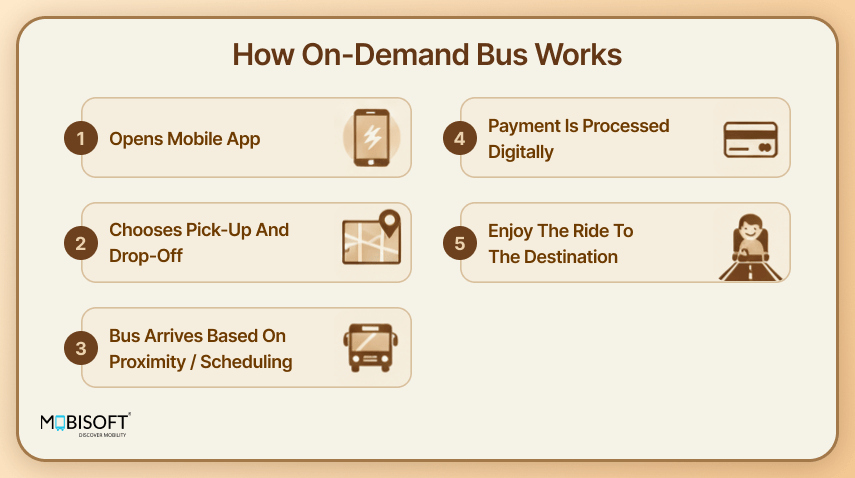
Bus-on-demand services combine technology and operational planning to provide efficient urban transportation. The smooth working of these services involves:
- Riders download a dedicated on-demand bus booking app to create their profile and request rides.
- The app's interface is intuitive, with elements of ride tracking and payment handling.
- On-demand bus technology thrives on advanced routing algorithms.
- The algorithms work with real-time data, including passengers and traffic, and determine the best routes.
- The result is a smart on-demand bus solution that minimizes waiting times and maximizes occupancy.
- Users can request rides and wait for their pick-up at virtual stops shown in the app.
- These virtual maps are placed strategically to offer the services to the maximum users possible, resulting in shorter travel time.
- Users can check driver ETAs as well as the approximate time of reaching the destination.
- Users can track their driver’s location, which is enabled through GPS systems.
- The ability to monitor location in real-time, also during the journey, makes a shuttle reservation software reliable and trusted by the users.
- Bus on-demand services can vary depending on the needs of the users.
- Many rideshare apps offer pooled rides for more affordable and efficient commutes, office buses, for example. Others offer a personalised commute with virtual stops.
- This room for customisation helps companies offer tailored services, so the users can enjoy safe and comfortable rides.
- The size of the vehicle can differ significantly depending on demand and population density.
- Most services employ minibuses or a shuttle software, which is best suited to on-demand services because of its effectiveness within urban settings.
Learn how our bus fleet tracking solutions help operators monitor performance, ensure route accuracy, and enhance real-time visibility for passengers.
Self-driving, automated bus on-demand services offer many benefits that can greatly enhance urban transport:
Increased Accessibility
On-demand bus solutions, NEMT transportation software, particularly, can attend to highly neglected populations of the disabled and the elderly. Through the provision of personalized service that caters to specific needs, cities can enhance accessibility to people who cannot access the traditional routes of the buses.
By providing ride shares and best route planning with real-time demand, smart on-demand bus solutions can significantly decrease traffic congestion. Research proves that better public transport can decrease car travel, thus decreasing overall traffic. Inevitably, these ride sharing softwarethemselves result in some traffic, especially during busy hours.
The adaptability of software for fleet management enables a higher return on resources for on-demand bus operators. Vehicles can be dispatched based on actual-time demand instead of by schedule, resulting in higher rider satisfaction and system efficiency overall.
On-demand bus service pricing adoption can significantly reduce costs to municipalities and transit agencies. There is evidence to show that, when done efficiently, populations benefit financially compared to their previous fixed-route service.
On-demand transportation fleet management provides a very attractive solution to commuters with their homes far from pick-up points. This is especially useful in neighborhoods that cannot be served by fixed routes by buses.
Software fleet management tools like on-demand bus transportation software can readily respond to varying demand and service areas, adjusting service hours in real time.
Companies combine on-demand bus service technology with digital bus booking solution platforms to ensure a smooth travel experience. This multimodality improves rider convenience and aids in the growth of public transport usage.
Electric on-demand buses run on electricity, which contributes to sustainability. It is one of the most beneficial aspects of some bus on-demand services. Most passenger travels twice each day, which results in significant CO2 emissions. Given the number of commuters each day, running on electricity helps the planet greatly.
Discover how an advanced on-demand bus booking system simplifies scheduling, booking, and fleet management for operators.
User feedback consistently indicates improved ride experiences when they use bus on-demand services. A study reveals that riders enjoy the lower waiting times and increased convenience that result in much higher satisfaction. Such positive feedback casts a favorable light on the service providers, facilitating broader utilization of public transport.
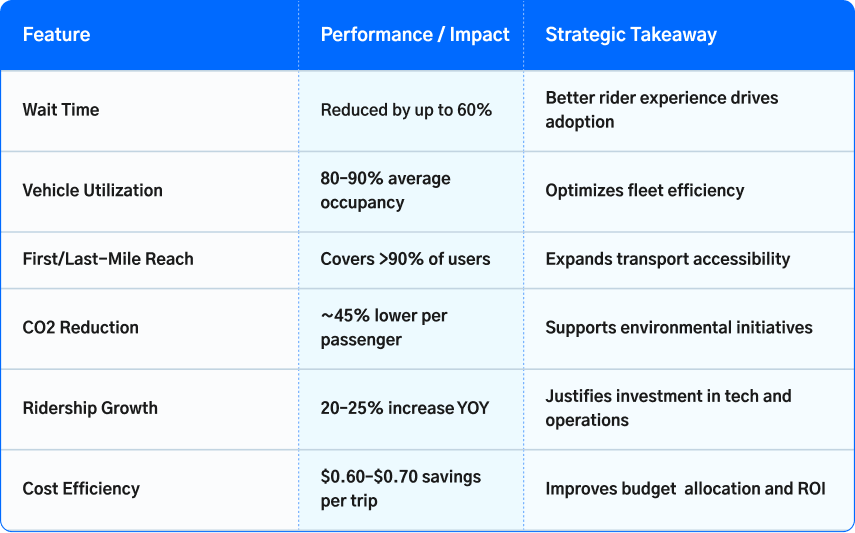
Explore how smart bus management software improves fleet performance and operational efficiency in on-demand systems.
Although bus-on-demand services offer a multitude of advantages, they also pose challenges that cities and transit operators must adeptly manage: