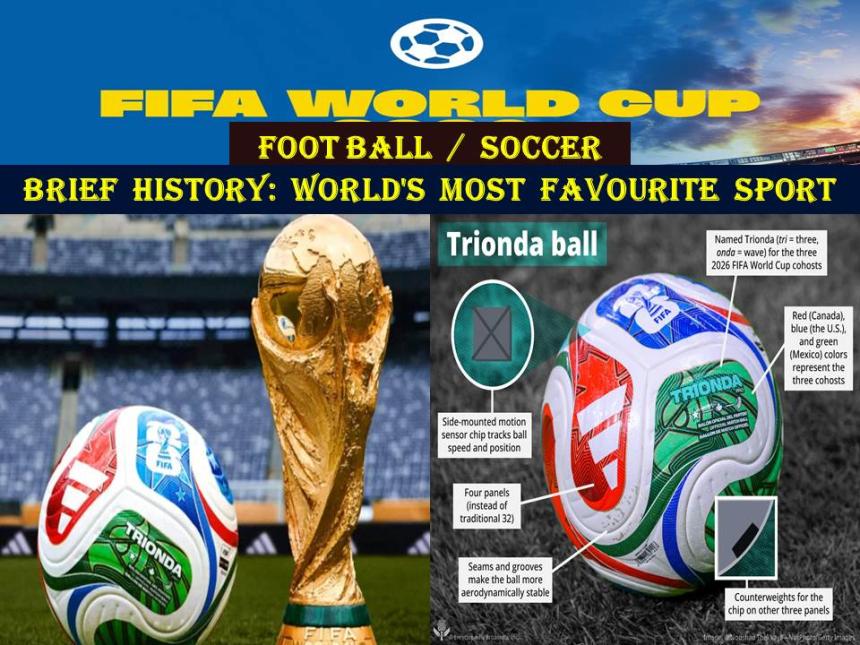

Brief History: World's Most Favourite Sport FIFA Soccer
Football also known as soccer, is a family of team sports, managed by 'International Association Football Federation' (FIFA). The FIFA World Cup is a football competition among the senior men's national teams held every four years. FIFA World Cup 2026™ is 23rd edition tournament, which began on June 11, 2026. This write up "Brief History: World's Most Favourite Sport FIFA Soccer" is about the "FootBall / Soccer".
أَعُوذُ بِاللّٰهِ مِنَ الشَّيْطَانِ الرَّجِيمِ
بِسۡمِ ٱللهِ ٱلرَّحۡمَـٰنِ ٱلرَّحِيمِ
In the name of ALLAH, the Most Gracious, the Most Merciful
Brief History: World's Most Favourite Sport FIFA Soccer
Since 1863, when first developed and codified in London, England, Football, also known as soccer, has become the world's most favorite sport. It commands an estimated 3.5 billion fans across the globe. Its massive popularity is driven by its simple rules, minimal equipment requirements, and massive international tournaments like the FIFA World Cup. Globally, an estimated 240 to 275 million people actively play association football (soccer). This massive figure, frequently cited by the Federation Internationale de Football Association (FIFA), encompasses all active participants, including registered amateurs, youth players, and professionals worldwide.
Football is a team sports where two teams maneuver a ball into each other's goal to score points, primarily involving kicking or carrying by foot or throwing by hand; it primarily is a sports, played with foot by teams of eleven players each in a ground of (295) and (394) feet long and (147) to (295) feet wide. The goalposts are always exactly (24) feet wide and (8) feet high.
FIFA World Cup started in the year 1930 and was hosted and won by Uruguay, featuring just 13 teams; all participating by invitation rather than a qualification process. The 13 nations included seven from South America, four from Europe, and two from North America. The 1934 FIFA World Cup was the first tournament where nations had to qualify to participate. Thirty-two nations entered qualification, and 16 teams reached the final tournament. The reigning champions, Uruguay, boycotted the event in response to European nations declining to travel to the 1930 tournament.
The 1934 tournament is often remembered for the heavy political influence of Italian dictator Benito Mussolini, who viewed the event as a propaganda tool for fascism. There were widespread allegations of refereeing bias in favor of Italy, particularly during their highly controversial quarter-final replay against Spain.
https://www.youtube.com/shorts/SXPPLfmuGM0
FIFA World Cup 1938, was the 3rd edition of the FootBall World Cup, the quadrennial international football championship. It was held in France from 4 to 19 June 1938. FIFA 1938 World Cup Teams:
Europe (13): Austria*, Belgium, Czechoslovakia, France, Germany (referred to as West Germany in later tournaments), Hungary, Italy, Netherlands, Norway, Poland, Romania, Sweden, Switzerland.
South America (01): Brazil.
North/Central America (01): Cuba
Asia (01): Dutch East Indies (now Indonesia)
FIFA WC 1938 tournament was played on Straight knockout basis (16 teams). The 1938 FIFA World Cup used a single-elimination "knockout" format. Teams played a bracket where losing a match meant instant elimination. Unlike modern tournaments, there were no group stages; every game was do-or-die, leading straight from the Round of 16 to the final.
The regular game was two half of 45 minutes each and if a match was tied after 90 minutes of regular play, the teams played 30 minutes of extra time in two halves. If the score was still a tie, there were no penalty shootouts. Instead, the two teams had to replay the entire match on a later day.
Austria qualified for the tournament, but the country was annexed by Germany shortly before the event. Austria withdrew, and the Austrian players were absorbed into the German squad. As a result, only 15 teams actually competed in the tournament).
Because FIFA did not replace Austria, their scheduled opponent, Sweden, received a free pass directly to the quarter-finals, and only seven matches were played in the Round of 16.
The quarter-final match between Brazil and Czechoslovakia became infamous for its brutal physical play and multiple red cards. The tournament took place under the heavy shadows of rising political tension, with some matches—such as the infamous quarter-final between Italy and the host nation France—played against a tense, hostile backdrop. The Dutch East Indies (now Indonesia) became the first Asian team to participate in a World Cup. Cuba reached the quarter-finals, marking their best performance in tournament history.
Italy successfully defended their title at the 1938 FIFA World Cup in France, defeating Hungary 4-2 in the final. Managed by Vittorio Pozzo, Italy became the first nation to win consecutive World Cups and the first to win the tournament on foreign soil.
FIFA World Cup Composition
FIFA WC 2026™ is 23rd edition; which began on June 11, 2026, and is scheduled to conclude on July 19. The WC 2026 is being hosted jointly by three countries in 16 cities – 11 in the United States, 3 in Mexico, and 2 in Canada. A record 48 teams are participating in the FIFA World Cup 2026. This marked a major tournament expansion from the previous 32-teams format.
The 32-team format was used from the 1998 FIFA World Cup in France until the 2022 FIFA World Cup in Qatar. The FIFA World Cup featured 24 teams starting in 1982 and continuing through the 1994 tournament. Earlier than 1982, i.e. 1978; the 16-team FIFA World Cup format was used, which started in 1954. This format was used continuously for seven tournaments, with 1978 being the last year to feature 16 teams.
Asia and Africa were formally included in the FIFA World Cup through separate qualification slots that allowed them to participate regularly starting in 1970.
First Appearances (1934 & 1938): Egypt was the first African team to play in the World Cup in 1934. Indonesia (then the Dutch East Indies) was the first Asian team in 1938.
The Boycott (1966): For decades, Asia and Africa had to share a single, combined qualification spot. In 1964, FIFA stated that these two regions—along with Oceania—must play off for just one spot at the 1966 tournament. Frustrated by this unfair setup, all 15 eligible African nations boycotted the 1966 World Cup in protest.
The Breakthrough (1970): The boycott worked. FIFA reformed the system for the 1970 World Cup in Mexico, granting Africa its own guaranteed spot and officially establishing a separate qualification path for Asia.
Expansion: Since 1970, both continents have had guaranteed places, growing from just one spot each to sending a combined 19 teams directly to the expanded 48-nation tournament for the current.
1954 World Cup Teams:
Europe (12): Austria, Belgium, Czechoslovakia, England, France, Hungary, Italy, Scotland, Switzerland, Turkey, West Germany, Yugoslavia
South America (2): Brazil, Uruguay
North/Central America (1): Mexico
Asia (1): South Korea
1970 World Cup Teams:
Europe (09): Belgium, Bulgaria, Czechoslovakia, England, Italy, Romania, USSR, Sweden, West Germany
South America (3): Brazil, Peru, Uruguay
North/Central America (1): El Salvador, Mexico
Asia (1): Israel
Africa (CAF): Morocco
1978 World Cup Teams:
Europe (10): Austria, France, Hungary, Italy, Netherlands, Poland, Scotland, Spain, Sweden, West Germany
South America (3): Argentina, Brazil, Peru
North/Central America (1): Mexico
Asia (1): Iran
Africa (1): Tunisia
2026 World Cup Teams:
Europe (16): Austria, Belgium, Bosnia and Herzegovina, Croatia, Czechia, England, France, Germany, Netherlands, Norway, Portugal, Scotland, Spain, Sweden, Switzerland, Türkiye.
South America (6): Argentina, Brazil, Colombia, Ecuador, Paraguay, Uruguay.
North/Central America (6): Canada, Curaçao, Haiti, Mexico, Panama, United States.
Asia (9): Australia, Iraq, Iran, Japan, Jordan, Qatar, Saudi Arabia, South Korea, Uzbekistan.
Africa (10): Algeria, Cape Verde (Cabo Verde), Egypt, Ghana, Ivory Coast, Morocco, Senegal, South Africa, Tunisia, DR Congo.
Oceania (01): New Zealand.
FIFA WC Format History
Round-robin league formats were introduced at the FIFA World Cup during the 1930 inaugural tournament, which used a group-stage round-robin. The concept was significantly expanded to include a final round-robin stage that directly decided the champion at the 1950 tournament.
FIFA WC 1930 (Uruguay): The very first World Cup used a round-robin group phase. Teams were placed into groups, and they played every other team in their group once.
FIFA WC 1950 (Brazil): This is the only World Cup in history that did not have a single-match final. Instead, the group winners advanced to a final round where they played each other in a round-robin format. The team with the most points at the end won the tournament.
FIFA WC 1958 (Sweden): FIFA refined the round-robin group stages to a classic 3-game format. This model became the standard.
FIFA WC 1982 to Present: The modern group stage (where teams are divided into small groups of three or four to play a round-robin) determines who advances to the single-elimination knockout rounds.
FIFA WC Title Record
80 nations that have appeared in the tournament, 13 have made it to the final, and 8 have won. Brazil, the only team that has participated in every World Cup, is also the most successful team in the competition, having won five titles and finished second twice.[5] Italy and Germany[n 2] have four titles each, with Germany having reached more finals than any other team, eight. Current champion Argentina has three titles, Uruguay and France have two each, while England and Spain have one each. Czechoslovakia, Hungary, Sweden, the Netherlands and Croatia have played in the final without winning. Only teams from Europe (UEFA) and South America (CONMEBOL) have ever competed in the final. Argentina defeated France on penalties in the latest final, staged at Qatar's Lusail Stadium in 2022.
FootBall / Soccer Popularity Leads to Commercialization
Football is the world's most popular sport, and this massive global reach has turned it into a multi-billion-dollar business. As viewership and participation grow, the sport relies heavily on corporate money. While this brings top talent to the pitch, it often forces tradition to take a backseat to profits.
Soccer leagues began in 1888. William McGregor founded the very first one, called the English Football League. It had 12 teams. Teams played each other twice (once at home, once away) to win points. This idea spread all over the world. The concept spread across the globe throughout the 1900s. Other countries adopted this format. For example, Argentina started a league in 1891, and the Netherlands began one in 1889. Since 992 Modern trends have got involved such as the famous English Premier League was formed. It allowed clubs to make their own commercial deals.
Before the Premier League started in 1992, football was merely just a weekend hobby compared to current day. The highest tier of English football before 1992 was the First Division, and this ran from 1888 right up until the Premier League’s formation. In 1961, the average wage for a player was £20 a week (Harris, 2011), which equates to £416 in today’s money due to inflation. This is a large contrast compared to the recent most expensive player in the world, Paul Pogba, who earns a staggering £290,000 a week. With all the money that has equated in football over the years through ownership, sponsorship, tickets and sales, stadium naming rights, Sky TV etc., where did it all begin?
Commercial deals entered soccer in the late 1960s and boomed in the 1970s and 1980s. Clubs shifted from local grassroots operations to global businesses. Think of soccer teams like giant billboards. In a normal business, companies pay for TV ads. In soccer, a company pays the team to put its logo on the players' jerseys and stadium walls. Millions of fans see these logos during games. This makes the company famous and gives the soccer team money to pay for the best players.
Today, these deals are worth billions. For example, clubs sign massive apparel and supply contracts, such as Real Madrid's multimillion-dollar agreement with Adidas. Some Key milestones are mentioned below:-
1960s: Brands started printing names on shirts. Lower-league English club Kettering Town was the first to wear a commercial sponsor on their jerseys in 1976.
1977: Liverpool FC broke into mainstream top-flight sponsorship by adding the Hitachi logo to their kits.
1982: UEFA, the governing body for European soccer, officially allowed teams to promote companies on their chests in tournaments.
1990s: Televised matches exploded in value. The launch of the English Premier League in 1992 and its massive TV deal with Sky Sports changed the game forever.
2000s: Stadium naming rights, tech sponsors, and international merchandise sales took off.
For the first time in tournament history, the 2026 FIFA World Cup introduced mandatory three-minute "hydration breaks" midway through each half of every match, regardless of the weather. Referees pause play around the 22nd minute to allow players to drink, and broadcasters are permitted to run commercials during this time. There may be many arguments given in this regards but the fact is that "hydration break" has been introduced due to commercialization purposes. The breaks give networks scheduled ad time, which has proven controversial and sparked mixed reactions among long-time football fans who are unaccustomed to these pauses. Such novel introduction may spoil the spirit of the FootBall / soccer and it may lose its charm as the most Favourite Sport of the globe.
NBA 2K27 Lightning Launch Guide for Beginners by U4gm
Lightning Launch in NBA 2K27 is about the first move from the perimeter: it helps a ball h...

Deburring and Surface Finishing with a Magnetic Polishing Machine
Every cutting operation leaves an edge. Sometimes the result is a visible curl of metal at...

Selecting the Right Magnetic Polishing Machine for Precision Component...
Buying finishing equipment looks simple until the first batch arrives. A machine that prod...
How a Magnetic Polishing Machine Works in Precision Surface Finishing
Precision metal parts almost always leave the machine shop with problems that drawings do...
How Can Scalable Web Applications Support Long-Term Business Growth?