Bottled Water Market Size, Growth Analysis, Industry Trends & Forecast 2034
The global bottled water market grew from USD 288.8 Billion in 2025 to USD 311.2 Billion in 2026.
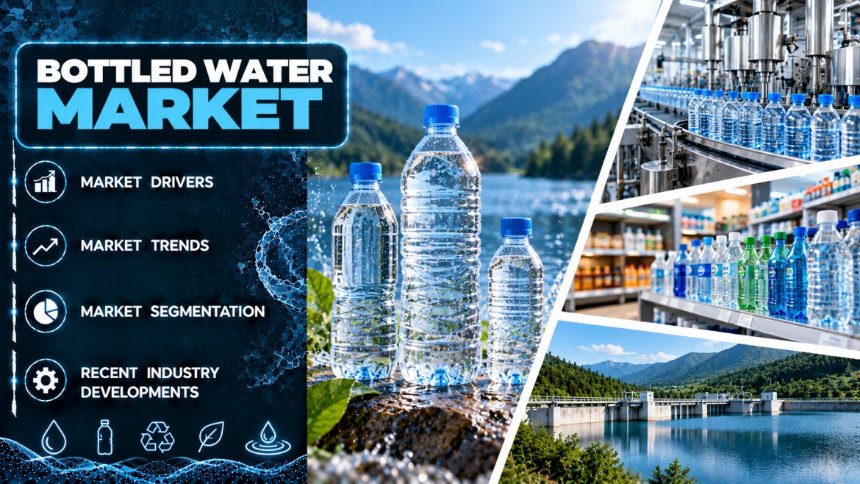
IMARC Group, a leading global market research and management consulting firm, has published its latest market intelligence report on the bottled water market. The global bottled water market grew from USD 288.8 Billion in 2025 to USD 311.2Billion in 2026. Looking forward, IMARC Group estimates the market to reach USD 498.4Billion by 2034, exhibiting a CAGR of 6.06% during 2026-2034, driven by rising health and wellness awareness, growing concerns over water contamination, rapid urbanization, expanding demand for premium and functional water, and continuous packaging innovation focused on recycled and lightweight materials worldwide.
The market is experiencing strong growth momentum as bottled water moves from an occasional purchase to a daily hydration staple. Consumers are replacing sugary soft drinks with water, and urban households are turning to packaged water because of doubts about tap water quality. The scale of the access gap shows why: about 2.2 billion people still lack safely managed drinking water, which keeps packaged water central to public health and consumer demand. Retailers, foodservice operators, and on-the-go consumers are also widening the product mix, from still and mineral water to flavored, alkaline, and vitamin-enriched variants. PET bottles hold roughly 80.0% of packaging demand, and manufacturers are working to reduce plastic weight and raise recycled content.
How AI is Reshaping the Future of the Bottled Water Market- AI-Powered Demand Forecasting and Distribution Optimization: Machine learning platforms let bottlers and distributors analyze weather patterns, retail sell-through, event calendars, and outlet-level purchase data. This helps them plan production, cut stock-outs during peak summer demand, and route delivery fleets efficiently. The result is more consistent availability across supermarkets, convenience stores, on-trade venues, and direct-delivery customers, and lower transport costs in a high-volume, low-margin category.
- Intelligent Quality Control and Smart Plant Management: Computer vision systems on high-speed filling lines inspect fill levels, cap sealing, label placement, and bottle integrity at speeds manual checks cannot match. Sensors paired with analytics also track water chemistry, filtration performance, and equipment health in real time. This reduces defects and downtime, and supports compliance with strict drinking water safety standards.
- Personalized Product Development Using Consumer Analytics: Brands are using sentiment analysis, online reviews, and sales data to spot rising interest in alkaline, oxygen-infused, flavored, and mineral-enriched water. This shortens development cycles. It also helps manufacturers target premium and functional niches, and choose packaging formats such as resealable caps, smaller portions, and sustainable bottles, before committing to full production runs.
Grab a sample PDF of this report: https://www.imarcgroup.com/bottled-water-market/requestsample
Bottled Water Market Trends and DriversThe global bottled water market is witnessing steady expansion, fueled by health-driven consumption, urban lifestyles, and a wave of packaging and product innovation. Health and wellness awareness is the foundation of demand. Consumers increasingly see water as a healthier alternative to sugary beverages, and this is reflected in spending behavior. An EY survey found that 40% of Indian respondents would pay a premium for health products, compared with 29% globally. Premium categories such as natural spring, mineral, alkaline, and functional water are benefiting from this willingness to pay, especially in fast-growing urban markets.
Urbanization and convenience are reinforcing this shift. More than half of the world’s population now lives in cities, and the share is expected to approach 70% over the coming decades. Asia alone holds about 54% of the global urban population, with roughly 1.2 billion additional urban residents expected. City dwellers with long commutes and busy schedules rely on portable, ready-to-drink water, and e-commerce is widening access further. About 56% of consumers in Indonesia and 50% in Thailand prefer shopping online. Hydration habits are also solid in mature markets: in the United States, 66% of adults drink three or more glasses of water daily, and only 8% drink water rarely or never.
Sustainability is now a central competitive lever and a regulatory pressure point. Governments are tightening plastic rules, and the European Union’s Single-Use Plastics Directive requires PET beverage bottles to contain a minimum share of recycled content. India’s Extended Producer Responsibility framework under its Plastic Waste Management Rules obliges bottlers to collect and recycle packaging. Food safety regulation adds another layer: India requires packaged drinking water to meet Bureau of Indian Standards and FSSAI norms, while the US FDA regulates bottled water as a food product. Brands are responding with recycled PET, lightweighting, plant-based bottles, and renewable energy at their plants. The shift is also visible in consumer attitudes, as 90% of Europeans surveyed said sustainability is a primary purchase factor. Water filter usage is rising too: 52% of Americans used a filter for environmental reasons, up from 41% a year earlier, which shows how closely hydration choices now track environmental concern.
Ask an analyst for customized report: https://www.imarcgroup.com/request?type=report&id=3131&flag=E
Bottled Water Industry SegmentationThe report has segmented the market into the following categories:
Breakup By Product Type:
- Still
- Carbonated
- Flavored
- Mineral
Still water accounts for the largest product type segment with a share of about 55.8%. It is the default choice for everyday hydration, valued for its neutral taste, affordability, and wide availability across household, office, and travel settings. Manufacturers are diversifying within the segment through alkaline, mineral-enriched, and oxygen-infused variants.
Breakup By Packaging Type:
- PET Bottles
- Metal Cans
- Others
PET bottles command about 80.0% of the packaging segment. They are lightweight, shatter-resistant, cost-efficient, and easy to transport. Recycled PET adoption and bottle lightweighting are improving their environmental profile.
Breakup By Distribution Channel:
- Supermarkets/Hypermarkets
- Convenience Stores
- Direct Sales
- On-Trade
- Others
Supermarkets and hypermarkets hold the largest channel share at about 59.4%. Bulk purchasing, wide brand selection, promotional pricing, and one-stop household shopping keep them the preferred destination for multipack and family-size formats.
Breakup By Region:
- North America (United States, Canada)
- Asia Pacific (China, Japan, India, South Korea, Australia, Indonesia, Others)
- Europe (Germany, France, United Kingdom, Italy, Spain, Russia, Others)
- Latin America (Brazil, Mexico, Others)
- Middle East and Africa
Asia Pacific dominates the global bottled water market with a share of over 44.5%. Rapid urbanization, rising disposable incomes, and concerns about polluted water and waterborne disease are the main drivers, supported by growing demand for premium natural spring and mineral brands. Younger consumers are also pushing demand for functional and flavored water and lightweight sustainable packaging. In North America, the United States accounts for over 87.3% of regional demand, while about 64% of the population in the Middle East and Africa lives in urban areas, which supports packaged water adoption.
Competitive LandscapeThe report provides a comprehensive analysis of the competitive landscape in the bottled water market with detailed profiles of all major companies, including:
- Bisleri International Pvt. Ltd.
- Danone S.A.
- Gerolsteiner Brunnen GmbH & Co. KG
- Nestle S.A.
- Nongfu Spring (Yangshengtang Co. Ltd.)
- Otsuka Pharmaceutical Co. Ltd.
- PepsiCo Inc.
- Primo Water Corporation
- Tata Consumer Products Limited
- The Coca-Cola Company
If you are tracking the bottled water market for investment decisions, market entry planning, competitive benchmarking, or strategic advisory, IMARC Group’s report gives you everything in one place:
- Complete market sizing with revenue forecasts covering the full projection period
- Quantified growth driver analysis with impact scoring across product type, packaging type, distribution channel, and regional markets
- Sub-segment breakdowns for still, carbonated, flavored, and mineral water, PET bottles, metal cans, supermarkets and hypermarkets, convenience stores, direct sales, and on-trade channels, with individual share data
- Country-level data for the United States, Canada, China, Japan, India, South Korea, Australia, Indonesia, Germany, France, the United Kingdom, Italy, Spain, Russia, Brazil, and Mexico
- Competitive profiles of 10 leading companies with strategic landscape assessment
- Porter’s Five Forces, value chain analysis, and pricing intelligence
- Latest innovation trends covering recycled and plant-based packaging, advanced purification, functional and flavored water, and smart dispensing, which are shaping competition and consumer preference across key regions
- May 2025: Nestlé planned to sell its water division, which includes Perrier and S.Pellegrino and is valued at over €5 billion. The company hired Rothschild & Co. as advisor and aims to retain a stake in the business, a sign of major portfolio reshaping among global water leaders.
- March 2025: Bisleri partnered with Schneider Electric’s Sustainability Business to add up to 13.6 MW of solar capacity across six plants. The program targets about 33% green energy use and roughly 16,000 tons of annual emissions reduction, alongside plans for PET bottle lightweighting and recycling.
- February 2025: IOTA Water launched in North India as the country’s first bottled water infused with oxygen nanobubble technology, developed with NICO Nanobubble India Co. It is priced for mass consumption, bringing functional water to a wider audience.
- February 2025: Win Win Water introduced 100% plant-based, biodegradable bottles made from sugarcane-derived PLA, which the company says decompose within 90 days in commercial composting conditions.
- January 2025: CR Beverage, a Chinese bottled water brand, invested in three high-speed aseptic complete lines from Sidel to meet rising demand for higher-quality, healthier, and eco-friendly packaging.
Note: If you require specific details, data, or insights that are not currently included in the scope of this report, we are happy to accommodate your request. As part of our customization service, we will gather and provide the additional information you need, tailored to your specific requirements. Please let us know your exact needs, and we will ensure the report is updated accordingly to meet your expectations.
Key Questions This Report Answers- What is the current global bottled water market size and what is its projected value?
- Which product type segment holds the largest share in the global bottled water market?
- What are the key drivers of global bottled water market growth?
- Which region dominates the global bottled water market and why?
- How are health and wellness trends, premium and functional water innovation, and sustainability pressures reshaping product development and competitive strategies in the bottled water industry?
- Who are the top companies in the global bottled water market and what are their competitive strategies?
- What are the investment and market entry opportunities across still, mineral, flavored, and functional bottled water segments?
IMARC Group is a global management consulting firm that helps the world’s most ambitious changemakers to create a lasting impact. The company provides a comprehensive suite of market entry and expansion services. IMARC offerings include thorough market assessment, feasibility studies, company incorporation assistance, factory setup support, regulatory approvals and licensing navigation, branding, marketing and sales strategies, competitive landscape and benchmarking analyses, pricing and cost research, and procurement research.
Media and Sales ContactIMARC Group
Email: [email protected]
United States: +1-201-971-6302
India: +91-120-433-0800
United Kingdom: +44-753-714-6104
CRC Price Trend Q2 2026 | Global Price Trends, Forecast, Chart, Prices...

Choose a Professional Driving School in Northern Virginia for Better R...

White Kitchen Countertops: Are White Granite Kitchen Countertops the B...

Modern Architectural Trends For Durable Ceilings in Commercial Spaces!
Among available options, metal ceilings are gaining attention for their versatility and co...
