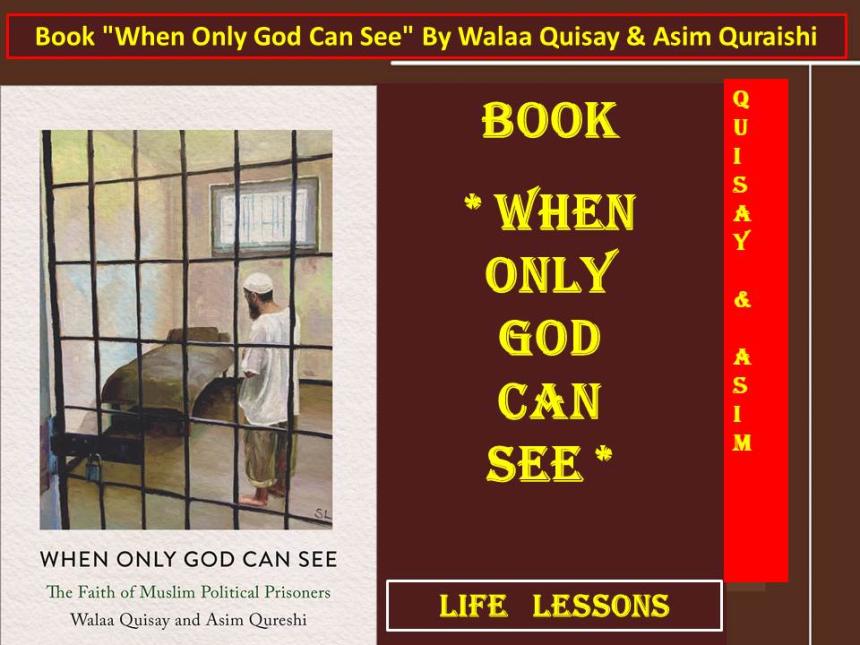

Book "When Only God Can See" By Walaa Quisay & Asim Quraishi
Dr. Walaa Quisay is an Egyptian researcher and scholar of Islamic studies and is a Leverhulme Early Career Fellow in the School of Divinity at the University of Edinburgh۔ Asim Qureshi is a British human rights lawyer and author based in London and is a Research Director at CAGE, an independent advocacy group۔ This write up is an introduction of the Book "When Only God Can See: The Faith of Muslim Political Prisoners" By Walaa Quisay & Asim Quraishi and arranged for educational purposes from material available freely on Web Net.
أَعُوذُ بِاللّٰهِ مِنَ الشَّيْطَانِ الرَّجِيمِ
بِسۡمِ ٱللهِ ٱلرَّحۡمَـٰنِ ٱلرَّحِيمِ
In the name of ALLAH, the Most Gracious, the Most Merciful
Book "When Only God Can See" By Walaa Quisay & Asim Quraishi
"When Only God Can See: The Faith of Muslim Political Prisoners" By Walaa Quisay & Asim Quraishi
Dr. Walaa Quisay is an Egyptian researcher and scholar of Islamic studies and is a Leverhulme Early Career Fellow in the School of Divinity at the University of Edinburgh. She has worked at numerous academic institutions, including the University of Manchester, the University of Birmingham and Istanbul Sehir University. She is the author of "Neo-Traditionalism in Islam in the West: Orthodoxy, Spirituality, and Politics".
Asim Qureshi is a British human rights lawyer and author based in London and is a Research Director at CAGE, an independent advocacy group working to empower communities impacted by the War On Terror. He specialises in investigating the impact of counterterrorism practices worldwide, and advises legal teams involved in defending terrorism trials in the US and at Guantanamo Bay, Cuba. He is the co-author of "When Only God Can See".
The Book "When Only God Can See" written by Walaa Quisay, who has worked closely with prisoners in Egypt, and Asim Qureshi, with years of experience supporting detainees at Guantanamo Bay, the authors’ deep connections with prisoner communities and their emphasis on the power of resistance shine through.
Book "When Only God Can See" By Walaa Quisay & Asim Quraishi is devoted to the multifaceted experiences of those Muslims detained in appalling conditions in the prisons of the United States and Egypt. The book "When Only God Can See" is arguably the more essential reading, as it centers on the contemporary and ongoing practices of carceral dehumanisation through the War on Terror. Indeed “counter-terrorism” is an essential subject for anyone interested in liberal processes of dehumanisation.
Dr. Tarek Younis says in a review on the book "For decades, Viktor Frankl’s Man’s Search for Meaning held a special place in psychotherapeutic literature. Frankl wrote his thoughts immediately after having survived a Nazi concentration camp. There he observed a stark difference between those inmates who clung unto some sort of meaning—a purpose to life—and those who did not. Walaa and Asim’s When Only God Can See echoes Frankl’s Man’s Search for Meaning".
Book "When Only God Can See" is an extraordinary exercise visibilising some of the most erased peoples in the world—political prisoners. Beginning with the harrowing experience of being taken into custody then continuing down the disturbing trail of forced disappearance and torture, the authors underline the intense brutality that is omnipresent in every encounter with State violence. Through these experiences, they shed light on the intricate composite of distress, faith and resistance at every moment.
From the Back Cover of Book "When Only God Can See" By Walaa Quisay & Asim Quraishi
‘This beautifully written and harrowing book bears witness to the devastating experience of imprisonment; it shows the centrality of faith; and tenderly details the prayers, communities and acts of resistance that sustained these prisoners when faced with forced disappearance, punishment, and torture’ Laleh Khalili, author of Time in the Shadows.
‘A passionate revelation of the secret endurance of people suffering extraordinary trauma ... A must read to understand the limitless potential of the human spirit’ Aida Seif El-Dawla, psychiatrist and co-founder of El Nadeem Centre for Rehabilitation of Victims of Violence and Torture.
Book "When Only God Can See" uncovers the unique experiences of Muslim political prisoners held in Egypt and under US custody at Guantanamo Bay and other detention black sites. This groundbreaking book explores the intricate interplay between their religious beliefs, practices of ritual purity, prayer, and modes of resistance in the face of adversity. Highlighting the experiences of these prisoners, faith is revealed to be not only a personal spiritual connection to God, but also a means of contestation against prison and state authorities, reflecting larger societal struggles.
Book "When Only God Can See" By Walaa Quisay & Asim Quraishi - Explains
It is a book about faith, geopolitics, prison, torture, the intensely personal and the blatantly public, and an ongoing reality for so many Muslims around the world. Muslim political prisoners in Guantanamo, Egypt, and America (& elsewhere) are not your "average" prisoner - they are guilty of nothing but being victims of a global War on Islam, a geopolitical & Islamophobic campaign of terror and torture. Many of these prisoners were at the wrong place at the wrong time, literally sold into prison by greedy Pakistani military or Afghan warlords, or picked up as part of a regular practice of squashing political & religious dissent against vicious dictators.
This book highlights who these otherwise anonymous prisoners - male & female - really are: what they endure(d), how they endured, & how Islam became their ultimate form of resistance against an injustice that is not held accountable in this Dunya but absolutely will be in the Aakhirah. One could write a hundred khutbahs about Eman, sabr, relationship with the Qur’an, personal crises of faith, resistance against oppression, understanding Qada & Qadr, & more - & one'd still have more to learn from what these prisoners go through.
One of the most important lessons of this book is that you & I (for that matter any practicing Muslim) could easily be any one of these people. Their stories are our stories. It's hard to summarize this book in any way. It is part of an ongoing tradition in Muslim history, of innocent believers imprisoned & tortured. It also sheds light on the ways that the West & governments of Muslim countries are intimately allied, the systems of power & Islamophobia that span continents & impact our everyday lives.
Book "When Only God Can See" By Walaa Quisay & Asim Quraishi is a very interesting insight into experiences of Muslim political prisoners (particularly those imprisoned under the courtesy of war-on-terror) with regards to them practicing their faith in captivity both in Egyptian and US Prison. It was heartbreaking and sad to read how much both the states used the captives religion in response to resistance for state sanctioned sexual humiliation and other derogatory interrogative methods and how they used Muslim chaplains and fatwas to support their own discrimination, like refusing prisoners to pray in congregation, disrespecting religious sentiments, questioning the prisoners into believing that hunger strikes are haram. It was also very reflective and very very informative as to how people remain steadfast in their faith even in the most dire of circumstances and how the prisoners tried to find comfort in Quranic stories particularly in the story of Yusuf AS.
Book "When Only God Can See" By Walaa Quisay & Asim Quraishi significantly differentiates (the Muslims and West along with Muslim's collaborators) that “They never explicitly admit that their abuse of our faith is systematic, but they all but admit through their actions — that their hate is directed towards Islam. If they could crush out every last trace, they would do so, but they don't because it's not practical, so that's why they create these notions of radicals and extremists and create separation between Muslims, giving the visage of honouring certain aspects of Islam while denying others. If they had their way, they would not let anyone utter the name of Allah or express the slightest aspect of Islam in any circumstances.”
Book "When Only God Can See" By Walaa Quisay & Asim Quraishi - Discussion
In Islam, there are different rulings for captives, for times of peace, and for times of War.
The book juxtaposes experiences of Muslim Political Prisoners, primarily the ones in US and Egypt, some from Pakistan, Syria, Jordan. We have seen what came out of Syria’s prisons. Similar is in Egypt. All leading back to US. Each line of the book gives you a reality check of what tyranny is, تغیان, Taghoot. The hadith of Khabbab r.a plays in your mind as you go through the book.
(Sahih al-Bukhari 3852)..
Khabbab bin Arrat (رضي الله عنه) narrated:-
We complained to the Prophet (s.a.w) while he was reclining on his cloak in the shade of the Ka’bah. We said, ‘Will you not ask Allah to help us? Will you not supplicate for us?’
The Prophet (ﷺ) replied:
‘Among the people before you, a man would be seized, a pit would be dug for him, and he would be placed in it. Then a saw would be brought and placed on his head, cutting him in half, yet this would not make him abandon his faith. Another would be combed with iron combs that would tear his flesh from his bones, yet this would not make him recant his religion. By Allah, this religion will prevail until a traveler from Sana‘a to Hadramawt will fear nothing but Allah and the wolf for his sheep, but you are being impatient."
This hadith still LIVES ON. People STILL GET ELECTROCUTED, RAPED, BUTCHERED, and endure most gruesome and cruel things that you cannot even think about. Systematically! By design! Purposefully! For who? Why?
Guantanamo Bay is STILL OPEN as of 2025, money still flows through the bank accounts of its administration. The guards still wake up and do their duty.
“Moazzam Begg described how he was led by his US interrogators to believe that his wife was being raped in the interrogation room next to his own.”
It’s not like Guantánamo was another planet with a different species of Americans operating it – these were the same people, these actions were part of Standard Operating Procedures that had been instituted by General Geoffrey Miller, whose appointments throughout the West Asia(incorrectly named Middle East Asia) were directly from Secretary of Defense,USA.
In 2004, a policy initiated by the Federal Bureau of Prisons on Religious Beliefs and Practices stated explicitly: ‘Islamic inmates may not hem or wear their pants above their ankles. As Muslims, many believed that the rule of isbaal meant that they were not permitted to wear their trousers below their ankles due to a narration of the Prophet Muhammad, that the clothing worn below the ankles would result in hellfire.
By the time the men arrived at Guantánamo Bay, US interrogators had learnt much of what might impact on the psychology of Muslim prisoners – often relying on Raphael Patai’s deeply racist and Islamophobic book The Arab Mind as a way of learning and dominating the culture of the prisoners.
Book "When Only God Can See" By Walaa Quisay & Asim Quraishi - The Contents
Book "When Only God Can See" By Walaa Quisay & Asim Quraishi - The Contents of the Book (256 Pages)
Introduction
1. Custody
2. The Prayers of Prisoners
3. The Ummah of Prisoners
4. Belief, Crisis and the Qur’an
5. Ethereal Beliefs
6. Torture
7. Faith and Resistance
Conclusion: Religion and the Deification of the National Security State
Delving into the extraordinary experiences of Muslim political prisoners held in Egypt and under US custody at Guantanamo Bay, this groundbreaking book explores the intricate interplay between their religious beliefs, practices of ritual purity, prayer, and modes of resistance in the face of adversity. Highlighting the experiences of these prisoners, faith is revealed to be not only a personal spiritual connection to God but also a means of contestation against prison and state authorities, reflecting more significant societal struggles.
By capturing how faith is practiced and modified behind bars, juxtaposing experiences from different regions, and presenting narratives of resistance When Only God Can See offers a compelling and original exploration of the intersection between faith, incarceration, and resistance.
"What a heavy read, @AsimCP the book explores an extremely important subject and brings to light the spirit of political resistance and faithful resolve of muslim prisoners against the pharaonic measures of the war on terror era, of upholding their muslim-ness when it is made to be the very evidence of their crimes. Multiple angles of faith and its functions during imprisonment are discussed, from ummatic solidarities to debating fiqh of prison life, the cases of upholding islam in the modern harrowing of circumstances brings the reader to tears/shame regarding their own lack of commitment in comfort.
The inspirations and motivations are extracted by Muslim prisoners from every aspect of the islamic tradition, from the archetype of prophet yusuf to the justice of the hereafter all while facing criticism from some "ulema" who legitimised their very imprisonment and torture.
One of the most interesting aspects of these stories was the attitudes of the local guards and police officers working for the imperial structures (in egypt & pakistan), who would, while torturing the prisoners simultaneously be also concerned about the prisons making dua against them ("we are just fulfilling our duties, please forgive us"), acting almost divided between the "sacred" imperial hierarchical command that they have to be dutiful to and the muslim conscience that realises the error of their actions.
The book touches the exact points of problems in regards to being/remaining Muslim vis-a-vis the neo-colonial/imperial nation-state structures of modernity from within the system or beyond it.
Book "When Only God Can See" By Walaa Quisay & Asim Quraishi- The Expert Opinion
‘This beautifully written and harrowing book does several things magisterially: it bears witness to the devastating experience of imprisonment in Egypt and the carceral houses-of-horror devised by the US in its War on Terror; it shows the centrality of faith in the lives of the Muslim prisoners whose stories are so sensitively rendered here; and tenderly details the dreams, prayers, communities and acts of resistance that sustained these prisoners when faced with forced disappearance, punishment, and torture.’
– Laleh Khalili, author of ‘Time in the Shadows: Confinement in Counterinsurgencies’
‘This is no easy read – but, for anyone who wants to understand the story of Muslim political prisoners in the 21st century and their unique connection to faith, it’s essential reading. Qureshi and Quisay have welded together the experiences and reflections of prisoners held in torturous conditions across continents and given life to their inner strengths and sensitivities. In giving a substantive voice to Egyptian women prisoners as much as it does to Muslim men imprisoned in Bagram and Guantanamo, this book opens a holistic door into the very heart and soul of how we all survived some of the most brutal prisons in the world.’
– Moazzam Begg, former Guantanamo Bay detainee and author of ‘Enemy Combatant’
‘After working for thirty years with survivors of brutal torture in Egyptian prisons and while watching with the rest of the world the horrors suffered by Palestinians in the war on the Gaza strip and the West Bank, When Only God Can See comes as a passionate revelation of the secret of endurance of people suffering extraordinary trauma. The secret is as simple as well as complicated as is Faith. An integral part of the self, which while the perpetrator seeks to use as tool of humiliation and punishment, is not aware that this same punishment, unintentionally, tests, sharpens and mobilizes a mechanism of resilience, solace, subversion and resistance that instills endurance, defiance and hope in the person harboring it. A passionately written work which tenderly investigates the limitless resources of human beings who when subjected to horrors committed by other human beings, seek refuge and power in a realm that belongs to them alone, a conviction that comes as a rescue when all other forms of rescue are unattainable. A must read to understand the limitless potential of a human spirit.’
– Aida Seif El-Dawla, Psychiatrist and co-founder of El Nadeem Centre for Rehabilitation of Victims of Violence and Torture
Book "When Only God Can See" presents the victims of a global “War on Terror” as protagonist in their own stories – despite suffering unspeakable traumas. In the midst of their incarceration, they turn back and speak to the One who created them with dignity. In examining the faith of Muslim political prisoners outside of a narrative of radicalization, we not only see how powerful Islam is as a spiritual source of enlightenment, but how pervasive the cruel narrative surrounding Muslim political prisoners is.’
– Imam Omar Suleiman, author of ’40 on Justice: The Prophetic Voice on Social Reform’
‘Profoundly illuminating work that looks at how faith and prayer become acts of radical resistance. By bearing witness to the lives and stories of Muslim political prisoners at the putrefying heart of the American empire, this book is a record of both repression and resistance to it.’
– Suchitra Vijayan, co-author of ‘How Long Can the Moon Be Caged?: Voices of Indian Political Prisoners’
The Conclusion
The US, Egypt, Israel and others want nothing more than to erase their political prisoners, strip them from their rights, and eliminate them completely. This book is both a rehearsal and a reminder of true memorialisation: to witness and validate those the State attempts to erase. The fields of law and counter-terrorism tend to dominate discussions around Muslim political prisoners. With exception of auto-biographies and the keen insights of critical scholars, less is known how Muslim political prisoners live, suffer, thrive and resist.
This book sheds much needed light on the internal and metaphysical experiences of Muslim political prisoners. "When Only God Can See", in all its violent depictions, ultimately conveys a message of hope. It demonstrates how, regardless of State violence, inside the prison or elsewhere, the human can not only overcome their oppression, but make it meaningful to themselves and others.
"When Only God Can See: The Faith of Muslim Political Prisoners" By Walaa Quisay & Asim Quraishi teaches that faith under extreme state oppression is not merely a private spiritual comfort, but an active form of political resistance, moral clarity, and communal survival against systemic injustice. Spiritual belief helps detainees find deeper meaning and retain their humanity inside isolation and torture. Religious grounding keeps the oppressed aware of systemic wrongdoings when authorities try to break their reality. Prisoners learn that while physical bodies are caged, ultimate power and justice rest with God, not captors.


Audio Transformers in Public Address Systems: Why Are They Needed?
Imagine yourself inside an active factory during the first hour of a working shift. You ne...