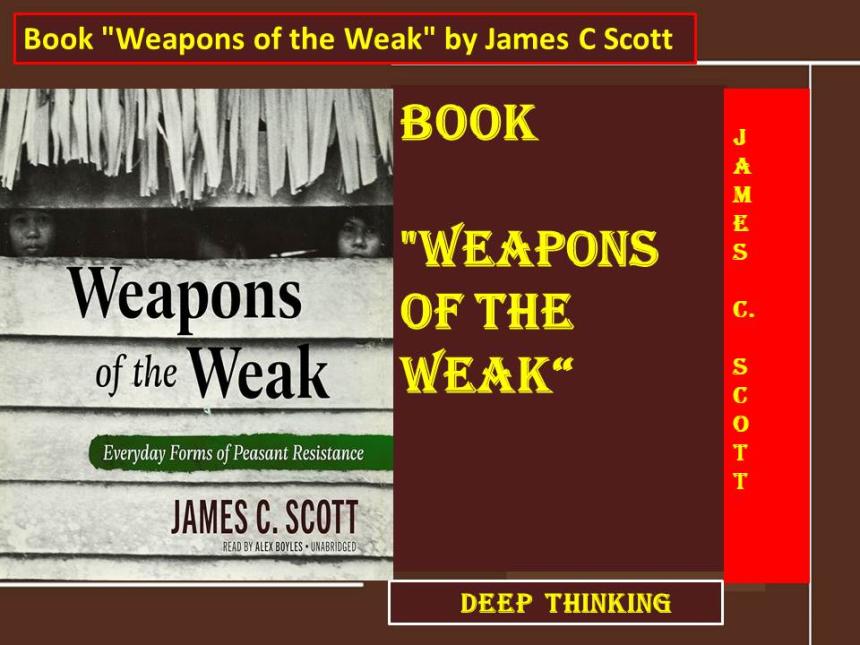

Book "Weapons of the Weak" by James C Scott
James Campbell Scott (1936 - 2024) was an American political scientist and anthropologist specializing in comparative politics. His research concerns political economy, comparative agrarian societies, theories of hegemony and resistance. "Weapons of the Weak" is a 1985 book by James C. Scott, on everyday forms of rural class conflict. This write up has been arranged for educational purposes.
أَعُوذُ بِاللّٰهِ مِنَ الشَّيْطَانِ الرَّجِيمِ
بِسۡمِ ٱللهِ ٱلرَّحۡمَـٰنِ ٱلرَّحِيمِ
اللہ کے نام سے شروع جو بڑا مہربان نہایت رحم کرنے والا ہے
In the name of ALLAH, the Most Gracious, the Most Merciful
Book "Weapons of the Weak" by James C Scott
James Campbell Scott (December 2, 1936, New Jersey, USA - July 19, 2024, Durham, Connecticut, USA) was an American political scientist and anthropologist specializing in comparative politics. His research concerns political economy, comparative agrarian societies, theories of hegemony and resistance, peasant politics, revolution, Southeast Asia, theories of class relations and anarchism.
"Weapons of the Weak: Everyday Forms of Peasant Resistance" is a 1985 book by James C. Scott, on everyday forms of rural class conflict as illustrated in a village of Sedaka in Malaysia's Kedah region. James C. Scott documented how poor farmers and landless laborers coped with the rapid mechanization and widening wealth gaps of the Green Revolution; exhibiting passive resistance against enforced power and ideological hegemony.
The central theme of James C. Scott's 1985 book, "Weapons of the Weak" is that subordinate groups do not passive accept domination; instead, they engage in silent, routine, and unorganized "everyday forms of resistance" to subvert authority without risking open conflict. Scott argues that focusing only on rare, large-scale revolutions overlooks the constant micro-struggles that actually define how the marginalized maintain their dignity, economic resources, and autonomy.
The Core Concept: "Everyday Forms of Resistance"
Scott shifts the focus away from overt political uprisings to what he terms "infrapolitics"—the quiet, low-profile strategies used by the poor. These ordinary tactics, or "weapons," require little to no coordination and are designed to avoid direct confrontation with powerful elites. Examples include:
Foot-dragging and performative laziness.
False compliance and feigned ignorance.
Subtle sabotage, arson, and pilfering.
Evasion, desertion, and slander.
Gossip and anonymous threats.
Key Analytical Pillars of the Book "Weapons of the Weak" by James C Scott
The Case Study: The book is an ethnography based on two years of fieldwork (1978–1980) in the Malaysian village of Sedaka. Scott tracks how the introduction of the Green Revolution—such as combine-harvesters and double-cropping—enriched wealthy landowners while stripping away land, jobs, and wages from poor laborers.
Rejection of Hegemony & "False Consciousness": Scott firmly rejects Marxist and Gramscian theories of ideological hegemony, which suggest that oppressed people are blinded by a "false consciousness" that makes them accept their subordination. He demonstrates that the peasants understand their exploitation perfectly well. They simply choose hidden non-cooperation because they are realistic about the fatal odds of an open revolt.
The Ideological Struggle: Resistance is not just physical; it is symbolic. The poor and the rich in the village constantly wage a quiet war of words to define social norms, charity, and fair play. For example, the poor use gossip and social stigma to shame wealthy neighbors who abandon traditional community obligations, creating a "hidden transcript" of dissent.
Cumulative Impact: While individual acts of foot-dragging or evasion seem trivial or self-interested, Scott argues that their aggregated weight can quietly grind down oppressive state policies, tax collections, or capitalist exploitation, making a massive historical impact over time.
Summary of the Book "Weapons of the Weak" by James C. Scott
Weapons of the Weak: Everyday Forms of Peasant Resistance by political scientist James C. Scott is a 1985 ethnographic study of a rural Malaysian village (Sedaka) navigating the agricultural shifts of the "Green Revolution". It highlights how marginalized peasants engage in subtle, everyday resistance—such as foot-dragging, sabotage, pilfering, and dissimulation—rather than open rebellion to protect themselves and challenge structural inequality.
Scott conducted fieldwork in Sedaka between 1978 and 1980, engaging with the socioeconomic impacts of the Green Revolution, specifically the introduction of double-cropping and combine harvesters. While the technology boosted overall agricultural yields, it decimated wage-earning opportunities for smallholders and landless laborers, thereby worsening wealth inequality.
Scott shifts focus away from traditional, large-scale peasant uprisings (revolutions and rebellions), which are rare and often brutally suppressed. Instead, he highlights the daily, low-profile actions taken by poor peasants to survive and push back against wealthy landowners and state policies.
These "weapons" include:
Foot-dragging and feigned ignorance: Working slowly or pretending not to understand instructions to reduce labor productivity.
Pilfering and theft: Stealing small amounts of grain or resources to supplement income.
Sabotage and arson: Secretly damaging machinery or crops to inflict material costs on larger landowners.
Gossiping and slander: Using village social structures to shame the wealthy and undermine their moral authority.
A primary theoretical goal of the book is to critique traditional Marxist and Gramscian theories regarding hegemony and false consciousness.
Often, elites attempt to establish hegemony by convincing the lower classes that the social order is natural or justified.
Scott argues that the peasants of Sedaka are not deceived; they have a clear-eyed understanding of their exploitation and the power dynamics at play.
Rather than exhibiting "false consciousness," the poor merely pretend to accept the dominant ideology as a survival tactic to avoid retaliation from the rich and powerful.
The book "Weapons of the Weak" by James C. Scott popularized the concept of "everyday resistance". It argues that while these individual acts lack the dramatic impact of a revolution, they cumulatively shape class relations, force compromises, and slowly undermine systems of domination over the long term.
Lessons to Learn from Book "Weapons of the Weak" by James C. Scott
Based on over two years of intensive fieldwork in a village named Sedeka during the late 1970s, Scott explores how the introduction of the Green Revolution (combine harvesters and double-cropping) disrupted local economic ties, displacing poor laborers and heightening class inequalities.
The book shifts the focus of political science and anthropology from dramatic, rare uprisings to the continuous, daily class struggle that defines most of human history.
It provides historians and social scientists with a vital framework to document the history and agency of illiterate, subaltern populations who leave behind few written records.
James C. Scott’s Weapons of the Weak offers a masterclass in governance: the governed always find ways to resist, reshape, or undermine policies they perceive as unjust. True governance must look beyond overt compliance to understand the hidden negotiations, covert actions, and silent ideological struggles of ordinary people. Leaders and policymakers must realize that structural friction isn't necessarily a failure of enforcement.
Rulers and governing bodies often mistake a lack of overt rebellion for consent or hegemonic agreement. People living under exploitative systems frequently feign deference and conformity simply for survival and self-preservation. Policies should not be deemed successful just because they are publicly accepted without protest. Effective governance requires creating safe, open channels for feedback rather than relying on forced or calculated obedience.
Good governance cannot be purely technocratic. Rules and regulations must align with the moral economy and the fundamental sense of justice shared by the populace, otherwise, the legitimacy of the state will steadily deteriorate. Successful governance must be highly localized and adaptable. A top-down policy that ignores realities on the ground will ultimately fail, as the governed will creatively adapt to circumvent it, rendering it ineffective.
The Conclusion
The book "Weapons of the Weak" by James C Scott was written in 1985; far away from the colonial era. The Federation of Malaya was granted independence from the United Kingdom on August 31, 1957. It is therefore, assumed that "Everyday Forms of Resistance" was not against foreign rule; and was basically a class struggle. Class struggle and political pushback are fundamentally struggles over meaning and values.
The struggle over meaning and values is the invisible architecture of political and class conflict. Rather than being solely about material resources, these battles are fought over which narratives, moral frameworks, and definitions of "legitimacy" become the accepted reality of a society. Such battles are common in almost all South Asian (like Pakistan) and Far East Countries (Like Malaysia).
Critics point out that the granular ethnographic details of a single Malaysian village can be difficult to generalize universally to all peasant societies or modern urban class struggles. The critics may not have viewed situations in many third world countries. PTV’s classic 1979 drama "Waris", penned by Amjad Islam Amjad, was one of the most renowned and realistic portrayals of class struggle in South Asian television history. It masterfully depicted the fierce clash between the oppressive, inherited power of feudal landlords (zamindars) and the rising demands of an urbanizing society.
The book also heavily addresses how elites manage to maintain control by securing the compliance and cooperation of certain individuals from within the lower classes. This is a major problem of lower working class in the third world countries. The "Everyday Forms of Resistance" on so many occasions turns bloody and fateful for lower class due to such elements of "compliance and cooperation". This probably is also one of the major causes of failing of third world countries in converting reforms agenda into meaningful growth and development to progress nd prosperity.
Leaders and mangers of third world countries must actively seek to understand the grievances shared in private spaces and genuine concerns for causes of poverty and backwardness. Listening to the working class candid critiques is essential for diagnosing inequality and injustices. Lastly, it’s important to address grievances on smaller scale when it’s only "Everyday Forms of Resistance" and fought by "weapons of the weak"; which if remains unresolved then the sudden, unexpected rupture of larger societal rebellions take place and prevention become hard.
Payments, Privacy, and Protection: A Practical Guide for Safer Online...
Payments, Privacy, and Protection: A Practical Guide for Safer Online Betting in Malaysia

Odds, Margins, and Smart Habits: Understanding Sports Betting in Malay...
Odds, Margins, and Smart Habits: Understanding Sports Betting in Malaysia


Blood Clots Explained: 6 Serious Risk Factors and Effective Treatment...
Discover 6 serious risk factors for blood clots, recognize warning signs, and learn about...